

Refractive Index
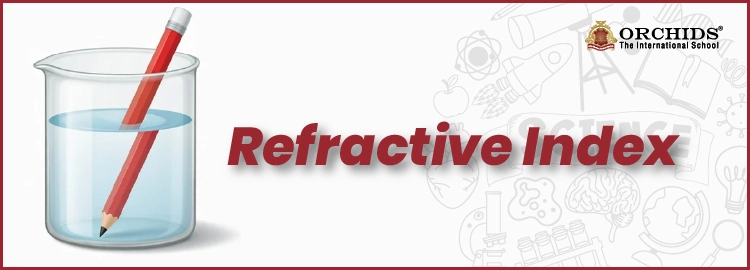
The Refractive Index is a key concept in physics that explains how light behaves when it moves from one medium to another. Have you ever noticed that when you place a straw in a glass of water, it looks bent, or how a diamond sparkles so brightly under light? All of these are directly linked to the refractive index. It tells us how much the speed of light changes when it enters materials like air, water, or glass.
This article is a complete guide for students to understand what is refractive index is, its importance, and how it can be calculated in detail.
Table of Contents
- What is the Refractive Index?
- Formula for Refractive Index
- Everyday Examples of Refractive Index
- Frequently Asked Questions on Refractive Index

What is the Refractive Index?
Before learning about refractive index, it’s important to understand refraction of light. Refraction is the bending of light when it travels obliquely from one medium to another, just like from air to water. This bending happens because the speed of light changes in different materials. Refraction through two different media is shown below.
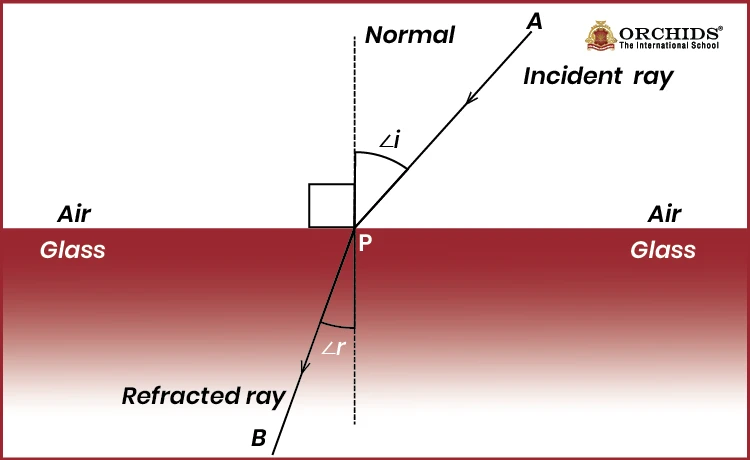
The Refractive index tells us how much light slows down when it passes through a material. It is defined as,
|
“Refractive index is the ratio of the speed of light in a vacuum to the speed of light in a specific medium.” |
Do you know that light travels fastest in a vacuum, where there are no particles to slow it down?
Light travels fastest in a vacuum because nothing slows it down. When it enters materials like air, water, or glass, atoms interact with light and slow it down slightly. That is why different substances have different refractive indices.
In simple words, it can be concluded :
- When a material has a higher refractive index, light travels more slowly through it, so it bends more.
- When a material has a lower refractive index, light travels faster in it, so it bends less.
Now that you know what refractive index means, let’s see how to calculate it mathematically.
Formula for Refractive Index
Do you know, the most interesting fact about refractive index is, it has no unit; it is a ratio of two speeds!
Refractive index is represented by the symbol n, and it’s calculated using this formula:
Where ‘n’ is the refractive index, ‘c’ is the speed of light in vacuum, and ‘v’ is the speed of light in the medium
A vacuum has a refractive index of 1, because light travels at its fastest speed there. In other materials, light travels more slowly, so their refractive index is higher.
In general, the higher the refractive index, the slower light moves, indicating that the material is optically denser.
Refractive Index of different materials,
|
Materials |
Refractive Index |
|
Air |
1.0003 |
|
Diamond |
2.417 |
|
Water |
1.333 |
|
Ice |
131 |
|
Ethyl Alcohol |
1.36 |
|
Crown glass |
1.52 |
|
Kerosene |
1.44 |
|
Ruby |
1.71 |
From this, you can see that diamond has the highest refractive index of all, which is why it sparkles so brilliantly!
Now, let’s look at a few examples to understand this concept better.
Everyday Example of Refractive Index
Let’s take an example to understand the refractive index clearly.
- Glass: 1.52
- Water:1.33
Since glass has a higher refractive index than water, light travels faster in water than it does in glass. From these, we can conclude that glass is optically denser than water and bends light more sharply.
Fun ActivityHere’s a quick activity you can try right now! Take a transparent glass of water and place a pencil or a straw inside it. Look at it from the side. Observe this, doesn’t it seem like the pencil is bent or broken at the surface?
This isn’t magic, it’s a refraction of light! The light rays coming from the pencil bend as they pass from water to air, making the pencil appear bent. So, the next time you notice this effect, you’ll know it’s because of the refractive index, which explains how and why light bends when it moves from one medium to another. |

Now that you know how refractive index works in everyday materials, you might wonder how this idea is used in real-life technology. Let's discuss some real examples of refractive index,
- The bottom of a swimming pool or pond is at a shallower depth than it actually is.
- The different colours of a rainbow are formed when sunlight enters raindrops, refracts, and then reflects off the back of the droplet.
- Lenses in eyeglasses, cameras, and telescopes use materials with specific refractive indices to bend light in a controlled way.
- The twinkling of stars is caused by starlight bending as it passes through different layers of atmosphere, which have different densities and therefore different refractive indices.
Here are some important questions discussed in
Why is High Refractive Index Important for Optical Polymers?
Optical polymers with a high refractive index can bend light more strongly inside the material. This stronger bending makes it possible to design lenses that are:
- Thinner (because less curvature is needed to focus light)
- Lighter (because less material is required)
- More compact (ideal for eyeglasses, phone cameras, and VR devices)
In simple words, when the refractive index is high, light bends more inside the material, allowing lenses to be thinner and lighter. But here’s something even more interesting: What is a Refractive Index Gradient?
A refractive index gradient refers to how the refractive index of a material changes gradually from one point to another.
It is defined as “The rate of change of refractive index with respect to distance inside a material.”
Key points:
- It describes how quickly the refractive index varies at different positions.
- It is expressed as the reciprocal of distance (e.g., per millimetre).
- It is a vector point function, meaning it has both a value and direction.
Materials with a refractive index gradient guide light smoothly; this principle is used in graded-index fibres, contact lenses, and special optical lenses.
And while studying all this, another question naturally arises: Does refractive index change for different colours of light?
The refractive index depends on the speed of light in a medium.
Since,
Speed of light=Frequency×Wavelength
And the frequency remains constant in all media, only the wavelength changes when light enters a new material.
Because wavelength changes while frequency stays the same, different wavelengths bend differently, which causes the refractive index to vary with colour.
The reason behind this is,
- Violet light bends more than red light.
- A prism splits white light into a rainbow (dispersion).
- Different colours focus at slightly different points in lenses.
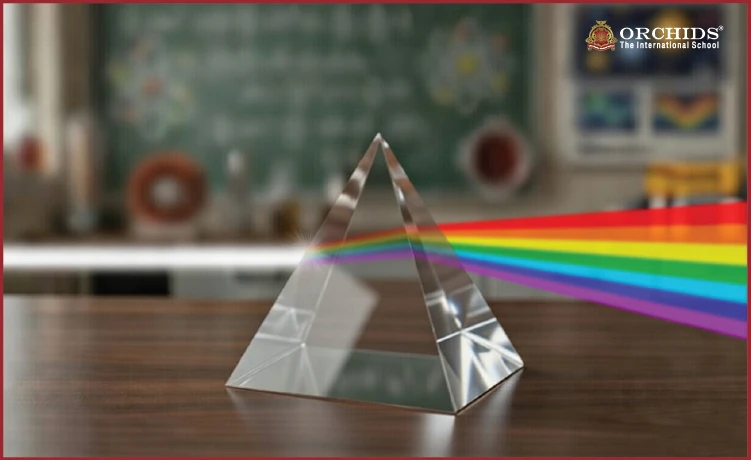
So far, we have learned that the refractive index helps us understand what is the reason behind the bending of light and how different materials affect the way we see things around us. From simple everyday effects to advanced optical devices, refractive index plays a key role in making modern technology clearer, sharper, and more efficient.
Frequently Asked Questions on Refractive Index
1. What is refractive index?
The refractive index measures how much light slows down when it passes through a material. It helps us understand why light bends when moving from one substance to another, like air to water.
2. How is refractive index calculated?
Refractive index n, calculated using this formula:
Where ‘n’ is the refractive index, ‘c’ is the speed of light in vacuum, and ‘v’ is the speed of light in the medium
3. What is the refractive index of water?
The refractive index of water is about 1.33. This means light travels more slowly in water than in air, causing objects under water to appear bent or shifted.
4. What is the refractive index of glass?
The refractive index of glass is around 1.52, which is higher than water.
5. Why does light bend when entering water or glass?
Light bends because it changes speed in different materials. The amount it bends depends on the refractive index of the new material as compared to the previous one.
6. Can the refractive index tell us how dense a material is optically?
Yes! Materials with a higher refractive index are optically denser, meaning they slow down light more than materials with a lower refractive index.
7. Does refractive index change with the colour of light?
Yes, different colours of light bend slightly differently because the refractive index varies with wavelength. That’s why prisms split white light into a rainbow.
Science isn't just a subject, it's the way of seeing the world. Curious how Orchids The International School teaches it that way? Talk to our admissions team.
Admissions Open for 2026-27
What type of concept pages would you prefer?
CBSE Schools In Popular Cities
- CBSE Schools in Bangalore
- CBSE Schools in Mumbai
- CBSE Schools in Pune
- CBSE Schools in Hyderabad
- CBSE Schools in Chennai
- CBSE Schools in Gurgaon
- CBSE Schools in Kolkata
- CBSE Schools in Indore
- CBSE Schools in Sonipat
- CBSE Schools in Delhi
- CBSE Schools in Rohtak
- CBSE Schools in Bhopal
- CBSE Schools in Aurangabad
- CBSE Schools in Jabalpur
- CBSE Schools in Jaipur
- CBSE Schools in Jodhpur
- CBSE Schools in Nagpur
- CBSE Schools in Ahmednagar
- CBSE School In Tumkur











Orchids The International School is one of India's leading chains of CBSE and ICSE schools, with 110+ schools across the country.