

Monochromatic Light
A Monochromatic light is light of a single wavelength or frequency, appearing as a pure, single colour. Have you ever noticed how a laser pointer gives out just one sharp, clean colour, while sunlight spreads into a rainbow? That’s because different kinds of light behave differently!
This article focuses on what monochromatic light is, its sources, its types, and why it is so important in science and daily life.
Table of Contents
- What is Monochromatic Light?
- Sources of Monochromatic Light
- Properties of Monochromatic Light
- Monochromatic Light Examples
- Real-Life Applications of Monochromatic Light
- Monochromator and Its Different Types
- Frequently Asked Questions on Monochromatic Light

What is Monochromatic Light?
Light is a form of energy that comes in many wavelengths. Light shows some amazing properties, such as diffraction of light, reflection of light, refraction of light, polarisation, and Interference.
Also, electromagnetic radiation is made up of light of many different wavelengths, each carrying its own energy and colour. Together, these wavelengths form different colours, which are just like the colours you see in a rainbow. But an interesting fact is that monochromatic light is special.
It consists of only one specific wavelength, which means it appears as a single, pure colour to our eyes. In simple language, monochromatic light can be defined as,
|
“Monochromatic light is electromagnetic radiation that consists of a single constant frequency or, equivalently, a single wavelength.” |
Here is one important fact everyone should know about monochromatic light,
The word mono means “one,” and chroma means “colour.”
When monochromatic light falls on an object, we see the object in the colour of that particular wavelength. Monochromatic light has a very narrow range of wavelengths, which makes it almost a single colour.
These lights can be recognised by their brightness, colour, direction of travel, and how the light waves are polarised.
Sources of Monochromatic Light
The most common source of monochromatic light is the LASER, which stands for:
“Light Amplification by Stimulated Emission of Radiation”
Have you ever thought why laser pointers can travel so far without spreading out?

It’s because laser light is coherent and monochromatic, meaning all the light waves move together in the same direction and colour. Laser light is produced when excited electrons in a material release energy as photons.
This energy release creates light that has:
- A very narrow single wavelength range
- High intensity
- A specific direction of travel
Before lasers became common, scientists used metal vapour lamps like Sodium Vapour Lamps and Mercury Vapour Lamps, along with filters to isolate a single wavelength of monochromatic light
Properties of Monochromatic Light
Monochromatic light has some unique properties, including
- The wavelength of monochromatic light has a very narrow bandwidth
- It has high intensity
- It is coherent, meaning it can stay focused over long distances
- It travels in a straight line
- It appears as one colour in the visible region
- It carries high energy
But what are the real-life examples of monochromatic light? Let's discuss. Let's discuss.
Monochromatic Light Examples
Monochromatic light is used in many areas of our daily lives and in science.
- Laser light is used in communication, surgery, and barcode scanners.
- Sodium light is commonly seen in street lamps.
- Fingerprint scanners also use monochromatic light to capture detailed images.
- Ultraviolet monochromatic devices are used for sterilisation and crime detection.
- Holograms are created using monochromatic light, and LEDs with a narrow colour output produce single-colour light for displays.
- Spark lamps are used in research to study specific wavelengths of light.
Have you seen the yellow-orange glow of old streetlights? That is sodium monochromatic light!
Real-Life Applications of Monochromatic Light
Monochromatic light is extremely useful in science and technology.
- Techniques like UV-Vis, IR, and Atomic Absorption use monochromatic light to study substances.
- Luminometers and calorimeters measure light intensity and energy changes accurately.
- In medicine, they recognise hidden bloodstains, fingerprints, fibres, and lesions under the skin and X-ray plate development
- In Photography labs, it is used to produce clear photographic images and negatives.
- Forensic investigations help reveal evidence like fingerprints, bloodstains, and fibres that are not visible to the naked eye.
Monochromator and Its Different Types
A monochromator is a device that selects a narrow band of wavelengths from a beam of polychromatic (multi-coloured) light.
When studying light and its spectrum, you might have heard about spectrophotometers, devices that measure how much light a solution absorbs by detecting the number of photons that pass through it. They help determine how much of a chemical substance is present in a sample.
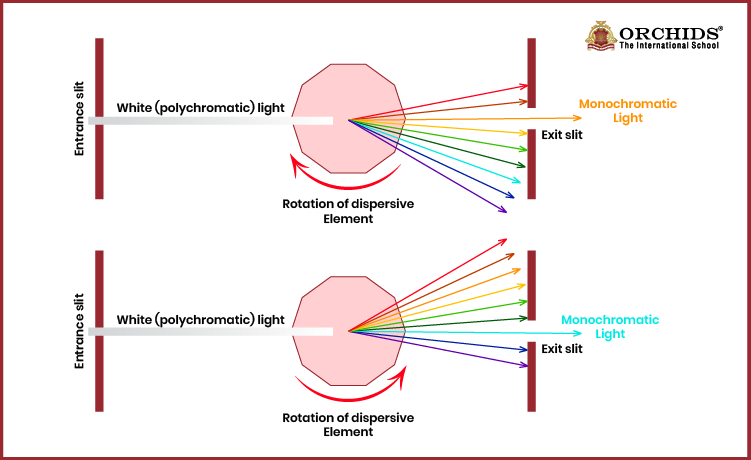
To isolate a specific, narrow band of wavelengths, a device called a monochromator is used.
A monochromator works on the principle of dispersion or diffraction, separating polychromatic (multi-wavelength) light into its individual wavelength components. From this range, a narrowband wavelength is selected for use.
This process of splitting light into its wavelength components is called dispersion. Inside the monochromator, a slit is used to block unwanted wavelengths so that only the desired narrow band of light passes through.
It works by:
- Splitting the light into different wavelengths through dispersion
- Allowing only a specific wavelength to pass through a slit
- Blocking all other wavelengths
This separation of light into components is called dispersion.
There are two main types of monochromators, including:
- Prism Monochromators are used in a prism as the dispersive element.
- Grating Monochromators, which use a reflecting diffraction grating.
So far, we have discussed that monochromatic light is special because it has a single wavelength and appears as a pure colour. From lasers to forensic investigations, it plays a key role in science, technology, and our daily lives.
Frequently Asked Questions on Monochromatic Light
1. What is monochromatic light?
Monochromatic light is light that has only one specific wavelength, so it appears as a single pure colour. It is often produced using devices like lasers or special lamps.
2. What is the monochromatic light's meaning?
The monochromatic light meaning refers to light that contains just one wavelength instead of many. This makes it look cleaner, sharper, and more uniform than normal light.
3. What are some monochromatic light examples?
Common monochromatic light examples include laser beams, sodium vapour lamps, and certain LED lights. These sources emit light of one main colour or wavelength.
4. What is the wavelength of monochromatic light?
The wavelength of monochromatic light depends on its colour. For example, red has a longer wavelength and blue has a shorter one. But in all cases, it stays within a very narrow range, so the light looks pure.
5. Is white light monochromatic?
No, white light is not monochromatic because it contains many different wavelengths mixed. When passed through a prism, it splits into several colours, showing it is polychromatic.
6. Is sunlight an example of monochromatic light?
No, sunlight is not monochromatic because it contains a wide range of wavelengths. That’s why it splits into many colours when it passes through a prism.
7. What is the best monochromatic light source?
The best monochromatic light source is a laser because it emits light of a very narrow wavelength, almost a single pure colour. Lasers are highly coherent, intense, and ideal for experiments requiring precise and stable monochromatic light.
Science isn't just a subject, it's the way of seeing the world. Curious how Orchids The International School teaches it that way? Talk to our admissions team.
Admissions Open for 2026-27
What type of concept pages would you prefer?
CBSE Schools In Popular Cities
- CBSE Schools in Bangalore
- CBSE Schools in Mumbai
- CBSE Schools in Pune
- CBSE Schools in Hyderabad
- CBSE Schools in Chennai
- CBSE Schools in Gurgaon
- CBSE Schools in Kolkata
- CBSE Schools in Indore
- CBSE Schools in Sonipat
- CBSE Schools in Delhi
- CBSE Schools in Rohtak
- CBSE Schools in Bhopal
- CBSE Schools in Aurangabad
- CBSE Schools in Jabalpur
- CBSE Schools in Jaipur
- CBSE Schools in Jodhpur
- CBSE Schools in Nagpur
- CBSE Schools in Ahmednagar
- CBSE School In Tumkur











Orchids The International School is one of India's leading chains of CBSE and ICSE schools, with 130+ schools across the country.