

Concave Lens
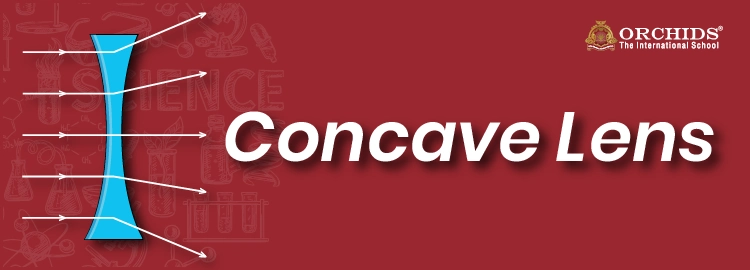
A Concave Lens is one of the most important optical devices that disperses the light beam. From eyeglasses that correct short-sightedness to lenses in binoculars, telescopes, and even peepholes in doors, concave lenses are quietly shaping our vision day by day.
This article contains all you need to know about concave lenses, how they work, their formula, image formation, and their real-life uses in detail.
Table of Contents
- What is a Concave Lens
- Concave Lens Formula
- Image Formation by a Concave Lens
- Uses of a Concave Lens
- Frequently Asked Questions on Concave Lens

What is a Concave Lens
A Concave Lens is a diverging lens, which spreads out light rays that pass through it. Anyone can easily recognise a concave lens because its surface curves inward, unlike a convex lens that bulges outward.
Have you ever wondered why the rays seem to move apart instead of meeting at a point? Let’s study that with the help of a simple concave lens ray diagram!
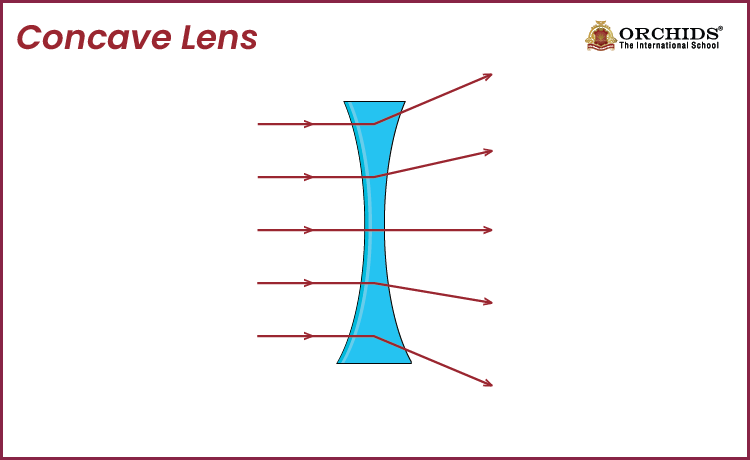
In the above ray diagram, when parallel rays of light enter a concave lens, they diverge, or spread apart from each other, as if they were coming from a point behind the lens.
Let's understand the reason behind this.
Light rays spread apart from each other because the concave lens is thinner at the centre and thicker at the edges, and the image formed by a concave lens is always virtual, upright, and smaller than the object.
But have you ever wondered how concave lenses are made? Let’s find out!
It is made up of two concave surfaces, which are part of spheres, as we can see clearly in the ray diagram.
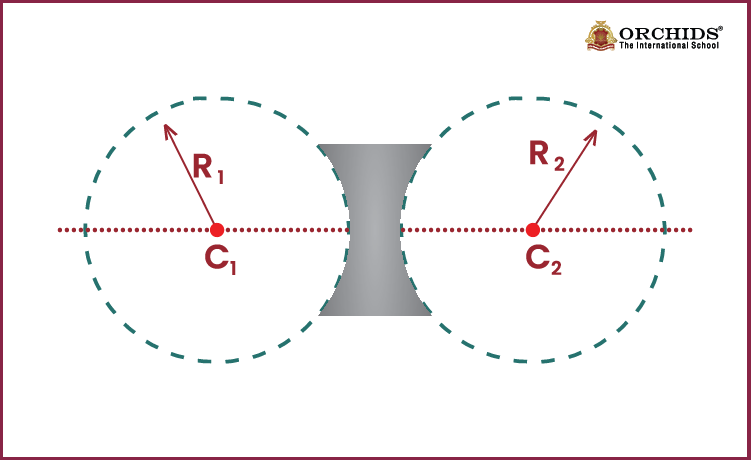
Interestingly! A concave lens is thinner at the centre and thicker at the edges, which makes it bend light outwards.
Now, before we move ahead, let’s look at some important terms related to convex lenses that everyone should know.
-
Center of curvature, C is the center of the sphere that a lens is made up of. Here lens has two surfaces, so it has two centers of curvature.
-
The radius of curvature, R, is the radius of the sphere.
-
The principal axis is an imaginary line passing through the optical center of the lens, and it is perpendicular to the surface of the lens.
-
The optical center is a point in the lens from which a ray passes through without deviation.
Now that we’re familiar with the key terms related to convex lenses.
Let’s move on to an important concept that helps us calculate where and how images are formed by these lenses.
Concave Lens Formula
A concave lens follows a specific mathematical relationship between its focal length, the object distance, and the image distance. For a concave lens, the focal length is considered negative.
The lens formula is given as:
Where,
-
f = focal length of a concave lens
-
v = image distance from the optical centre
-
u = object distance from the optical centre
The magnification (M) produced by a concave lens is given by:
Where:
-
= height of the image
-
= height of the object
Magnification tells us how large or small the image appears compared to the original object.
If the magnification is less than 1, the image is smaller than the object, and if it is negative, the image is inverted (though for a concave lens, images are usually upright and virtual).
Now that we know how to measure the size and nature of images, let’s take a closer look at how a concave lens actually forms these images at different object positions.
Image Formation by a Concave Lens
To truly understand how a concave lens works, it helps to see how it forms images at different positions.
1. When the object is placed very far away, i.e., at infinity, the rays of light coming from it are almost parallel to the principal axis.
After passing through the concave lens, these rays appear to diverge from the focus on the same side of the lens.
Characteristics of the image:
-
The image is formed at the focus.
-
It is virtual, erect, and highly diminished (very small).
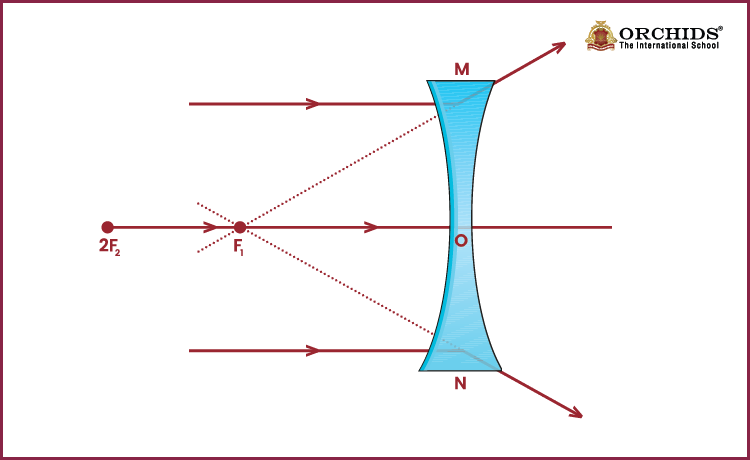
2. Now, if the object is placed at a finite distance from the lens along the principal axis,
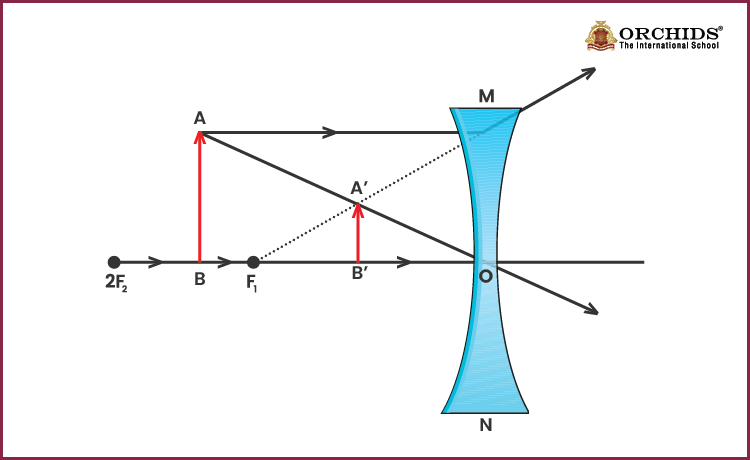
As we can see in the above ray diagram, the light rays after refraction appear to diverge from a point between the focus and the optical center (O) of the lens.
Characteristics of the image:
-
The image is formed between the focus and the optical center.
-
It is virtual, erect, and smaller than the object.
From both cases, it can be concluded that: the concave lens forms a virtual image, which means the rays do not actually meet; they only appear to do so when extended backwards.
Uses of a Concave Lens
Concave lenses might look simple, but they are used in many everyday devices that help us see better or work with light more effectively.
-
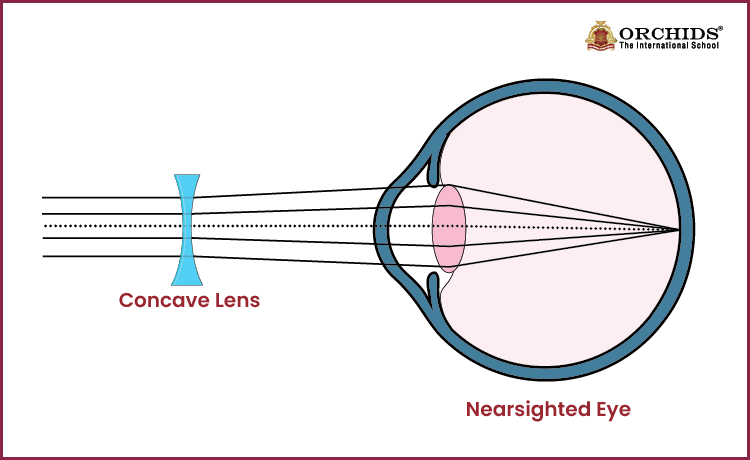
In Eyeglasses, Concave lenses help people with myopia see distant objects clearly by diverging incoming light before it reaches the retina.
-
Concave lenses are used in Peepholes in Doors to allow a wide field of view so you can see a larger area outside, even from a small opening.
-
In Cameras and Telescopes, these lenses are used in combination with convex lenses to reduce image distortion and improve focus.
-
In Lasers and Flashlights, these lenses help spread out laser beams or light for broader coverage.
-
In Optical Instruments, they are used in microscopes and projectors for better light control and image clarity.
Till now, we have learned, a concave lens is a diverging optical device that spreads light rays apart to form smaller, virtual images. With their simple shape and powerful effect, concave lenses are vital in correcting vision, improving instruments, and expanding how we see the world.
Frequently Asked Questions on Concave Lens
1. What is a concave lens in simple words?
A concave lens is a piece of glass that spreads out light rays and forms smaller, upright images. It is thinner at the centre and thicker at the edges.
2. Why is a concave lens called a diverging lens?
Because it diverges (spreads out) light rays that enter it, instead of converging them.
3. What kind of image does a concave lens form?
It forms a virtual, erect, and diminished image of the object.
4. What is the sign of the focal length of a concave lens?
The focal length of a concave lens is always negative because it diverges light rays.
5. How does a concave lens correct myopia?
It diverges incoming light rays so that they focus properly on the retina, allowing people to see distant objects clearly.
6. Where are the uses of concave lenses used in real life?
They are used in eyeglasses, door viewers, cameras, projectors, and optical devices.
7. What happens in image formation by a concave lens when the object is very far away?
When an object is placed at infinity, parallel rays hit the concave lens and diverge such that they appear to come from the focus; the image formed is virtual, upright, and highly diminished.
Science isn't just a subject, it's the way of seeing the world. Curious how Orchids The International School teaches it that way? Talk to our admissions team.
Admissions Open for 2026-27
What type of concept pages would you prefer?
CBSE Schools In Popular Cities
- CBSE Schools in Bangalore
- CBSE Schools in Mumbai
- CBSE Schools in Pune
- CBSE Schools in Hyderabad
- CBSE Schools in Chennai
- CBSE Schools in Gurgaon
- CBSE Schools in Kolkata
- CBSE Schools in Indore
- CBSE Schools in Sonipat
- CBSE Schools in Delhi
- CBSE Schools in Rohtak
- CBSE Schools in Bhopal
- CBSE Schools in Aurangabad
- CBSE Schools in Jabalpur
- CBSE Schools in Jaipur
- CBSE Schools in Jodhpur
- CBSE Schools in Nagpur
- CBSE Schools in Ahmednagar
- CBSE School In Tumkur











Orchids The International School is one of India's leading chains of CBSE and ICSE schools, with 110+ schools across the country.