

Hot Air Balloon

A hot air balloon is a giant, colourful balloon that floats gracefully in the sky. But have you ever wondered how it stays up despite Earth’s gravity? The hot air balloon was invented in Paris in 1783. Its design includes a fabric envelope to hold hot air, an exhaust at the top, and a basket for passengers. The interesting thing is that it has never changed in centuries.
This article makes it easy to understand hot air balloons, how they work, and the science behind them in detail.
Table of Contents
- Fun Facts About Hot Air Balloons
- What Is a Hot Air Balloon?
- How Does a Hot Air Balloon Float?
- How Pilots Operate Hot Air Balloons?
- How Buoyancy, Air Pressure, and Gravity Make a Hot Air Balloon Rise?
- Frequently Asked Questions on Hot Air Balloon

Fun Facts About Hot Air Balloons
|
What Is a Hot Air Balloon?
A hot air balloon is a flying aircraft that floats in the air using hot air. In 1783, the Hot air balloon was designed and developed by the Montgolfier brothers, Joseph-Michel and Jacques-Étienne, in Paris(France). A hot air balloon is made up of three main parts:
-
The Envelope is the large, colourful balloon that holds hot air
-
The burner is the flame that heats the air inside the envelope
-
The basket is the part that carries the passengers and the pilot

A hot air balloon floats because the air inside is heated, which has a lower density and becomes lighter than the cooler air outside. Just like a boat is supported by the water in the ocean, a hot air balloon is supported by the cooler air around it.
So, the big question that arises here is: how does science make a hot air balloon float in the sky? Let's discuss
How Does a Hot Air Balloon Float?
You might have observed how a boat floats on water. Or how a leaf floats on a pond? We already know that the scientific phenomenon behind this is buoyancy. Hot air balloons float for the Same reason!
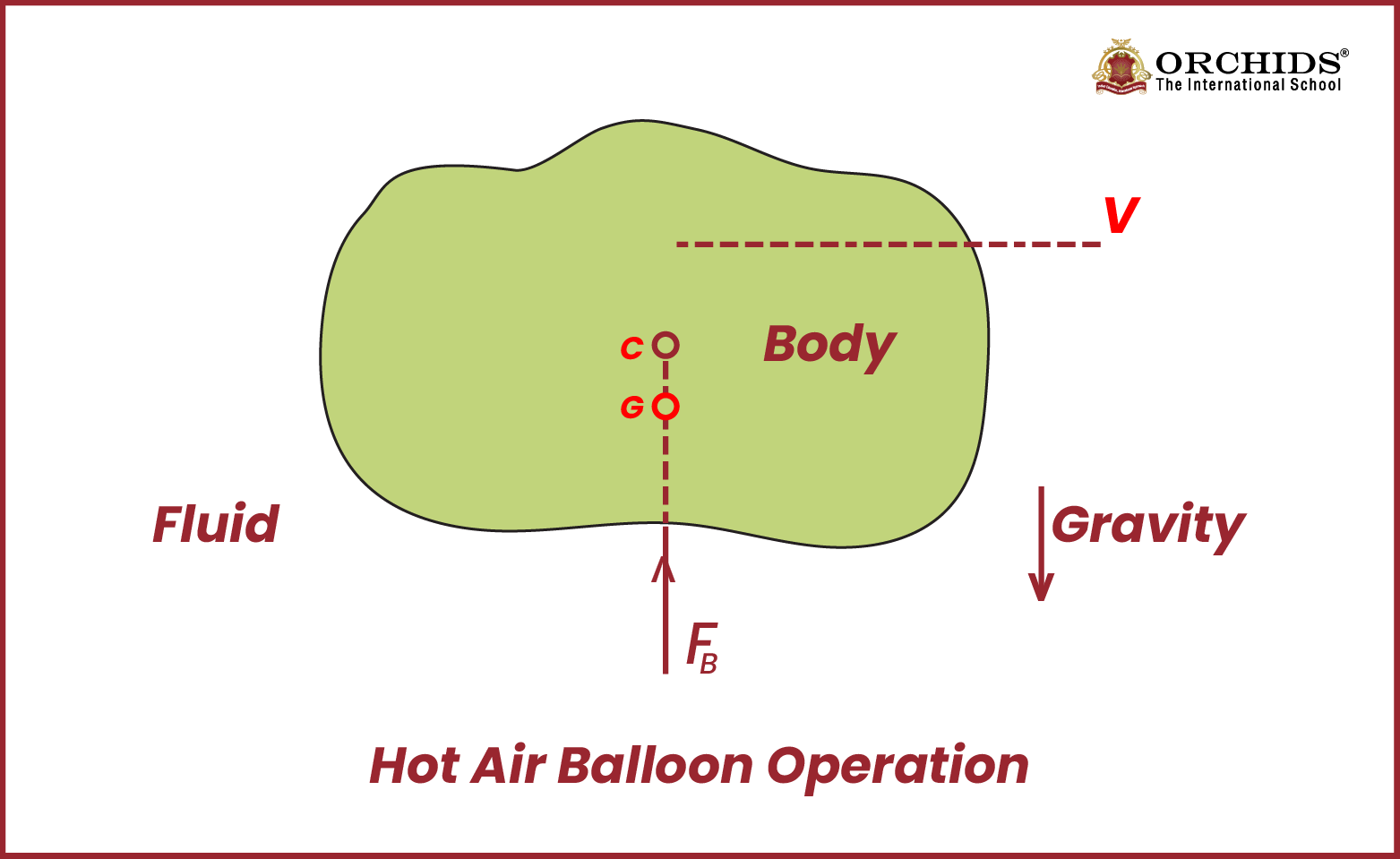
But what is buoyancy?
“Buoyancy is the upward force that pushes an object in a fluid (like water or air).”
In a hot air balloon,
-
Air acts like a fluid
-
Hot air inside the balloon is less dense than the colder air outside
-
The colder, heavier air pushes the balloon upward, lifting it off the ground
This principle is called Archimedes’ Principle:
“Any object submerged in a fluid experiences an upward force equal to the weight of the fluid it displaces.”
It can be concluded that, if something is lighter than the air or water it’s in, it floats!
Here, for a balloon to rise because,
Buoyant Force > Weight of (Balloon + Air + Passengers)
If the weight is greater, the balloon stays on the ground. If the buoyant force is greater, up it goes! Interesting!

Now you might be wondering, how does a hot air balloon change direction? Let's discuss,
How Pilots Operate Hot Air Balloons?
Here’s the funny part about hot air balloons: they don’t have steering wheels or engines. Pilots use their knowledge of wind patterns at different altitudes to move the balloon sideways.
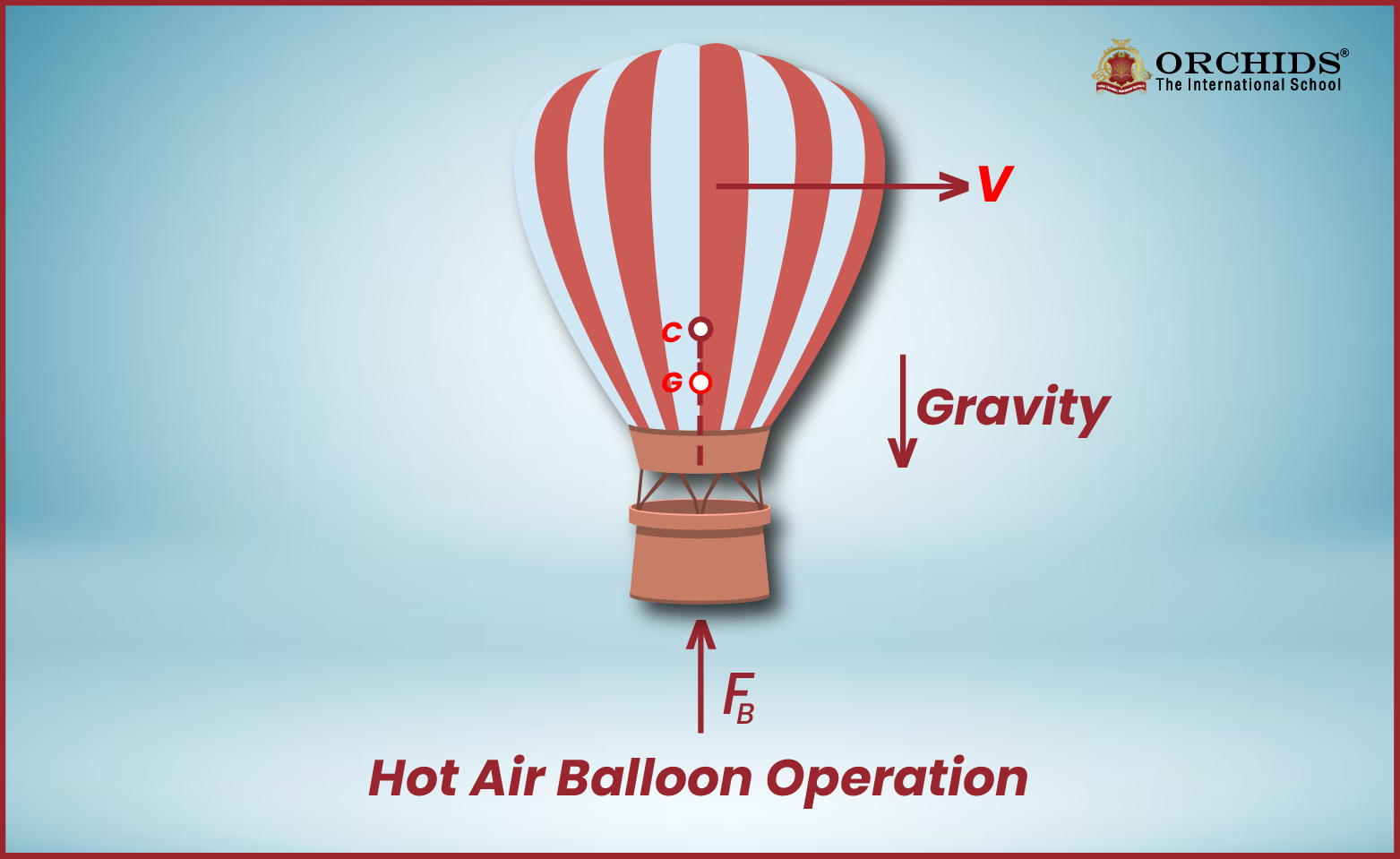
Pilots control only the vertical motion of a balloon:
-
To rise, they turn on the burner to heat the air
-
To descend, they stop the burner or open a vent at the top to release hot air
Since hot air rises and cold air sinks, the balloon can hover at the perfect altitude when the pilot balances the heat and air release.
The weight of the basket and passengers is at the bottom, while the buoyant force acts from the top. This makes the centre of mass lower than the centre of buoyancy.
But how exactly does a hot air balloon stay stable in the air?
The weight of the basket and passengers is at the bottom, while the buoyant force acts from the top. This makes the centre of mass lower than the centre of buoyancy.
How Buoyancy, Air Pressure, and Gravity Make a Hot Air Balloon Rise?
We already know that Gravity pulls air particles toward the Earth, creating air pressure. At the ground, the pressure is highest. As you rise in altitude, the pressure decreases because there is less air above.
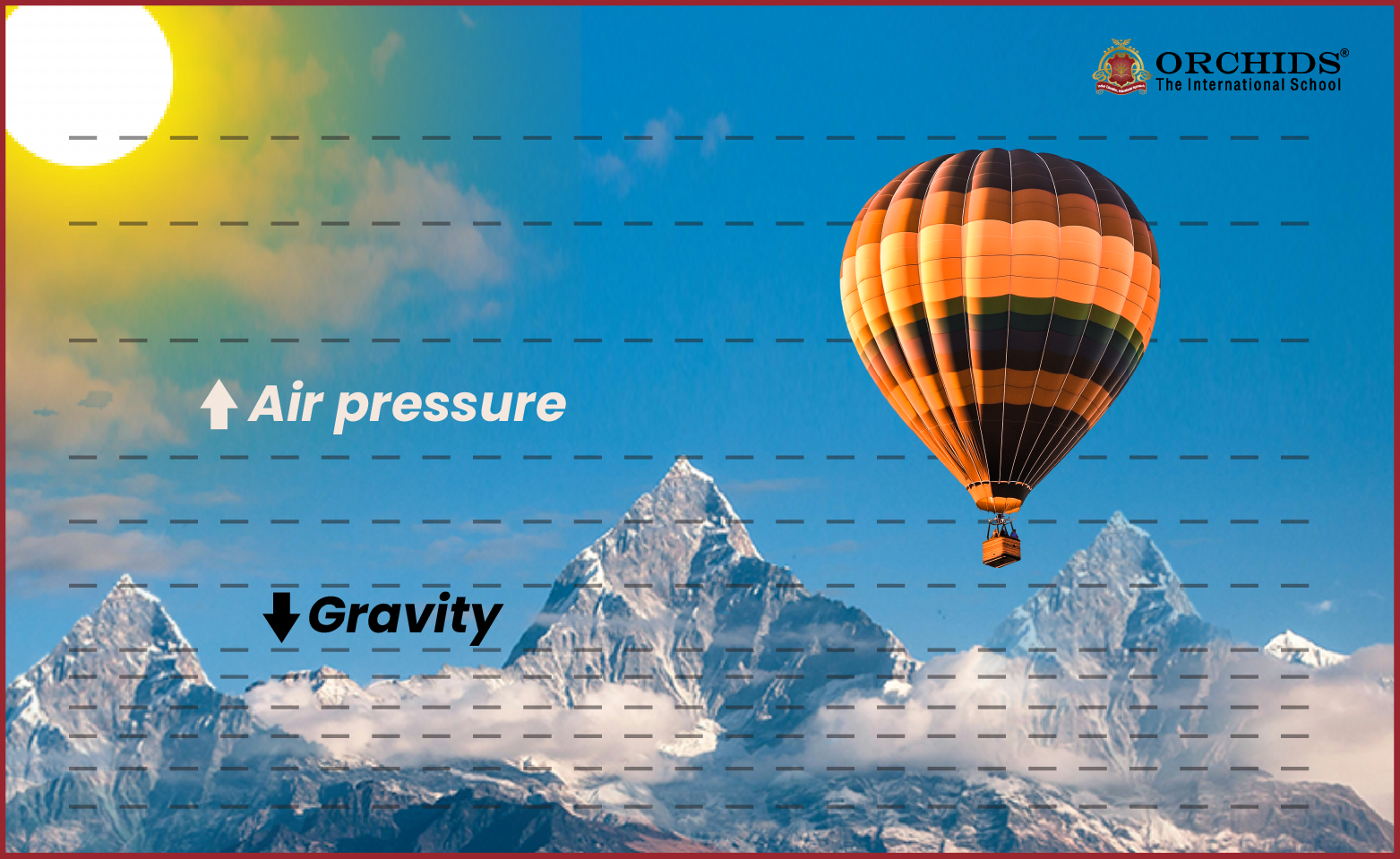
Air pressure is highest at the surface of Earth because the weight of all the air above pushes down with more gravitational force. As you rise higher into the atmosphere, there is less air above, so the pressure decreases. That’s why air pressure drops as you go up in altitude.
Here, due to the pressure difference, an upward buoyant force is created. However, this buoyant force will be quite weak here. So, for buoyancy to lift an object into the air, the object must be lighter than an equal volume of the surrounding air.
The pressure of air can increase in two ways:
-
Adding more air particles makes them hit surfaces more often, increasing the overall pressure.
-
When the particles move faster, each hit is stronger and more frequent, also raising the pressure.
In a hot air balloon, heating the air makes the particles move faster, which reduces the air’s density and helps the balloon rise. Because the air inside the balloon is lighter, the cooler, denser outside air pushes it upward, just like water pushes a boat to the surface.
Till now, we have seen that hot air balloons may look magical, but they rise, float, and move because of simple scientific phenomena such as buoyancy, air pressure, gravity, and heat. Once you understand how these forces work together, the floating balloon in the sky makes perfect sense.
Frequently Asked Questions on Hot Air Balloon
1. What is a hot air balloon, and how does it work?
A hot air balloon is an aircraft that rises because warm air inside the envelope becomes lighter than the cooler air outside. This difference in density creates an upward buoyant force that lifts the balloon into the sky.
2. What is the lifespan of a hot air balloon?
A well maintained hot air balloon can last about 500 to 600 flight hours, which usually means 8 to 10 years of safe use, depending on weather conditions and how often it flies.
3. Do hot air balloons need fuel?
Yes. Hot air balloons use propane gas as fuel. It powers the burner, which heats the air inside the envelope and helps the balloon rise.
4. Which gas is used in hot air balloons?
Hot air balloons use propane gas, stored in cylinders, to create a flame that heats the air. The heated air makes the balloon buoyant and allows it to lift off.
5. Who invented a hot air balloon?
The hot air balloon was invented in 1783 by the Montgolfier brothers, Joseph-Michel and Jacques-Étienne, in France. Their first flight carried a sheep, a duck, and a rooster.
6. Can hot air balloons fly in the rain?
No. Rain is dangerous because hot air inside the balloon can heat raindrops, which can damage the fabric. Pilots avoid flying in wet weather.
7. How do pilots control the balloon’s direction?
Hot air balloons don’t have engines or steering wheels. Pilots rise or descend to catch winds blowing in the direction they want to go, using their knowledge of wind patterns at different altitudes.
8. Why are hot air balloons colourful?
Bright patterns help pilots spot each other in the sky and make the flight more fun and visually appealing for everyone on the ground.
Science isn't just a subject, it's the way of seeing the world. Curious how Orchids The International School teaches it that way? Talk to our admissions team.
Admissions Open for 2026-27
What type of concept pages would you prefer?
CBSE Schools In Popular Cities
- CBSE Schools in Bangalore
- CBSE Schools in Mumbai
- CBSE Schools in Pune
- CBSE Schools in Hyderabad
- CBSE Schools in Chennai
- CBSE Schools in Gurgaon
- CBSE Schools in Kolkata
- CBSE Schools in Indore
- CBSE Schools in Sonipat
- CBSE Schools in Delhi
- CBSE Schools in Rohtak
- CBSE Schools in Bhopal
- CBSE Schools in Aurangabad
- CBSE Schools in Jabalpur
- CBSE Schools in Jaipur
- CBSE Schools in Jodhpur
- CBSE Schools in Nagpur
- CBSE Schools in Ahmednagar
- CBSE School In Tumkur











Orchids The International School is one of India's leading chains of CBSE and ICSE schools, with 110+ schools across the country.