

Ammeter
An Ammeter is one of the most important tools, which is used while performing physics experiments in a physics lab. Have you ever tried to check whether a device is getting the right amount of electric current or not? When scientists and students want to know how much electric current is flowing through a circuit, they check by using a device called an Ammeter.
In this article, we will be going through what ammeter is, why ammeter is connected in series, and how it actually works using a circuit diagram.
Table of Contents
- What is Ammeter, & the Symbol of Ammeter?
- Important Properties of an Ammeter
- Why Ammeter is Connected in Series?
- Different Types of Ammeters
- Effect of Temperature on Ammeter
- Real-Life Application & Example of an Ammeter
- Frequently Asked Questions on Ammeter

What is Ammeter?
An ammeter is an electrical measuring instrument used to measure electric current flowing through a circuit. The current is measured in amperes (A), which defines how many charges pass through a point per second.
In very simple language ammeter definition:
|
An ammeter is a device that tells you “how much current is flowing in a circuit.” |
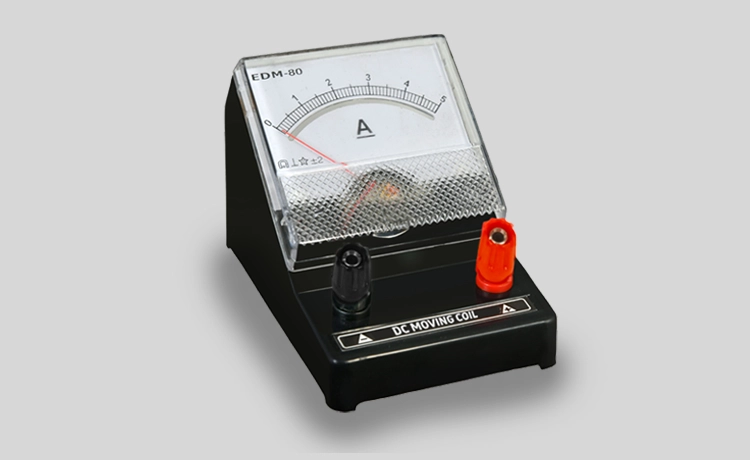
In the 19th century, an advanced form of the ammeter was invented, one that could provide accurate measurements and could be mounted in any position without affecting its reading.
An ammeter is an electrical instrument used to measure the flow of electric current, whether alternating current (AC) or direct current (DC).
While drawing a circuit diagram, the ammeter is represented using a standard symbol.
The symbol of an ammeter is shown below: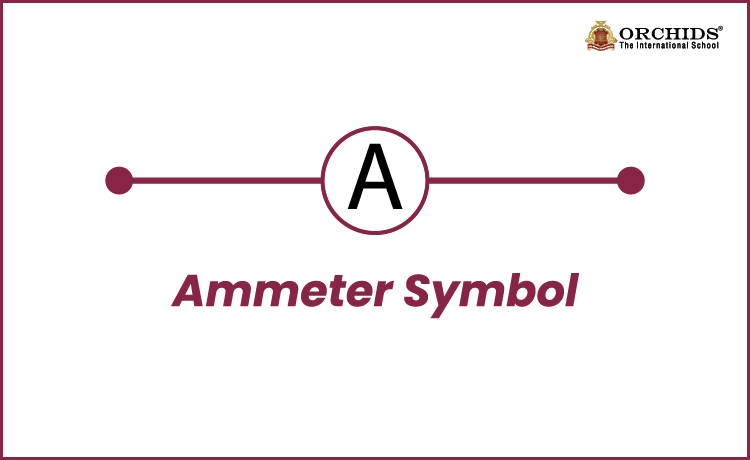
Important Properties of an Ammeter
To measure electric current, an ammeter is always connected in series with the circuit. It is mainly used for measuring small currents, usually in the milliampere (mA) or microampere (µA) range.
- A device used to measure current in milliamperes is called a milliammeter.
- A device used to measure extremely small currents, typically in the range of microamperes, is called a microammeter.
Here is one important thing to remember: that an ammeter always has very low internal resistance, and an ideal ammeter would have zero resistance. Real ammeters have a very small but negligible internal resistance.
But here, one important question arises: why does an ammeter offer low resistance?
An ammeter offers low resistance,
- So that the input current passes completely through the device without being obstructed.
- To ensure that a very small voltage drop occurs across the ammeter.
- To avoid altering the actual current in the circuit, ensure accurate measurement.
You may be amazed after knowing that most ammeters have an inbuilt fuse to protect the device from large currents.
If excessive current flows through it, the fuse blows and breaks the circuit. The ammeter will remain non-functional until the fuse is replaced.
Why Ammeter is Connected in Series?
An ammeter is always connected in series with the circuit so that the entire current flows through it. This is necessary because an ammeter measures the total flow of electrons (current) in the circuit.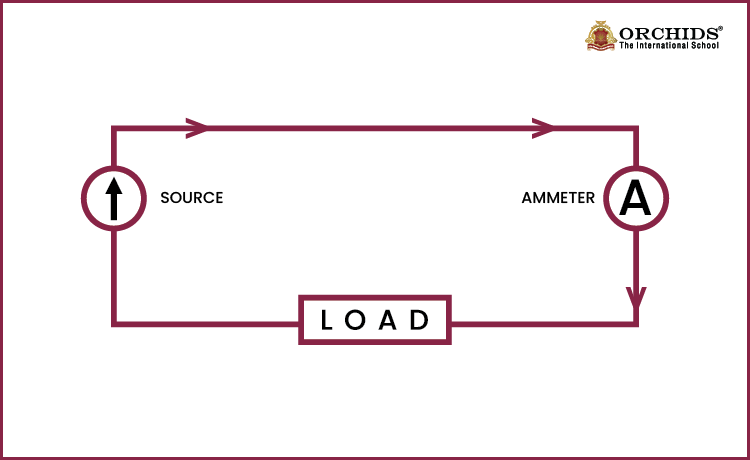
The current passing through the ammeter and its small internal resistance can cause a slight power loss; however, this effect is minimised by designing the ammeter with very low resistance.
A low resistance ensures that only a small voltage drop occurs across the device, allowing the circuit to function normally while still providing an accurate current reading.
Different Types of Ammeters
Ammeters can be classified in two ways:
- Based on the type of current they measure
- Based on their design and construction
Let's discuss them in detail,
Again, based on the current passed, it is classified into two categories, that is
- An AC ammeter is used to measure alternating current (AC) in a circuit. It is designed to handle the changing direction and magnitude of AC.
- A DC ammeter is used to measure direct current (DC), which flows in one constant direction.
Now, based on design and construction pattern, the ammeter is classified as:
- A permanent moving coil ammeter works on the principle of electromagnetic deflection. It is used only for DC measurements. It provides highly accurate readings.
A permanent moving coil ammeter is also known as a D’Arsonval meter or galvanometer.
- Moving Iron (MI) Ammeter can measure both AC and DC. Simple, rugged, and commonly used in general electrical measurements. In this type, the coil freely moves between the poles of a permanent magnet.
- Electro-dynamometer Ammeter works on the interaction between two coils carrying current. It is suitable for both AC and DC. This ammeter is often used in precision measurements.
- Rectifier-type Ammeter uses a rectifier to convert AC into DC, then measures it using a DC meter movement. Widely used in electronic instruments and low-cost AC measurement devices.
Effect of Temperature On Ammeter
You might wonder after knowing that an ammeter is a thermally sensitive measuring device, which means its readings can be affected by changes in temperature.
Both internal heating (caused by current flowing through the coil) and external environmental temperatures can influence the resistance of the components of the meter. Since the resistance of metals increases with temperature, the reading of the ammeter may change even if the current remains constant.
To reduce this error, a special resistor called swamping resistance is used.
But what is Swamping Resistance?
Swamping resistance is a resistor that has a zero or very low temperature coefficient, meaning its resistance does not change with temperature.
Now we know what swamping resistance is, let's discuss how it helps.
When the swamping resistance is connected in series with the coil of the ammeter:
- It stabilises the total resistance of the instrument
- It reduces the effect of temperature variations
- It ensures more accurate and reliable readings
Thus, adding swamping resistance ensures that the ammeter operates correctly even when the temperature changes.
Real-life Application & Example of an Ammeter
Ammeters are widely used in various electrical and electronic systems to measure how much current is flowing through a circuit. Here are some common real-life applications:
- Ammeters help troubleshoot circuits by checking current flow.
- Electricians use them for routine electrical inspections.
- They measure battery charging and discharging current.
- EV charging stations use them to monitor charging current.
Let’s look at where you commonly find ammeters in everyday life:
- Multimeters include ammeter functions to measure current in small circuits.
- Clamp meters are used by electricians to measure current without breaking the circuit.
- Technicians use ammeters to check current flow from solar panels and inverters.
- Power supplies often have built-in ammeter displays to show real-time current output.
So far, we learned, an ammeter is a low-resistance device used in series to measure current accurately in a circuit. Different types of ammeters are used in labs, vehicles, and electrical systems, making them an essential tool for checking and monitoring electric current in daily applications.
Frequently Asked Questions on Ammeter
1. Why should an ammeter have low resistance?
An ammeter must have low resistance so that it does not reduce the current flowing in the circuit. This ensures accurate current measurement without altering the original value.
2. What is the use of an ammeter in a circuit?
An ammeter is used to measure the electric current flowing through a circuit. It helps identify faults, monitor loads, and ensure proper circuit functioning.
3. Why ammeter is connected in series and voltmeter in parallel in a circuit?
An ammeter is connected in series so the entire current passes through it for correct measurement? A voltmeter is connected in parallel to measure the potential difference across components.
4. What is ammeter and its unit of measurement?
An ammeter is a device used to measure electric current in a circuit. Its unit is the ampere (A).
5. What is an ammeter vs voltmeter in electrical measurement?
An ammeter measures current flowing through a circuit, while a voltmeter measures the voltage across two points. Both are essential for understanding circuit behavior.
6. What are two types of ammeters commonly used?
The two main types of ammeters are AC ammeters and DC ammeters. They are designed to measure alternating and direct current, respectively.
7. What is the ammeter definition?
An ammeter is an electrical instrument used to measure the amount of current flowing through a circuit. It shows the current value in amperes (A).
Science isn't just a subject, it's the way of seeing the world. Curious how Orchids The International School teaches it that way? Talk to our admissions team.
Admissions Open for 2026-27
What type of concept pages would you prefer?
CBSE Schools In Popular Cities
- CBSE Schools in Bangalore
- CBSE Schools in Mumbai
- CBSE Schools in Pune
- CBSE Schools in Hyderabad
- CBSE Schools in Chennai
- CBSE Schools in Gurgaon
- CBSE Schools in Kolkata
- CBSE Schools in Indore
- CBSE Schools in Sonipat
- CBSE Schools in Delhi
- CBSE Schools in Rohtak
- CBSE Schools in Bhopal
- CBSE Schools in Aurangabad
- CBSE Schools in Jabalpur
- CBSE Schools in Jaipur
- CBSE Schools in Jodhpur
- CBSE Schools in Nagpur
- CBSE Schools in Ahmednagar
- CBSE School In Tumkur











Orchids The International School is one of India's leading chains of CBSE and ICSE schools, with 110+ schools across the country.