

Circular Motion Explained for Class 6 Students
Circular motion is one of the most important concepts in physics. It describes the movement of an object along a circular path. From a spinning fan to planets revolving around the Sun, circular motion can be seen in many everyday activities. Circular motion is the movement of an object along a circular path. In this article, you will learn what circular motion is, its types, and real-life examples, explained in simple language for Class 6 students.
Table of Contents
- Understanding What is Circular Motion
- Different Types of Circular Motion
- Frequently Asked Questions on Circular Motion

Understanding What is Circular Motion
Circular motion is commonly observed in many natural and mechanical systems. In simple words, it can be defined as,
|
“Circular motion is the movement of an object along the circumference of a circle or along a circular path.” |
For example, the rotation of wheels, the orbit of planets, and the movement of amusement park rides all demonstrate circular motion.
Different Types of Circular Motion
Circular motion is a type of motion in which an object moves along a circular path. Unlike linear motion, where an object moves in a straight line, circular motion involves a continuous change in the direction of the object’s velocity while the speed may remain constant. There are two main types of circular motion:
- Rotational Motion
- Revolutionary Motion
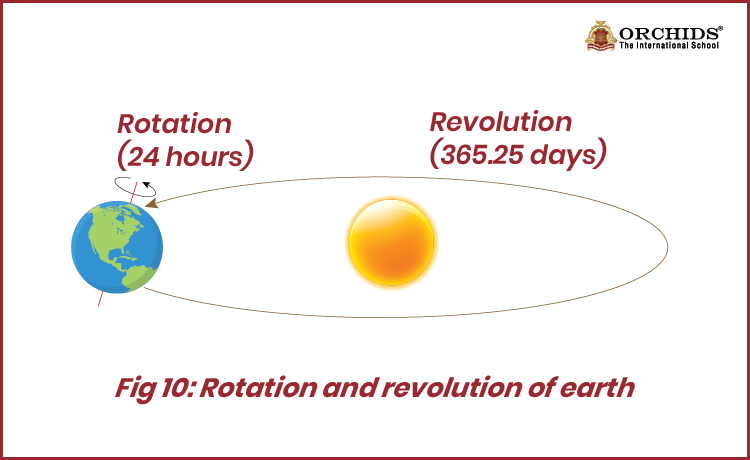
Now, let's discuss each type of circular motion one by one.
Rotational Motion
Motion of a body in which it spins about a fixed axis without changing its position is called rotatory motion. The motion of a spinning top and the merry-go-round are examples of rotational motion. The motion of the Earth about its axis is also an example of rotational motion. Rotational motion is important because it helps us understand how machines, planets, and many devices function in a circular pattern without changing their position.
Revolutionary Motion
Motion of an object around any other object along a circular path is called revolutionary motion. The motion of planets around the sun is an example of revolutionary motion. This type of motion explains phenomena like satellite orbits, planetary revolutions, and even the movement of electrons around a nucleus.
Revolutionary motion allows us to study how one object moves relative to another while maintaining a circular trajectory.
In this article, we understood circular motion, its types, rotational and revolutionary, and examples that illustrate this concept in real life. Also, we have seen that circular motion helps explain many natural and man-made movements, from spinning wheels to planets revolving around the Sun.
Frequently Asked Questions on Circular Motion
1. What is circular motion in simple terms?
Circular motion is the movement of an object along a circular path or the circumference of a circle.
2. What are the two main types of circular motion?
The two types are rotational motion (spinning about a fixed axis) and revolutionary motion (moving around another object).
3. Can you give examples of rotational motion?
Yes, examples include a spinning top, a merry-go-round, and Earth’s rotation about its axis.
4. Can you give examples of revolutionary motion?
Yes, examples include planets revolving around the sun and satellites orbiting Earth.
5. How is circular motion different from linear motion?
In circular motion, an object moves along a curved path, while in linear motion, it moves in a straight line.
6. What is the major difference between rotational and revolutionary motion?
Rotational motion is spinning about a fixed axis without changing position, while revolutionary motion is moving around another object along a circular path.
Science isn't just a subject, it's the way of seeing the world. Curious how Orchids The International School teaches it that way? Talk to our admissions team.
Admissions Open for 2026-27
What type of concept pages would you prefer?
CBSE Schools In Popular Cities
- CBSE Schools in Bangalore
- CBSE Schools in Mumbai
- CBSE Schools in Pune
- CBSE Schools in Hyderabad
- CBSE Schools in Chennai
- CBSE Schools in Gurgaon
- CBSE Schools in Kolkata
- CBSE Schools in Indore
- CBSE Schools in Sonipat
- CBSE Schools in Delhi
- CBSE Schools in Rohtak
- CBSE Schools in Bhopal
- CBSE Schools in Aurangabad
- CBSE Schools in Jabalpur
- CBSE Schools in Jaipur
- CBSE Schools in Jodhpur
- CBSE Schools in Nagpur
- CBSE Schools in Ahmednagar
- CBSE School In Tumkur











Orchids The International School is one of India's leading chains of CBSE and ICSE schools, with 110+ schools across the country.