

Atmosphere
The atmosphere is one of the most essential yet unseen shields of our planet. Without it, there would be no oxygen to breathe, no protection from harmful radiation, and no climate to support living beings.
Although it may seem thin compared to Earth’s size, this blanket of gases is far more stronger than it appears.
This article is a complete guide to the atmosphere, offering insights into its definition, main features, layers, composition, and the many reasons it is one of Earth’s most valuable treasures.
Table of Contents
- Amazing Facts About Our Atmosphere
- Understanding Atmosphere
- Different Layers of Earth's Atmosphere
- Does the Atmosphere Support Life on Earth?
- What Would Happen If the Atmosphere Disappeared?
- Relationship Between Air, Pressure, and Atmospheric Pressure
- Frequently Asked Questions on Atmosphere

Amazing Facts About Our Atmosphere
|
Interesting, right? Now, let’s understand what the atmosphere really is.
Understanding Atmosphere
The atmosphere is one of Earth’s most essential features. It is a blanket of gases surrounding our planet, keeping life safe and conditions stable. Without it, Earth would be too harsh for living things to survive.
So what exactly does the atmosphere do?
It regulates Earth’s temperature, provides oxygen and nitrogen for life, shields us from harmful radiation, and drives the water cycle and weather systems.
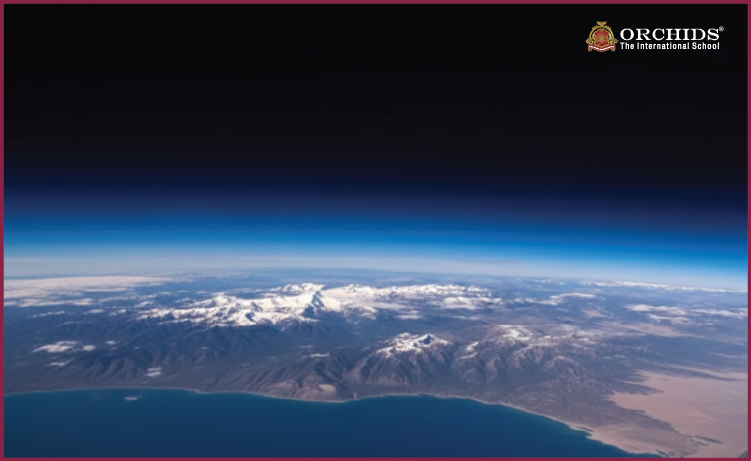
In simple words, it is Earth’s life-support system.
Scientists often define it as a protective layer of gases that supports life by keeping temperatures stable, blocking harmful rays, and allowing weather to exist.
But what exactly is this protective layer made of?
Let’s break it down.
When we look at its composition, most of the atmosphere is made of Nitrogen, about 78%, and Oxygen, about 21%.
These two gases form the foundation of life. Alongside them are Argon (0.93%), Carbon dioxide (0.04%), and tiny amounts of gases like Neon, Helium, Methane, and Ozone. Water vapor, which makes up about 1% near sea level, also plays an important role.

Interestingly, not all parts of the atmosphere are equally important; some, however, play critical roles that make life possible. Ozone, for example, absorbs harmful ultraviolet rays, water vapour helps regulate heat and weather, and even tiny dust particles assist in forming clouds.
So, why is ozone so special?
- Located in the stratosphere, between 10 and 50 kilometres from the surface, the ozone layer acts like the planet’s natural sunscreen and forms a protective shield around the Earth.
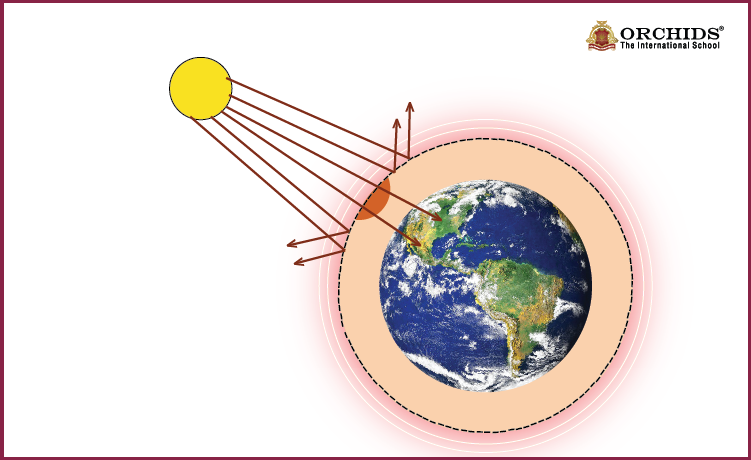
- Made of ozone molecules, it blocks dangerous ultraviolet radiation from the Sun. Without it, humans could face higher risks of skin cancer, plants and animals could be harmed, and glaciers would melt faster.
Unfortunately, human-made chemicals such as CFCs have weakened this protective layer, making its preservation a global priority.
But the ozone layer is just one element. How does the rest of the atmosphere protect us?
It keeps Earth warm enough for life, shields us from harmful radiation, drives the water cycle, and maintains a moderate climate.
Even though it seems endless, the atmosphere gradually thins and eventually blends into the vastness of space, quietly performing its life-supporting functions every day.
Different Layers of Atmosphere
We know that Earth is surrounded by a protective blanket of gases called the atmosphere, but here’s the interesting part: it is not uniform.
The atmosphere is divided into several layers, each with unique characteristics and roles that make life possible. Scientists classify these layers based on temperature changes and altitude.
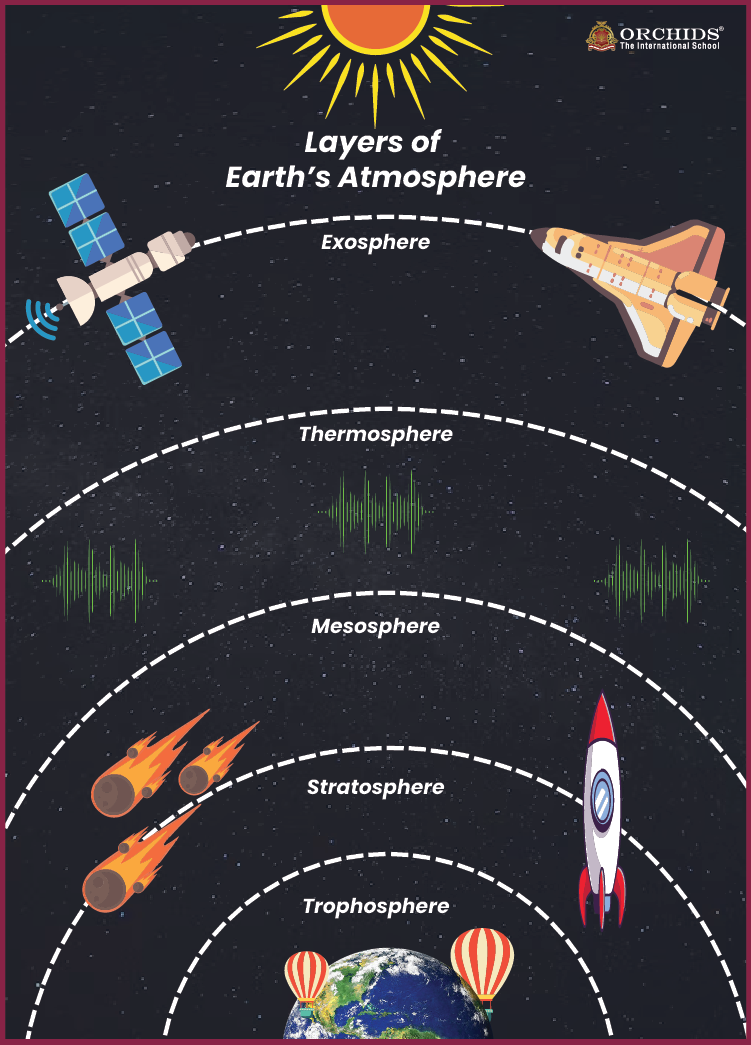
To understand the layers of the atmosphere better, let’s take a closer look at each layer in detail.
- The troposphere is the lowest layer, extending from the Earth’s surface up to 8 to 18 km, with an average height of 13 km.
It is thickest at the equator due to strong convection currents that push warm air upward. This is where we live, and all weather phenomena like clouds, rain, and storms occur here.
About 75% of the atmosphere’s mass is found in this layer, along with nearly all water vapor.
Temperature decreases with altitude at a rate of 1°C per 165 m, a phenomenon known as the normal lapse rate. The tropopause forms the top boundary, separating it from the stratosphere above.
- Above the tropopause lies the stratosphere, reaching up to 50 km. This layer is dry and stable, which is why airplanes often fly here for a smoother ride.
It is home to the ozone layer, which absorbs harmful ultraviolet (UV) radiation from the Sun and converts it into heat, making this layer warmer as you go higher. The stratopause marks the boundary between the stratosphere and mesosphere.
- The mesosphere extends from the stratopause to roughly 80 to 85 km. This is the coldest layer of the atmosphere, with temperatures dropping to –90 to –100°C.
Meteors entering Earth’s atmosphere burn up in this layer. The mesopause forms the top boundary, leading into the thermosphere.
- The thermosphere stretches from the mesopause up to about 400 km. Here, the temperature rises with altitude due to the absorption of high-energy ultraviolet and X-ray radiation from the Sun.
Despite extremely high temperatures, the air is so thin that it would feel freezing to humans. Satellites orbit within this layer, and the auroras, like the Northern and Southern Lights, occur here.
- The ionosphere is a region within the lower thermosphere, between roughly 80 and 400 km. It contains electrically charged particles, or ions, created by solar and cosmic radiation. These ions reflect radio waves back to Earth, enabling long-distance communication.
- Finally, the exosphere is the outermost layer, extending from the top of the thermosphere up to 10,000 km.
The air here is extremely thin, and molecules gradually escape into space. There is no distinct boundary, as the exosphere merges seamlessly into the vastness of outer space.
Though we can separate the atmosphere into layers based on their characteristics, one big question remains:how do these layers work together to sustain life on Earth, and does it truly support life?
Let’s discuss.
Does the Atmosphere Support Life on Earth?
Interestingly, the atmosphere is much more than just a layer of air, it is essential for life itself. It quietly ensures that Earth remains a place where living things can exist and grow.
- It provides the oxygen we need to breathe and shields us from meteors and harmful radiation.
- At the same time, it helps regulate rainfall and climate, keeping temperatures stable so life can continue.
But its benefits don’t stop there.

- Our understanding of the atmosphere allows us to forecast weather, study climate patterns, and plan for changes in the environment.
- It ensures safe air travel for planes, enables satellite communication and GPS, and supports research on global warming and environmental science.
When we consider the atmosphere as a whole, it is far more than just a cover of air. It is a balanced system that keeps Earth warm enough for life, protects us from harmful radiation, supports the water cycle, and maintains a moderate climate.
What Would Happen If the Atmosphere Disappeared?
It’s hard to imagine, but the effects would be immediate and severe. Birds and planes would fall from the sky, while the familiar blue sky would vanish, leaving complete darkness.
And sound could no longer travel, and oceans and lakes would start to evaporate. Life, as we know it, would end very quickly.
Thinking about this, it becomes clear just how essential the atmosphere is. It protects life, keeps Earth’s conditions stable, and makes our planet a safe place to live.
Relationship Between Air, Pressure, and Atmospheric Pressure
Air surrounds us everywhere, but what exactly is it? Air is a mixture of gases that forms a protective layer around Earth, making life possible.
Along with gases like nitrogen, argon, carbon dioxide and oxygen, it has weight, and this weight creates pressure on everything below it. This is what we call air pressure.Whereas, atmospheric pressure is simply the force exerted by the weight of the air above a certain point.
You can think of it like this: when you dive underwater, the deeper you go, the more water presses on you.
Similarly, the more air stacked above you, the higher the pressure. At sea level, this pressure is strong enough to support life and influence weather patterns.
For example, when you climb a mountain, you may notice it’s harder to breathe.
That’s because there’s less air above you, so the atmospheric pressure is lower.
The relationship between the atmosphere and pressure is constant: the thicker the layer of air above, the higher the pressure it exerts.
Now that we understand the connection between air and pressure, we can look at the formula that describes atmospheric pressure:
Where:
- P = pressure
- h = height of the air column
- ρ = density of air
- g = gravitational acceleration
At sea level, the average atmospheric pressure is 1 atm, which is enough to sustain life and influence everything from the weather to our breathing.
So far, in this article, we learned how the atmosphere is vital for life on Earth. From controlling climate and rainfall to protecting us from harmful radiation and enabling modern communication, the atmosphere is far more than a simple layer of air. These insights highlight its role as an invisible system that sustains and protects life on our planet.
Frequently Asked Questions on Atmosphere
1. Which layer of the atmosphere contains the ozone layer?
The ozone layer is found in the stratosphere, high above the Earth. It acts like a sunscreen, absorbing harmful ultraviolet radiation from the Sun.
2. Why do planes prefer flying in the stratosphere?
The stratosphere offers smoother airflow and less turbulence, making flights more stable and efficient.
3. What exactly is the greenhouse effect?
The greenhouse effect is the process where certain gases in the atmosphere trap the Sun’s heat. This keeps Earth warm enough to support life, maintaining a balance in our climate.
4. Which instrument measures air pressure?
A barometer is used to measure air pressure, helping meteorologists predict weather and study atmospheric conditions.
5. Where does the atmosphere end?
The atmosphere does not have a sharp edge. It gradually thins out and merges with outer space, extending thousands of kilometers above the Earth.
6. How does atmospheric pressure change with altitude?
As you go higher, there is less air above you, so the pressure decreases. This is why breathing can feel harder on mountains, and why aircraft cabins are pressurized for passenger comfort.
Science isn't just a subject, it's the way of seeing the world. Curious how Orchids The International School teaches it that way? Talk to our admissions team.
Admissions Open for 2026-27
What type of concept pages would you prefer?
CBSE Schools In Popular Cities
- CBSE Schools in Bangalore
- CBSE Schools in Mumbai
- CBSE Schools in Pune
- CBSE Schools in Hyderabad
- CBSE Schools in Chennai
- CBSE Schools in Gurgaon
- CBSE Schools in Kolkata
- CBSE Schools in Indore
- CBSE Schools in Sonipat
- CBSE Schools in Delhi
- CBSE Schools in Rohtak
- CBSE Schools in Bhopal
- CBSE Schools in Aurangabad
- CBSE Schools in Jabalpur
- CBSE Schools in Jaipur
- CBSE Schools in Jodhpur
- CBSE Schools in Nagpur
- CBSE Schools in Ahmednagar
- CBSE School In Tumkur











Orchids The International School is one of India's leading chains of CBSE and ICSE schools, with 110+ schools across the country.