

Asteroid and Comet Difference
The asteroid and comet difference is one of those space topics that instantly catches our curiosity. Space has always been a place of wonder. From the glowing sun to the twinkling stars, everything up there seems magical.
But not all objects in space are as big and bright; some are small, mysterious, and constantly moving. Among them, asteroids and comets stand out the most.
At first, they may look alike, but they are not the same. Asteroids are more like rocky leftovers from planet formation, while comets are icy visitors that leave behind glowing tails when they pass near the Sun.
In this article, we will explore what makes asteroids and comets unique, how they differ, and why scientists find them so important in understanding the story of our solar system.
Table of Contents
- Amazing Facts About Asteroids and Comets
- What is an Asteroid
- What is a Comet
- Difference Between Asteroid and Comet
- Frequently Asked Questions on Asteroid and Comet Difference

Amazing Facts about Asteroids and Comets!
|
But wait, what exactly are these asteroids? Let’s take a closer look at what makes an asteroid, and why scientists call them the fossils of our solar system.
What is an Asteroid?
Asteroids are not just random rocks drifting in space. They are ancient leftovers from when our solar system first formed about 4.6 billion years ago.
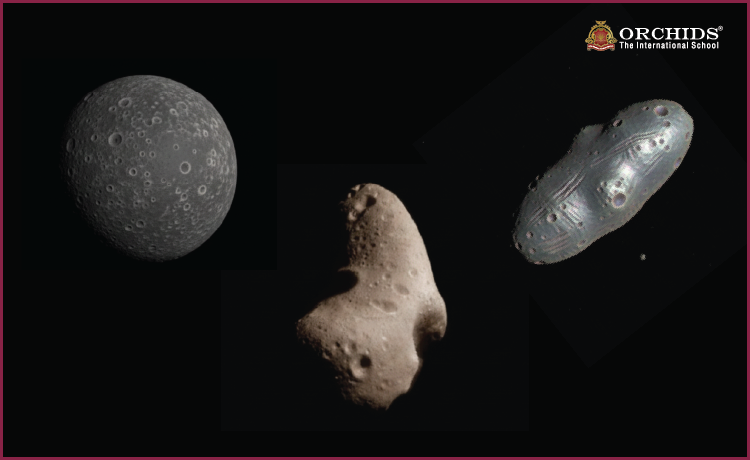
Today, astronomers know of over 1.1 million asteroids, most of them orbiting the Sun in the asteroid belt between Mars and Jupiter.
They tumble and spin as they travel, ranging in size from tiny rocks less than a metre wide to giants nearly 1,000 km across. Some scientists even believe they may have carried the building blocks of life to early Earth.
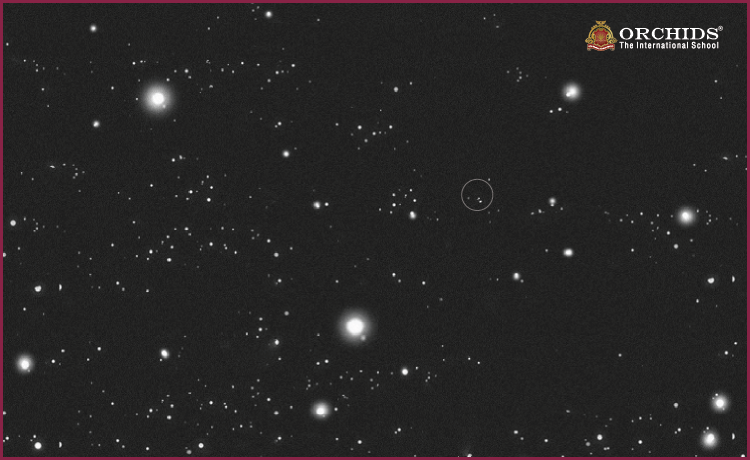
That brings up a big question: where did all these rocky objects come from in the first place?
Asteroids are the remains of the solar system’s formation. When a giant cloud of gas and dust collapsed billions of years ago, most of the material became the Sun and planets.
The leftovers that never grew into planets stayed behind as asteroids, tiny time capsules from the dawn of the solar system.
And since no two time capsules are the same, it makes sense that asteroids are quite different from each other.
Now that we know what asteroids are, let’s look at how big they can get and what kinds exist.
Size and Types of Asteroids
Not all asteroids look alike. While the three largest ones are almost spherical, most are oddly shaped and jagged. They can be as small as pebbles or hundreds of kilometres wide.
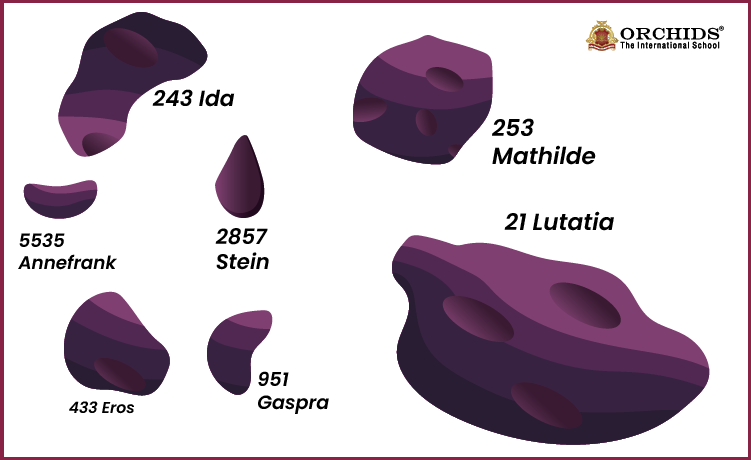
Based on what they’re made of, asteroids fall into three main groups:
- C-type: carbon-rich
- S-type: silicate (rocky)
- M-type: metallic
So, asteroids come in all shapes, sizes, and materials. But how did we first find out about them? Let’s discuss.
The very first asteroid, Ceres, was discovered in 1801 by Giuseppe Piazzi. With a diameter of about 950 km, it’s now classified as a dwarf planet.
In fact, Ceres, Pluto, Eris, Makemake, and Haumea all earned this title in 2006. Since then, advanced telescopes have helped astronomers find countless more asteroids and study them in detail.
After learning about asteroids, it’s time to understand their icy counterparts.
What is a Comet?
Comets are like giant space snowballs made of ice, dust, and rock. They have been around since the solar system first formed.
When they are far from the Sun, comets stay frozen and quiet. But as they get closer, the Sun’s heat makes the ice melt and release gas and dust.
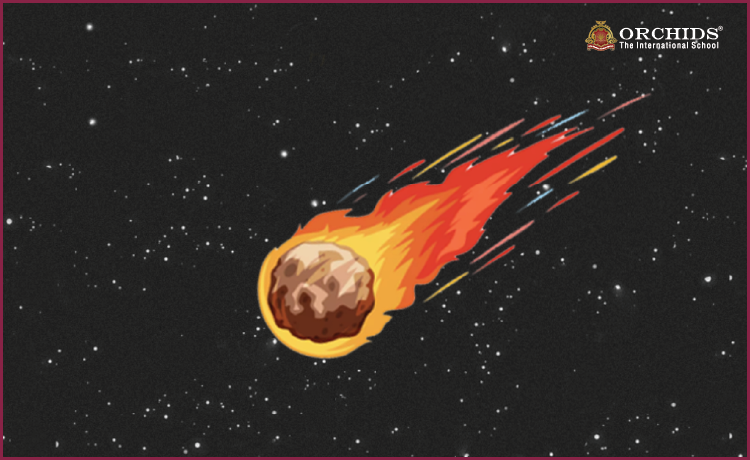
This forms a glowing cloud called the coma and two beautiful tails, a white dusty one and a blue ion tail that always points away from the Sun.
So where do these glowing travellers come from?
Well, the frequent visitors usually come from the Kuiper Belt, a region just beyond Neptune filled with icy objects.
But the ones that take thousands or even millions of years to return likely come from the faraway Oort Cloud, a giant shell of frozen bodies situated at the edge of the solar system.
Now let’s take a closer look at their parts. A comet has four main features:
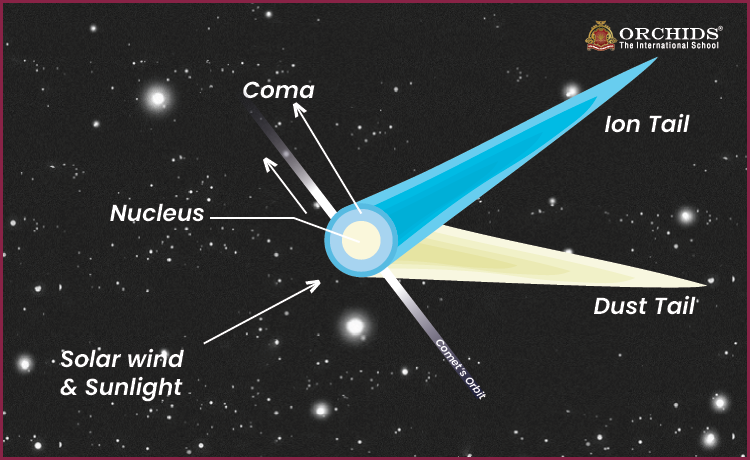
- Nucleus is the solid core of rock, dust, and frozen gases, usually just a few kilometres across.
- A coma is the glowing cloud of gas and dust that forms around the nucleus as it heats up.
- A dust tail is a wide, curving trail of tiny solid particles pushed back by sunlight.
- An ion tail is a straighter, bluish stream of charged gas carried away by the solar wind.
Put together, these parts make comets some of the most breathtaking sights in the night sky.
One of the most famous recent visitors was 3I/ATLAS, spotted on July 1st, 2025. It became so bright that people around the world could see its glowing tail with their naked eyes.
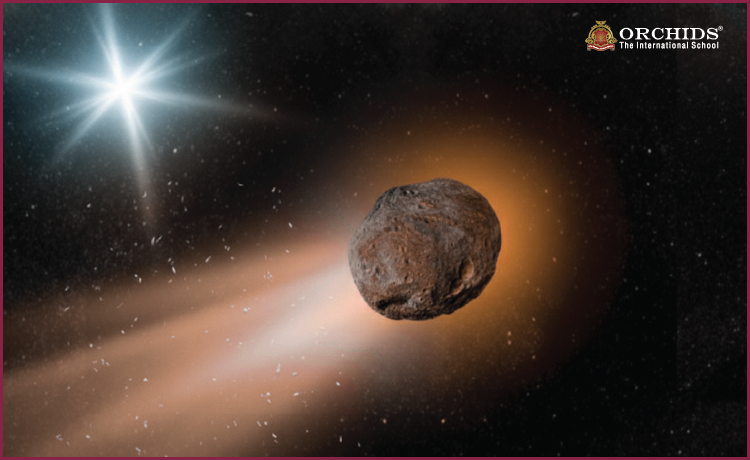
So, in simple words, a comet is like a frozen time capsule from the early solar system, carrying clues about how planets, including Earth, came to be. And every time one passes by, it gives us a dazzling show and a glimpse into our cosmic past.
Next, let’s talk about the main intent of this blog, i.e, asteroid and comet differences.
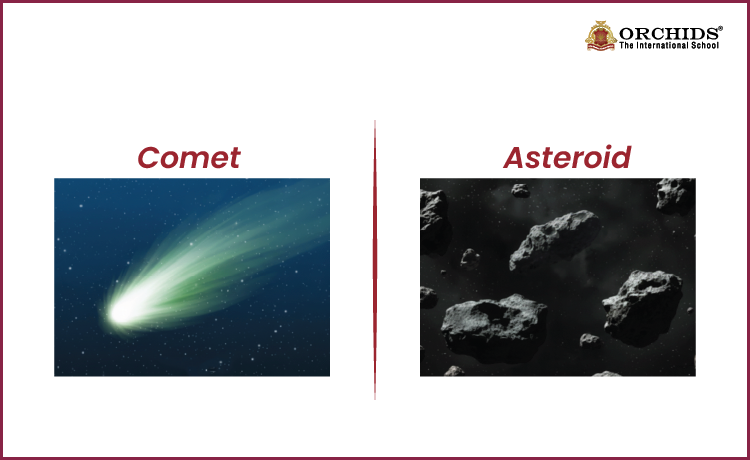
To understand this difference visually, take a look at the illustration below:
Difference Between Asteroid and Comet
|
Feature |
Asteroid |
Comet |
|
Composition |
Made mostly of rock and metal |
Made of ice, dust, and frozen gases like a cosmic snowball |
|
Location |
Mostly found in the asteroid belt between Mars and Jupiter |
Come from the Kuiper Belt and the faraway Oort Cloud |
|
Orbit |
Follow round or slightly oval paths |
Travel in long, stretched, and tilted orbits |
|
Tail |
No tail, they just look like space rocks |
Grow glowing tails when near the Sun, one dusty and one bluish |
|
Size |
Range from tiny pebbles to giants like Ceres (nearly 1,000 km wide) |
Usually just a few kilometres across |
|
Surface |
Hard and rocky |
Soft, icy, and dusty |
|
Discovery |
First found: Ceres in 1801 |
Famous one: Halley’s Comet, seen since ancient times |
|
Examples |
Ceres, Vesta, Eros |
Halley’s Comet, Comet NEOWISE, Hale-Bop |
Till now, we learned how asteroids and comets differ, where they come from, and why they matter to our understanding of the solar system.
So, the next time you read about an asteroid passing by or a comet lighting up the sky, pause and think about the ancient history they carry with them.
Frequently Asked Questions on Asteroid and Comet Difference
1. Could an asteroid really strike Earth?
Yes. Tiny ones hit our atmosphere often but burn up as shooting stars. Big impacts are rare, and scientists keep a close watch on near-Earth asteroids.
2. Do comets always have tails?
No. A comet only grows a tail when it gets near the Sun. The heat turns its ice into gas and dust, forming a glowing coma and tail.
3. Which is usually bigger: an asteroid or a comet?
Asteroids can be much larger, some nearly 1,000 km wide. Comets are smaller, but their bright tails can make them look bigger in the sky.
4. Can we see asteroids and comets from Earth?
Yes. Some large asteroids can be spotted with telescopes, while bright comets with long tails are sometimes visible to the naked eye.
5. Why do scientists study asteroids and comets?
Because they are like time capsules from the early solar system, holding clues about how planets and even life may have formed.
Science isn't just a subject, it's the way of seeing the world. Curious how Orchids The International School teaches it that way? Talk to our admissions team.
Admissions Open for 2026-27
What type of concept pages would you prefer?
CBSE Schools In Popular Cities
- CBSE Schools in Bangalore
- CBSE Schools in Mumbai
- CBSE Schools in Pune
- CBSE Schools in Hyderabad
- CBSE Schools in Chennai
- CBSE Schools in Gurgaon
- CBSE Schools in Kolkata
- CBSE Schools in Indore
- CBSE Schools in Sonipat
- CBSE Schools in Delhi
- CBSE Schools in Rohtak
- CBSE Schools in Bhopal
- CBSE Schools in Aurangabad
- CBSE Schools in Jabalpur
- CBSE Schools in Jaipur
- CBSE Schools in Jodhpur
- CBSE Schools in Nagpur
- CBSE Schools in Ahmednagar
- CBSE School In Tumkur











Orchids The International School is one of India's leading chains of CBSE and ICSE schools, with 110+ schools across the country.