

Uses of a Concave Mirror
Uses of a concave mirror are found all around us because a concave mirror has a special ability to focus light. A concave mirror, also called a converging mirror, has a reflecting surface curved inward, that is, away from the incident light. It focuses parallel light rays to a single point after reflection. Because of this property, concave mirrors are used in many everyday applications, from shaving mirrors and headlights to solar furnaces, telescopes, and medical instruments.
This article provides insights into the real-life applications of concave mirrors and also explains how they are important in our daily lives and modern technology.
Table of Contents
- What is a Concave Mirror?
- Real Life Uses of a Concave Mirror
- Frequently Asked Questions on Uses of a Concave Mirror

What is a Concave Mirror?
Have you ever noticed? When you looked into a mirror while getting ready, like a shaving mirror or a makeup mirror, your face suddenly appeared bigger, brighter, or clearer as you moved closer? That’s the amazing job of the concave mirror, because these types of mirrors are designed with an inward curve that changes how light behaves.
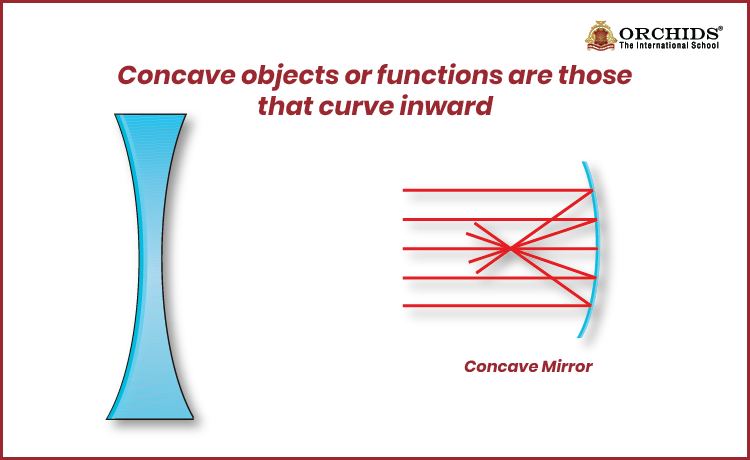
And it’s interesting to note that a concave mirror reflects light inward to a focal point, making it useful for focusing light and producing enlarged, bright images. The type of image formed depends on the distance between the mirror and the object.
Now that you know what a concave mirror is, let’s look at where you actually see them in everyday life.
Real Life Uses of a Concave Mirror
Some of the most common uses of a concave mirror include:
- The most familiar use of a concave mirror is in Shaving and Makeup Mirrors.
Have you ever wondered why your face suddenly looks bigger when you move closer to a shaving or makeup mirror?
It is because the curved surface of the mirror forms an enlarged, erect image of the face when held close. And, this helps in performing close-up tasks like shaving or applying makeup with precision.
- Concave mirrors are used as reflectors in the headlights of vehicles, torches, and railway engines. If you have ever noticed how these lights manage to shine so far ahead, the secret lies in the mirror behind the bulb.
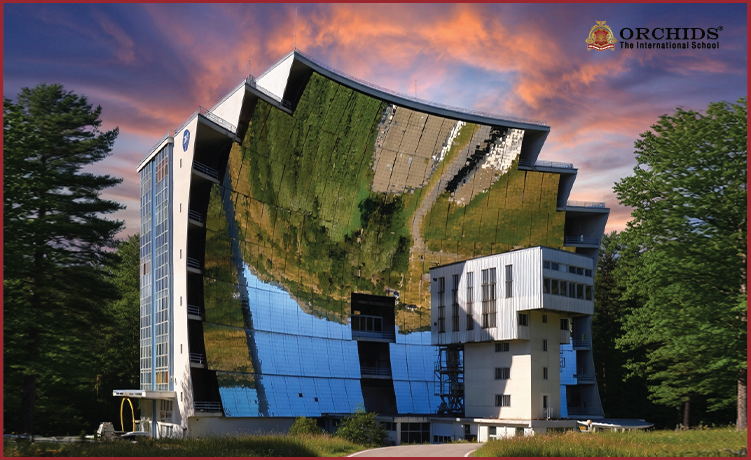
- Concave mirrors are used in Solar Furnaces and solar cookers to focus sunlight onto a small area.
Let's discuss how exactly it works. When sunlight falls on the mirror, it converges the rays to a focal point and generates heat. And this generated heat at the focus can be used for heating, cooking, or melting metals. This is a clean, renewable energy application of optics.
- Concave mirrors are an important component in Astronomical Telescopes.
But why are concave mirrors so important? Because they collect and focus light coming from distant celestial objects. In telescopes, a large concave mirror works as the objective mirror.
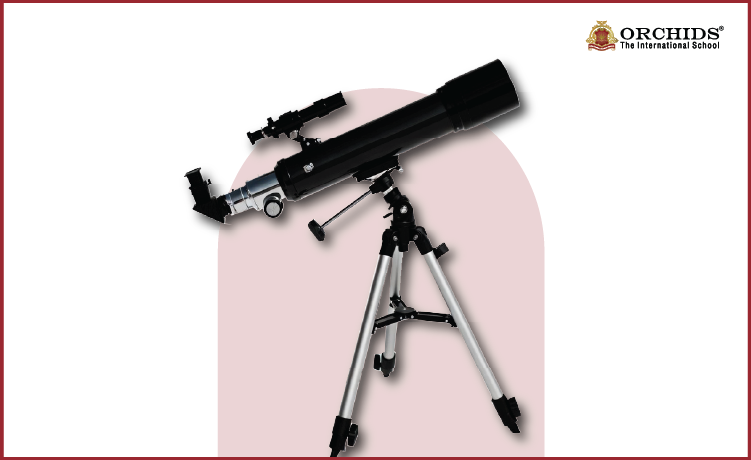
It gathers faint light from stars, planets, and galaxies and forms a bright, inverted, and magnified image. This helps astronomers observe stars, planets, and galaxies with high precision.
- Dentists use concave mirrors to examine the inside of a mouth of patient.

The concave mirror creates a clear, magnified image of teeth and gums. Its curvature helps focus light into the mouth, making it easier to see even tiny details. This helps dentists check for cavities, clean teeth, and diagnose problems with accuracy. Interesting!
- Modern Projector Systems also use concave mirrors. But what exactly do these mirrors do in projector systems?
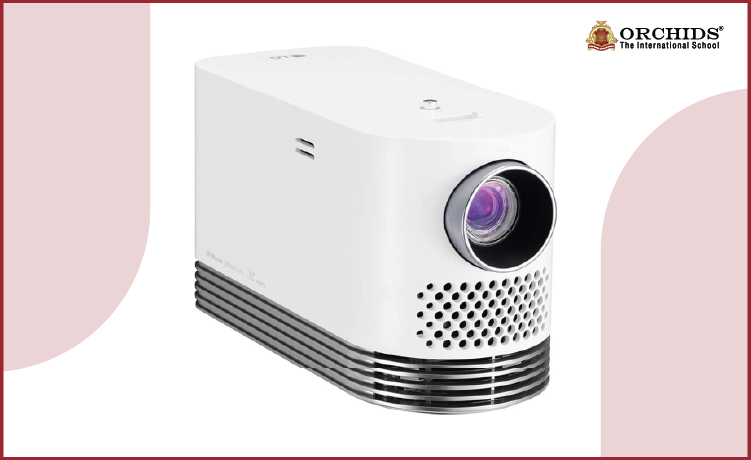
As we already know, concave mirrors focus and direct light onto a screen so the visuals appear large and bright. Even though the light source inside a projector is small, the curved mirror reflects and spreads the light in just the right way. This is what allows projectors to deliver clear, magnified visuals that an entire audience can enjoy.
- Concave mirrors are used in Searchlights to project a powerful beam over long distances. Let’s see how this works.

The light source is positioned at the focus of the mirror. After reflection, the rays become parallel, forming a strong, directed beam. This makes searchlights more effective for rescue missions, lighthouses, and stage lighting.
- In medical applications, concave mirrors are used in Ophthalmoscopes, instruments that help doctors examine the retina of the eye.
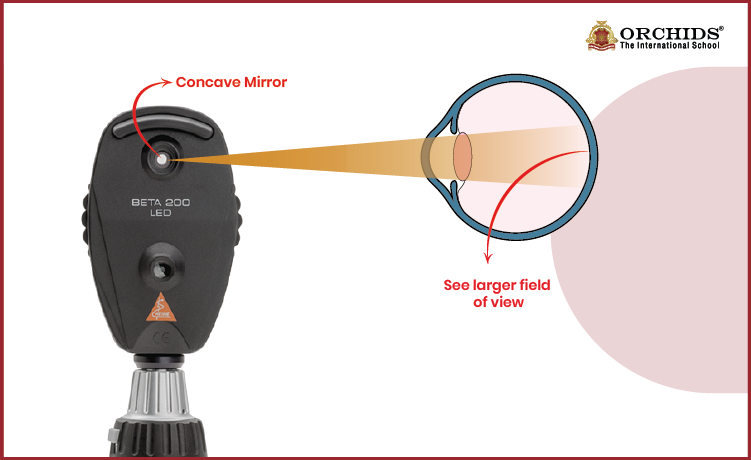
But have you ever wondered how such a small device lets doctors see deep inside the eye? Let's discuss,
The mirror has a small hole in the centre through which the doctor looks. A beam of light passes through the hole and enters the eye of the patient. The concave mirror focuses the light to illuminate the retina clearly.
Concave mirrors also play important roles in several other technologies. Let's discuss them.
- In Satellite Dishes, a concave mirror collects and focuses incoming signals onto the receiver for clear transmission.
- In Visual Bomb Detectors, a concave mirror is used to reflect and magnify light so that hidden objects can be easily spotted.
- In Aircraft Landing Systems, concave mirrors help to guide planes during landing.
So far, we have discussed that concave mirrors are more than simple reflecting surfaces, as they are an important optical device. Their converging property allows them to focus light and produce magnified images, making them useful in medical, industrial, and scientific applications. From shaving mirrors and headlights to solar furnaces and telescopes, concave mirrors show us how physics shapes our everyday life.
Frequently Asked Questions on Uses of a Concave Mirror
1. What is a Concave Mirror?
A concave mirror is a type of spherical mirror that has a reflective surface that curves inward, like a cave, and converges light rays.
2. Which type of mirror is known as a converging mirror?
A concave mirror is known as a converging mirror because it reflects light inward to a single focal point.
3. Why are concave mirrors used in shaving mirrors?
They form a magnified and upright image when the face is close, helping in clear visibility while shaving.
4. How does a concave mirror work in headlights?
The bulb is placed at the mirror’s focus, and the reflected rays travel as parallel beams, increasing brightness and visibility.
5. Why is a concave mirror used in solar furnaces?
It focuses sunlight to produce high temperatures for cooking, heating, and melting.
6. What is the use of a concave mirror in telescopes?
It collects and focuses light from distant objects, enabling detailed astronomical observation.
7. Are Concave lenses used in ATM’s?
Yes, convex mirrors are used in ATMs for security purposes. They allow users to see who is behind them and check for anyone trying to look at their PIN.
Science isn't just a subject, it's the way of seeing the world. Curious how Orchids The International School teaches it that way? Talk to our admissions team.
Admissions Open for 2026-27
What type of concept pages would you prefer?
CBSE Schools In Popular Cities
- CBSE Schools in Bangalore
- CBSE Schools in Mumbai
- CBSE Schools in Pune
- CBSE Schools in Hyderabad
- CBSE Schools in Chennai
- CBSE Schools in Gurgaon
- CBSE Schools in Kolkata
- CBSE Schools in Indore
- CBSE Schools in Sonipat
- CBSE Schools in Delhi
- CBSE Schools in Rohtak
- CBSE Schools in Bhopal
- CBSE Schools in Aurangabad
- CBSE Schools in Jabalpur
- CBSE Schools in Jaipur
- CBSE Schools in Jodhpur
- CBSE Schools in Nagpur
- CBSE Schools in Ahmednagar
- CBSE School In Tumkur











Orchids The International School is one of India's leading chains of CBSE and ICSE schools, with 110+ schools across the country.