

The Law of Conservation of Energy: Statement, Explanation and Real-Life Examples for Class 5
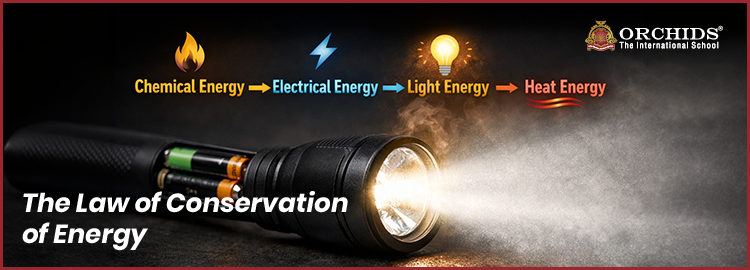
The Law of Conservation of Energy is one of the most important laws in science that helps us understand how energy works in our daily lives. Whether it is moving objects, electricity, or heat, energy is always being used and transformed.
By learning this law, we can better understand how energy is neither lost nor gained but simply changes its form. In this article, we will state the law of conservation of energy and how it works with real-life examples.
Table of Contents
- What is the Law of Conservation of Energy
- How Does the Law of Conservation of Energy Work
- Real-Life Law of Conservation of Energy Examples
- Frequently Asked Questions on The Law of Conservation of Energy

What is the Law of Conservation of Energy
We know that energy comes in many forms, and it can be converted from one form to another.
When we observe closely, the amount of energy spent in any form will be equal to the amount of energy converted to a new form. This observation helped scientists formulate a law called the law of conservation of energy.
It states that,
This means that energy always remains constant and only changes its form from one type to another.
How Does the Law of Conservation of Energy Work
Energy never really disappears. It simply moves from one object to another or changes into a different form.
Think about a rolling ball. As it slows down, it may look like the ball is losing energy. However, the energy is actually changing into heat because of friction with the ground and sound when the ball hits small obstacles.
In an isolated system, where no energy enters or leaves, the total amount of energy always stays the same. If one part of the system loses energy, another part gains exactly the same amount. This is why the total energy remains constant.
Scientists have observed this rule in countless natural and man-made systems. Even though it cannot be directly proved in every situation, no experiment has ever shown that energy is created from nothing or completely disappears.
Real-Life Law of Conservation of Energy Examples
In our daily life, many machines and devices work because energy is conserved and changes from one form to another. Let’s look at some simple examples.
Mechanical Systems
Mechanical systems clearly show how one form of energy changes into another.
- Swing: When a person reaches the highest point on a swing, the swing has maximum potential energy. As it moves downward, this potential energy changes into kinetic energy, making the swing move faster.
- Roller Coaster: At the top of the highest track, the coaster has maximum gravitational potential energy. As it moves downhill, this energy changes into kinetic energy. Some energy also changes into heat and sound because of friction and air resistance.
- Newton's Cradle: When one metal ball is pulled back and released, its potential energy changes into kinetic energy. This energy passes through the other balls and makes the ball at the opposite end move upward.
Household Devices
Many electrical appliances in our homes work by changing one form of energy into another.
- Electric Bulb: An electric bulb changes electrical energy into light energy. At the same time, some energy is released as heat.
- Speaker and Microphone: A speaker converts electrical energy into sound energy. A microphone does the opposite by changing sound energy into electrical energy.
- Battery: A battery stores chemical energy. When it is connected to a device, this chemical energy changes into electrical energy to power the device.
Nature and Living Organisms
The law of conservation of energy also works in nature.
- Photosynthesis: Green plants use sunlight to prepare food. During this process, light energy is converted into chemical energy, which is stored in glucose.
- Human Body: The food we eat contains chemical energy. Our body changes this energy into mechanical energy for activities like walking, running, and lifting objects. Some of it also changes into heat energy to keep the body warm.
Power Generation
Electricity production also follows this important law.
- Hydroelectric Power Plant: Water stored high behind a dam has gravitational potential energy. As the water flows downward, it gains kinetic energy. This moving water turns turbines, which convert the energy into electrical energy.
Transportation
- Car or Bus: The fuel inside a vehicle contains chemical energy. When the engine burns the fuel, it changes into mechanical energy that moves the vehicle. Some energy is also released as heat and sound.
- Electric Vehicle (EV): In an electric vehicle, the battery stores electrical energy. This energy is converted into mechanical energy to rotate the wheels, while a small amount is lost as heat.
Sports and Games
Many sports activities involve energy changing from one form to another.
- Kicking a Football: Your muscles use chemical energy from food to kick the ball. This changes into kinetic energy, making the football move.
- Archery: When an archer pulls back the bowstring, elastic potential energy is stored in the bow. After releasing the string, this energy changes into the kinetic energy of the arrow.
- High Jump: As a player runs, the body has kinetic energy. During the jump, part of this energy changes into gravitational potential energy as the player rises.
Everyday Home Activities
Many daily activities around us show energy transformation.
- Electric Fan: An electric fan converts electrical energy into mechanical energy to rotate its blades. Some energy is also released as sound and heat.
- Mixer Grinder: A mixer changes electrical energy into mechanical energy to rotate the blades. Friction also produces heat and sound.
- Electric Iron: An electric iron changes electrical energy into heat energy for ironing clothes.
Renewable Energy Sources
Renewable energy systems also follow this law.
- Solar Panels: Solar panels convert light energy from the Sun into electrical energy, which can be used to power homes and devices.
- Wind Turbines: The kinetic energy of moving air turns the blades of a wind turbine. This movement is then converted into electrical energy.
Toys and Simple Machines
Children's toys also demonstrate energy conversion.
- Wind-up Toy: When you wind the toy, energy is stored as elastic potential energy in the spring. As the spring unwinds, it changes into kinetic energy, making the toy move.
- Yo-Yo: At the top, the yo-yo has more potential energy. As it moves downward, this changes into kinetic energy. When it climbs back up, the kinetic energy changes back into potential energy.
Space and Astronomy
Energy transformations also occur beyond Earth.
- Satellite Launch: Rocket fuel contains chemical energy, which changes into thermal energy during combustion and then into kinetic energy that lifts the rocket into space.
- The Sun: Inside the Sun, nuclear energy is converted into light energy and heat energy, which reach Earth and support life.
In this article, we learned about the law of conservation of energy and how energy can only change from one form to another without being created or destroyed.
Frequently Asked Questions on The Law of Conservation of Energy
1. State the law of conservation of energy.
Energy can neither be created nor destroyed but can only be converted from one form to another.
2. Can energy be created or destroyed?
No, energy cannot be created or destroyed.
3. Give examples of the law of conservation of energy.
Examples include a torch, a loudspeaker, a microphone, a generator, burning fuels, and the human body.
4. How does a torch show energy conversion?
A torch converts chemical energy into electrical energy and then into light and heat energy.
Science isn't just a subject, it's the way of seeing the world. Curious how Orchids The International School teaches it that way? Talk to our admissions team.
Admissions Open for 2026-27
What type of concept pages would you prefer?
CBSE Schools In Popular Cities
- CBSE Schools in Bangalore
- CBSE Schools in Mumbai
- CBSE Schools in Pune
- CBSE Schools in Hyderabad
- CBSE Schools in Chennai
- CBSE Schools in Gurgaon
- CBSE Schools in Kolkata
- CBSE Schools in Indore
- CBSE Schools in Sonipat
- CBSE Schools in Delhi
- CBSE Schools in Rohtak
- CBSE Schools in Bhopal
- CBSE Schools in Aurangabad
- CBSE Schools in Jabalpur
- CBSE Schools in Jaipur
- CBSE Schools in Jodhpur
- CBSE Schools in Nagpur
- CBSE Schools in Ahmednagar
- CBSE School In Tumkur











Orchids The International School is one of India's leading chains of CBSE and ICSE schools, with 110+ schools across the country.