

Calorimeter
A Calorimeter is an important device that is used for measuring the heat energy produced during different kinds of reactions. Calorimetry is a branch of science that deals with the measurement of the amount of heat released or absorbed during a chemical reaction. Do you know an interesting fact about calorimeters? They are super useful in labs and even in school experiments. And the reason behind this is that they make it easy to study reactions, check concentrations, and understand what kind of changes happen in a solution during a reaction.
This article completely focuses on what a calorimeter is, how a calorimeter works, its types, uses of calorimetry.
Table of Contents
- What is a Calorimeter?
- The Working Principle of a Calorimeter
- Different Types of Calorimeters
- Real-Life Uses of Calorimetry
- Frequently Asked Questions on Calorimeter

What is a Calorimeter?
We already know that a calorimeter is a simple scientific instrument that helps us measure how much light a coloured solution absorbs. Interestingly,
“A calorimeter tells us how dark or light a liquid is, which helps us understand how much of a substance is present in it.”
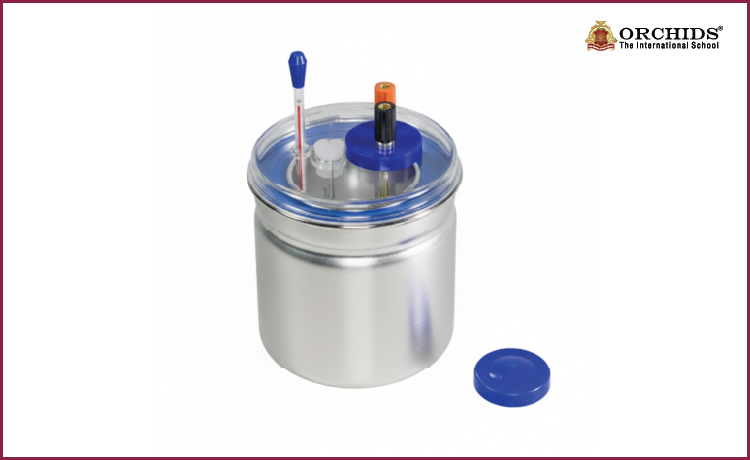
This makes it a very useful tool in physics labs, chemistry labs, school experiments, and even in industries where colour and concentration matter.
Now let’s look at the idea that makes all of this possible.
Calorimeter Principle
The working principle of a calorimeter is based on how heat moves between objects.
Do you know, when two substances at different temperatures, for example, a hot solid and a cooler liquid, come into contact, heat always flows from the hotter object to the cooler one. This continues until both reach the same temperature, a point called thermal equilibrium.
Here is a point to remember: this process follows the law of conservation of energy, which says that energy cannot be created or destroyed. So it can be concluded that the heat lost by the hot object is exactly equal to the heat gained by the cooler object.
Heat Lost = Heat Gained
To calculate the amount of heat exchanged, we use the calorimetry formula:
Q = mCΔT
Here,
Q = heat absorbed or released
m = mass of the substance
C = specific heat capacity
ΔT = change in temperature
This principle helps us understand how materials heat up, cool down, and transfer energy, ideas that are important in both science and everyday life.
Now you know on what principle a calorimeter works, let's discuss how a calorimeter works.
How Does A Calorimeter Work?
As we already know, the calorimeter works by measuring how much heat is transferred during a reaction. Interestingly, the setup of a calorimeter is designed to ensure accurate results. It consists of an inner metal vessel filled with water, placed inside an insulated outer container to prevent heat loss.
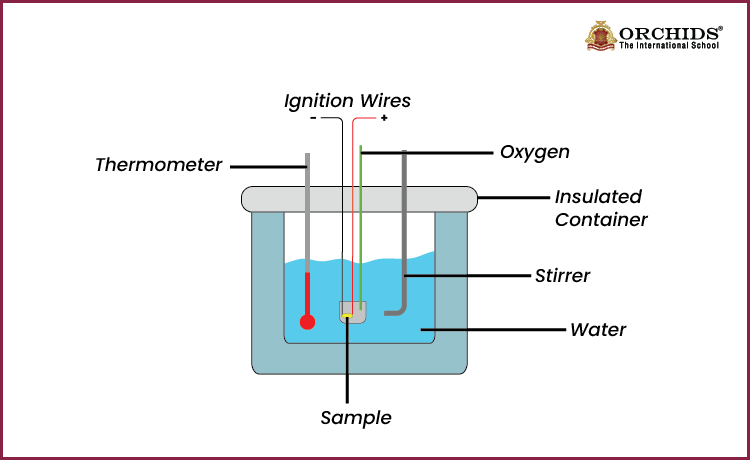
Now, have a look at the image above. You can clearly see how the different parts of the calorimeter, such as the inner vessel, outer container, stirrer, thermometer, and ignition wires, are arranged to reduce heat loss.
A sample is kept inside and connected to ignition wires, while oxygen is supplied to help it burn completely.
Here is one interesting fact to know: Whenever the sample is ignited, it releases heat, which is absorbed by the water. A stirrer mixes the water so the heat spreads evenly, and a thermometer inserted through a small opening measures the temperature rise.
What’s even more important is thatthe calorimeter is well insulated, and almost all the heat released by the sample is absorbed by the water.
In a calorimeter, a fixed amount of fuel is burned. The vessel is filled with water, and the fuel is burned, which leads to the heating of the water.
From this, it can be concluded that heat loss by the fuel will be equal to the heat gained by the water. Because of this, it is important to insulate the calorimeter from the environment to improve the accuracy of the experiment.
This temperature change is measured by a thermometer, and using the temperature change, along with the mass and specific heat capacity of water, we can calculate the total heat released during the reaction.
Different Types of Calorimeters
There are different types of calorimeters, but each of them is designed for a special purpose. Here are some common ones:
- An Adiabatic Calorimeter is designed so that no heat is lost to or gained from the surroundings. It helps measure heat changes very accurately because all the heat stays inside the system.
- A Reaction Calorimeter is used to study chemical reactions in real time. It measures the heat released or absorbed during a reaction, helping scientists understand how fast or slow a reaction happens.
- In a Bomb Calorimeter (Constant Volume Calorimeter), reactions happen in a strong, sealed container called a “bomb”. It is mostly used to find the energy content of fuels by burning them at constant volume.
- The Constant Pressure Calorimeter works under normal atmospheric pressure. It is often used in laboratories to measure heat changes in processes like dissolving or mixing substances.
Real-Life Uses of Calorimetry
An interesting fact about calorimetry is that it’s much more than a simple lab technique. Every material naturally tries to stay in its “comfort zone” or lowest energy state, but some substances store much more energy than others.
You may wonder, how do they manage to store more energy? Let's try to understand this by using a simple example. Fuels like petrol or coal pack a lot of chemical energy, while elements like uranium store an even greater amount.
Now, let’s explore how calorimetry shows up in real life and makes science practical and exciting:
- While performing Science Experiments in Schools, students use calorimeters to see how the depth of colour changes with concentration, making chemistry more interactive and enjoyable.
- In Medical Testing, calorimetry helps in important tests like measuring blood glucose or hemoglobin levels. The colour change in the sample tells how much of a substance is present.
- In Water Quality Testing, it is used to check drinking water, river water, and even pool water to detect harmful chemicals, pollutants, or impurities.
- In the Food and Beverage Industry, Calorimetry helps determine the quality of juices, oils, soft drinks, and other food items.
- Scientists analyse soil, air, and water pollution using calorimetric methods, helping track and control environmental damage.
- For Chemical and Pharmaceutical Research, researchers use calorimetry to study reactions, check concentrations, and monitor changes during experiments.
- In Agriculture and Soil Testing, calorimetry helps test nutrient levels in soil, so farmers can improve crop growth effectively.
- In Industry and Manufacturing, calorimetry is used in industries like paints, textiles, cosmetics, and plastics to ensure the colour of products stays consistent and high-quality.
Till now, we have learnt that the calorimeter is a powerful device that helps us understand how heat moves and how substances store energy. From studying chemical reactions to testing food, water, and everyday materials, calorimetry plays a vital role in both science and real-life applications.
Frequently Asked Questions on Calorimeter
1. What does a calorimeter diagram show?
A calorimeter diagram shows all the parts, like the inner chamber, thermometer, and insulating walls. It helps you clearly understand how the device prevents heat loss during experiments.
2. What are the main calorimeter uses?
Some common calorimeter uses include measuring heat changes in chemical reactions and checking food energy content. Scientists rely on it whenever they need accurate heat transfer data.
3. What is a calorimeter used to measure?
A calorimeter is used to measure the amount of heat gained or lost during a physical or chemical process. This helps us understand how much energy is involved in those changes.
4. What is the calorimeter definition?
The calorimeter definition is a device that measures heat transfer between substances. In simple words, it helps us track how much heat is absorbed or released.
5. Why is a calorimeter diagram important for students?
A calorimeter diagram makes it easy for students to visualise how heat is exchanged inside the device. It turns a complex idea into something simple and relatable.
6. How do calorimeters help in daily life?
Many calorimeters are used in food testing, where they help calculate the energy in the food we eat. It also supports industries in designing safer and more efficient products.
7. Why do scientists say a calorimeter is used to measure heat accurately?
Scientists say a calorimeter is used to measure heat accurately because its insulated design prevents energy loss. This ensures the results are reliable and close to real-life heat changes.
Science isn't just a subject, it's the way of seeing the world. Curious how Orchids The International School teaches it that way? Talk to our admissions team.
Admissions Open for 2026-27
What type of concept pages would you prefer?
CBSE Schools In Popular Cities
- CBSE Schools in Bangalore
- CBSE Schools in Mumbai
- CBSE Schools in Pune
- CBSE Schools in Hyderabad
- CBSE Schools in Chennai
- CBSE Schools in Gurgaon
- CBSE Schools in Kolkata
- CBSE Schools in Indore
- CBSE Schools in Sonipat
- CBSE Schools in Delhi
- CBSE Schools in Rohtak
- CBSE Schools in Bhopal
- CBSE Schools in Aurangabad
- CBSE Schools in Jabalpur
- CBSE Schools in Jaipur
- CBSE Schools in Jodhpur
- CBSE Schools in Nagpur
- CBSE Schools in Ahmednagar
- CBSE School In Tumkur











Orchids The International School is one of India's leading chains of CBSE and ICSE schools, with 110+ schools across the country.