

Chandrasekhar Limit
The Chandrasekhar Limit sounds like a big scientific term, but it reveals one of the coolest secrets of our universe: how stars die! Interestingly, stars shine for millions of years, but they eventually run out of fuel and begin to collapse. And here is the exciting part: not all stars collapse in the same way!
Imagine a giant star, thousands of times bigger than our Sun, exploding into a supernova. Why do some stars end as calm white dwarfs while others become mysterious black holes? This article is a perfect guide to know the story of dying stars, collapsing cores, Chandrasekhar limit, and one of the most important limits in astrophysics!
Table of Contents
- Must-Know Facts Chandrasekhar Limit
- What is Chandrasekhar limit?
- Significance of the Chandrasekhar Limit
- Chandrasekhar limit Unit
- Applications of Chandrasekhar Limit
- Frequently Asked Questions on Chandrasekhar Limit

Must-Know Facts About Chandrasekhar Limit
|
What is Chandrasekhar limit?
The Chandrasekhar Limit is the maximum mass a white dwarf can have while remaining stable.
In simple words:
- If a white dwarf is lighter than the limit, it stays a white dwarf.
- If it is heavier than the limit, it cannot support itself and collapses further.
To understand this, there is one simple example. Consider a small table that can hold weight. If you put light books on it, it stands firm. But if you pile on heavy boxes past the table’s strength, the table breaks. The Chandrasekhar Limit is like the maximum weight the table can hold.
But who discovered the Chandrasekhar limit? Let's discuss this in detail,
This idea came from Subrahmanyan Chandrasekhar, a brilliant Indian-born astrophysicist. He showed the world that there is a clear mass limit for white dwarfs.

If a leftover mass of a star after it dies is over that limit, the star can not stay a white dwarf; it must collapse further.
But one question arises here: why does it matter?
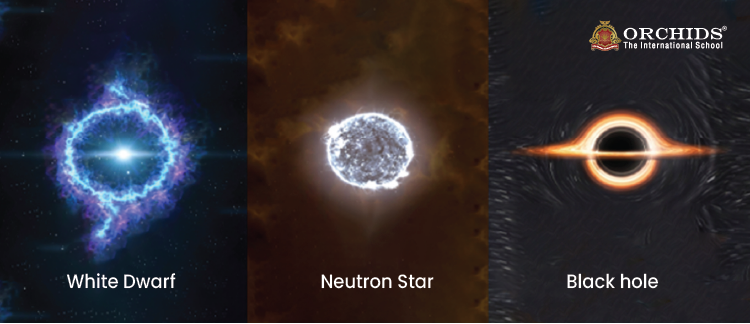
So, the limit helps scientists understand how different dead stars turn into white dwarfs, neutron stars, or black holes. It explains why not all stars end their lives the same way.
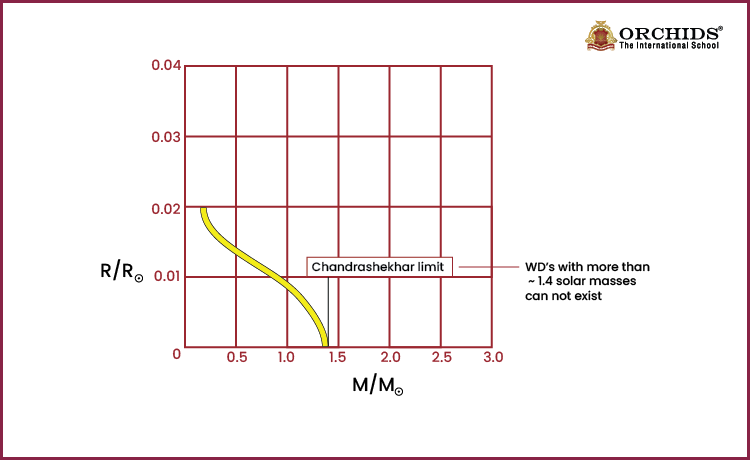
The Chandrasekhar Limit is the maximum mass a white dwarf can have and still stay stable. E.C. Stoner and Wilhelm Anderson first discussed it, and it was later named after Subrahmanyan Chandrasekhar, who improved the calculations.
At first, scientists ignored this idea because it supported the existence of black holes, which seemed impossible then. A white dwarf stays stable due to electron degeneracy pressure, which pushes against gravity.
But if the star becomes heavier than the limit, about 1.39 times the mass of the Sun, and this pressure cannot hold it up anymore, the star collapses further. The limit that has been established these days is 1.39 M☉.
This idea might sound difficult at first, so let's discuss it with a detailed explanation.
Pauli’s exclusion principle is a rule in quantum physics that says no two electrons can stay in the same energy state. Electrons follow this rule because they are a type of particle called fermions.
Because of this rule, electrons must spread out across different energy levels. When the gas of electrons inside a white dwarf is squeezed into a smaller space, more electrons get packed into the same volume. This forces some electrons to move to higher energy levels.
As a result, the electrons push back and create a force called electron degeneracy pressure. This pressure helps the white dwarf stay stable and stops it from collapsing under its own gravity.
But if the pressure becomes extremely high, something else happens: the electrons get pushed so hard that they are forced into the nuclei of atoms. This process is called electron capture.
Read More: Star
Significance of the Chandrasekhar Limit
- The Chandrasekhar Limit is about 1.44 times the mass of the Sun.
A white dwarf below this limit remains stable indefinitely. - A star exceeding this limit can explode as a supernova or collapse into a neutron star or black hole.
- It helps explain the properties and ultimate fate of white dwarfs.
- It is important for understanding the life cycle of stars and the evolution of galaxies.
- It is also used to confirm the existence of neutron stars and black holes.
Chandrasekhar limit Unit
The Chandrasekhar limit is the unit of measuring the maximum stable mass of a white dwarf star. This value is about 1.44 times the mass of the Sun. If a white dwarf grows heavier than this limit, it can no longer stay stable and may collapse into a neutron star or a black hole.
Let's discuss what the Chandrasekhar limit is for a neutron star.
The maximum Chandrasekhar limit for a neutron star is 3Msun, which means it can be up to three times the mass of the Sun before collapsing.
Applications of Chandrasekhar Limit
The Chandrasekhar Limit helps us understand what happens to stars when they run out of fuel. Its key applications are:
- When nuclei of lighter elements fuse to form heavier ones, they release heat. This heat stops the core of the star from collapsing.
- As the star uses up its fuel, its core becomes smaller, hotter, and more tightly packed.
- Fusion cannot produce energy from iron ions, so when iron builds up in the core, the star enters a dangerous stage.
- If the mass of stars is less than 8 times the mass of the Sun, its core will remain below the Chandrasekhar Limit.
- If the star is more massive, electron degeneracy pressure cannot hold it up forever. The core collapses further and may eventually turn into a black hole.
- During this collapse, electrons get captured by protons, creating neutrinos. These neutrinos carry away a huge amount of energy that's around 10⁴⁶ joules.
Till now, we have learnt that the Chandrasekhar Limit helps us understand how stars end their lives and why they become white dwarfs, neutron stars, or black holes. It is a key idea in astrophysics that explains the fate of dying stars and deepens our understanding of the universe.
Frequently Asked Questions on Chandrasekhar Limit
1. What is the Chandrasekhar limit?
The Chandrasekhar limit is the maximum mass a white dwarf can have before it becomes unstable and collapses. It helps scientists understand how stars end their life cycles in space.
2. Who discovered the Chandrasekhar limit?
The Chandrasekhar limit was discovered by Subrahmanyan Chandrasekhar, an Indian astrophysicist known for his groundbreaking work on stellar evolution. His discovery changed how we understand dying stars.
3. The Chandrasekhar limit is the unit of what?
The Chandrasekhar limit is the unit of measuring the maximum stable mass of a white dwarf star. It is usually expressed in solar masses to show how much mass a white dwarf can safely hold.
4. What is meant by the Chandrasekhar limit?
The Chandrasekhar limit is the maximum mass a white dwarf can have before it becomes unstable. If it crosses this limit, it can no longer support itself against gravity.
5. Who gave the Chandrasekhar limit?
The Chandrasekhar limit was given by Subrahmanyan Chandrasekhar, an Indian astrophysicist. His work helped scientists understand how stars end their lives.
6. What happens beyond the Chandrasekhar limit?
Beyond the Chandrasekhar limit, a white dwarf collapses because its pressure cannot balance gravity. This collapse can lead to a neutron star, black hole, or even a supernova.
7. What is 1 CSL?
1 CSL stands for 1 Chandrasekhar Unit, which is the maximum stable mass of a white dwarf. It is roughly equal to 1.44 times the mass of the Sun.
Science isn't just a subject, it's the way of seeing the world. Curious how Orchids The International School teaches it that way? Talk to our admissions team.
Admissions Open for 2026-27
What type of concept pages would you prefer?
CBSE Schools In Popular Cities
- CBSE Schools in Bangalore
- CBSE Schools in Mumbai
- CBSE Schools in Pune
- CBSE Schools in Hyderabad
- CBSE Schools in Chennai
- CBSE Schools in Gurgaon
- CBSE Schools in Kolkata
- CBSE Schools in Indore
- CBSE Schools in Sonipat
- CBSE Schools in Delhi
- CBSE Schools in Rohtak
- CBSE Schools in Bhopal
- CBSE Schools in Aurangabad
- CBSE Schools in Jabalpur
- CBSE Schools in Jaipur
- CBSE Schools in Jodhpur
- CBSE Schools in Nagpur
- CBSE Schools in Ahmednagar
- CBSE School In Tumkur











Orchids The International School is one of India's leading chains of CBSE and ICSE schools, with 110+ schools across the country.