

AC Generator
An AC Generator is a device that converts mechanical energy into electrical energy. You may wonder after knowing that these generators in power stations, which help produce the electricity that lights up our homes, charge our phones, and keep machines running. These generators play an important role in ensuring a continuous supply of electricity, making our daily tasks easier.
This article is a perfect guide for students to learn about the AC generator, how it is built, how it works, the AC generator working principle, and why it is so widely used.
Table of Contents
- What is an AC Generator?
- Construction of an AC Generator
- Parts of an AC Generator and Their Functions
- AC Generator Working Principle
- Advantages of Using AC Generators Over DC Generators
- Frequently Asked Questions on AC Generator

What is an AC Generator?
An AC Generator is a machine that changes mechanical energy into electrical energy. The input comes from machines like steam turbines, gas turbines, or engines, and the output is AC electricity, which is an electric current that keeps changing its direction.
You may wonder after knowing that, AC generators work on Faraday’s Law of Electromagnetic Induction, which says that when a conductor moves through a magnetic field, a voltage (EMF) is produced.
This can be achieved in two simple ways:
- A coil rotates inside a fixed magnetic field
- A magnetic field rotates around a fixed coil.
Here is something interesting to know: in most generators, the coil is kept stationary because it is easier to take out the generated electricity from a coil.
But here, the amount of EMF produced totally depends on:
- The number of turns in the coil
- The strength of the magnetic field
- The speed at which the magnetic field rotates
Now, let's discuss how exactly AC generators are constructed,
Construction of an AC Generator
The construction of an AC generator is very simple. It mainly includes a rotating coil, magnets, slip rings, brushes, and a frame to hold everything in place.
But here’s something interesting to think about: how are all these components actually arranged? Here is a reference AC generator diagram, which shows how the basic parts are arranged:
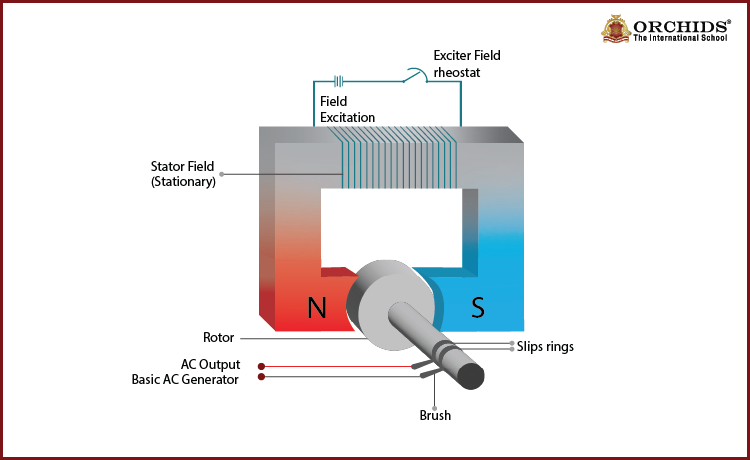
The AC generator diagram ensures that as the coil rotates between the poles of the magnet, it continuously cuts through magnetic field lines, which is what produces electricity.
Parts of an AC Generator and Their Functions
Let’s break down each part of the AC Generator, so you can understand its role inside the generator:
- The field consists of coils of wire that produce a magnetic flux when electricity passes through them. This magnetic field is very important because the armature coil cuts through these magnetic lines, which leads to the production of voltage.
- The armature is the part where electricity is actually produced. It is made up of strong wire coils designed to carry the full current of the generator. When the armature coil rotates inside the magnetic field, it generates an AC voltage.
- The prime mover is the machine that turns the generator. It could be a diesel engine, steam turbine, water turbine, or even a motor. The prime mover provided rotating motion to keep the generator working.
- The rotor is the rotating part of the generator. The prime mover spins the rotor, which allows the armature or the magnetic field to rotate and cut through magnetic lines of force.
- The stator is the stationary part of the generator, which is made of thin laminated steel sheets to reduce unnecessary heating caused by eddy currents.
- Slip rings are smooth metal rings connected to the rotating part of the generator. This ring transfers current between the rotating coil (rotor) and the external circuit.
Each part plays a specific and important role, and when they all work together, electricity is generated smoothly. Now, let's discuss how exactly electricity gets generated.
AC Generator Working Principle
To understand the principle of an AC generator, let’s connect the dots step by step.
The working AC generator principle is based on Faraday’s Law of Electromagnetic Induction, which says:
“Whenever a conductor moves in a magnetic field, an electric current is produced in it.”
Here’s what happens inside the generator:
- The armature coil is rotated using mechanical energy.
- As the coil spins between the magnetic poles, it cuts through magnetic field lines.
- This motion produces an induced current in the coil.
- Since the coil keeps rotating, the direction of current also keeps changing, and this is how AC (Alternating Current) is generated.
- The slip rings and brushes help deliver this current to the outer circuit.
Here, you will be amazed after knowing that a simple spinning movement is all it takes to power everything from street lights to school projectors!
Advantages of Using AC Generators Over DC Generators
AC generators are widely used because they offer several advantages:
- They are simpler in design, since slip rings are easier to maintain than a commutator.
- They generate AC, which can travel long distances with very little energy loss.
- They are more efficient, especially for large-scale power generation.
- Turbines (wind, water, steam) can easily drive them, making them ideal for power plants.
This is the reason why all big power stations use AC generators instead of DC generators.
Till now, we have learned what an AC generator is, construction of an AC generator by understanding how each component works to produce electricity. Overall, an AC generator may seem like a complex machine, but its working is simply systematic, and it shows us how mechanical energy is easily converted into electrical energy.
Frequently Asked Questions on AC Generator
1. What does an AC generator diagram show?
An AC generator diagram shows the main parts, like the coil, slip rings, brushes, and magnetic field. It helps you visually understand how electricity is produced inside the generator.
2. What is the principle of an AC generator?
The principle of the AC generator is based on electromagnetic induction, where a moving coil in a magnetic field generates current. It’s the same simple idea Faraday discovered, now powering our homes and machines.
3. What is the working of AC generator?
The working of an AC generator involves rotating a coil inside a magnetic field to create alternating current. As the coil spins, the direction of current keeps changing, giving us AC electricity.
4. Why is understanding an AC generator diagram important?
An AC generator diagram makes it easier to identify each component and how they work together. It’s like a map that helps you grasp the flow of energy inside the generator.
5. How does the principle of the AC generator help in real life?
The principle of the AC generator helps us produce electricity in power plants using turbines driven by water, wind, or steam. This simple scientific idea supports our daily life by keeping lights, fans, and appliances running.
6. How is the working of an AC generator different from a DC generator?
The working of an AC generator uses slip rings to produce an alternating current, while a DC generator uses a commutator for direct current. This difference changes the type of electricity we get, depending on the use.
Science isn't just a subject, it's the way of seeing the world. Curious how Orchids The International School teaches it that way? Talk to our admissions team.
Admissions Open for 2026-27
What type of concept pages would you prefer?
CBSE Schools In Popular Cities
- CBSE Schools in Bangalore
- CBSE Schools in Mumbai
- CBSE Schools in Pune
- CBSE Schools in Hyderabad
- CBSE Schools in Chennai
- CBSE Schools in Gurgaon
- CBSE Schools in Kolkata
- CBSE Schools in Indore
- CBSE Schools in Sonipat
- CBSE Schools in Delhi
- CBSE Schools in Rohtak
- CBSE Schools in Bhopal
- CBSE Schools in Aurangabad
- CBSE Schools in Jabalpur
- CBSE Schools in Jaipur
- CBSE Schools in Jodhpur
- CBSE Schools in Nagpur
- CBSE Schools in Ahmednagar
- CBSE School In Tumkur











Orchids The International School is one of India's leading chains of CBSE and ICSE schools, with 110+ schools across the country.