

Types of Circuits
Types of Circuits play a major role in deciding how electricity flows through different devices around us. Have you ever noticed how some lights in your home keep glowing even if one bulb fails, while others all switch off together? That happens because each device is connected using a different kind of circuit.
This article provides insights into what is electric circuit is, types of electrical circuits, in the simplest and most relatable way.
Table of Contents
- What is an Electric Circuit?
- Types of Electrical Circuits
- Difference between Series and Parallel Circuit
- Other Types of Circuits
- Frequently Asked Questions on Types of Circuits

What is an Electric Circuit?
An electric circuit is a closed path through which electric current flows. It allows electricity to be stored, moved, and changed so that different devices can work.
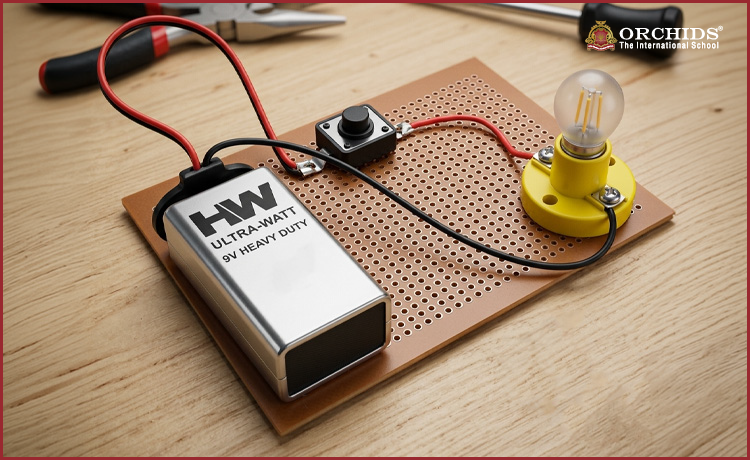
Energy enters the circuit through sources like cells or batteries and leaves through devices like bulbs, fans, or motors. In this, one form of energy gets transformed into another, such as chemical or mechanical energy, which is changed into electrical energy.
Here is something important to remember: An electric current moves because of the tiny charged particles, which are known as electrons.
Inside any electrical circuit, energy is carried by moving electric charges and supported by electric and magnetic fields.
Now we know what an electric circuit is and how current flows through it. Let's discuss types of circuits in detail.
Types of Electrical Circuits
Depending on how the components are connected and how the power source is arranged, circuits can be grouped into different types. Interestingly, in the most basic electrical setups, you will mainly find two important types of circuits: Series circuits and Parallel circuits. Let’s discuss them in detail!
Series Circuit
Series circuits are a type of circuit in which all the electrical components are connected one after another in a single line. This arrangement is also called an end-to-end or cascade connection.
In a series circuit, there is only one path for the current to travel. That is the reason why the same amount of current flows through every component placed in the circuit. Here is a series circuit diagram for your reference.
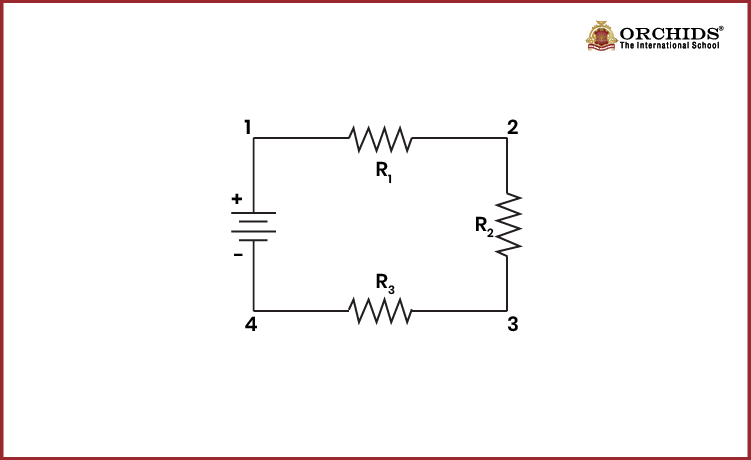
Now, let's discuss what kind of properties are followed by a series circuit.
Properties of Series Circuit
- In a Series Circuit, the same current flows through every component.
- The total voltage is the sum of the voltage used by each component. Mathematically, it can be represented by,
V = V₁ + V₂ + V₃ + …Vn
- The equivalent resistance is the sum of all the resistances of each component that is present in the electric circuit. And mathematically it can be expressed as,
- The equivalent electrical resistance is equivalent to the total of all individual resistances. And it can be expressed as,
From this, it can be concluded that the overall resistance of the circuit becomes higher than any single resistor.
Let’s connect this to a real-life situation. You must have observed somewhere that decorative string lights were wired in a series circuit. So if even one bulb fused, the entire chain went dark, just like how a whole train gets delayed if even one coach has a problem! Interesting!
Parallel Circuits
Parallel circuits are a type of circuit in which electrical components are connected side by side, or across the same two points. This creates two or more paths for the electric current to flow.
In a parallel circuit, the voltage across each component remains the same, no matter how many components are connected. However, the current divides and flows differently through each path, depending on the components present. Here parallel circuit diagram is shown.
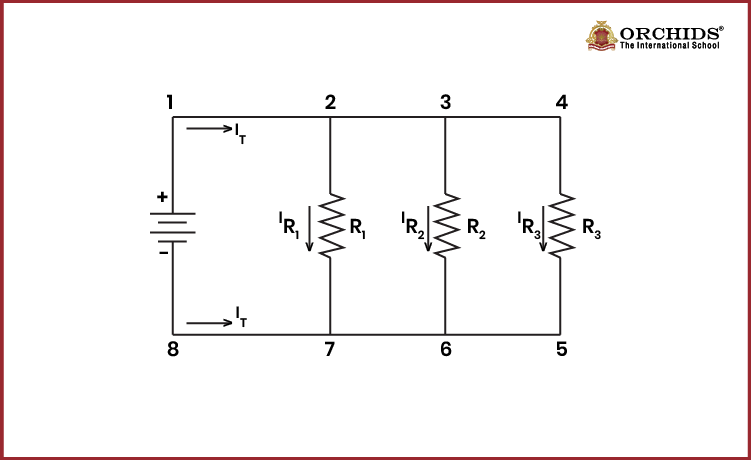
Let's try to understand this by comparing it with a real-life scenario, a road that splits into several lanes. Each car chooses its own lane and keeps moving without stopping others.
Similarly, in a parallel circuit, electric current flows through multiple paths independently, so if one path stops, the others keep working!
Now, let's move to properties of parallel circuits,
Properties of a Parallel Circuit
- All components get the same voltage (Potential Difference).
- The total current splits into branches can be expressed as,
I = I₁ + I₂ + I₃ + …In
- Here, the reciprocal of equivalent resistance is the sum of reciprocals of individual resistances.
- The overall resistance becomes lower than any individual resistor.
The equivalent conductance is the mathematical addition of the single conductances.
A perfect real-life example of a parallel circuit is your home wiring. All the appliances, lights, fans, TV, and chargers are connected in parallel. That’s why you can switch on the fan even if the light is off; each device gets its own separate path for the current to flow.
Here is something to remember: In a parallel circuit, the equivalent resistance is always smaller than the smallest resistance among all the resistors connected.
Combination Circuits
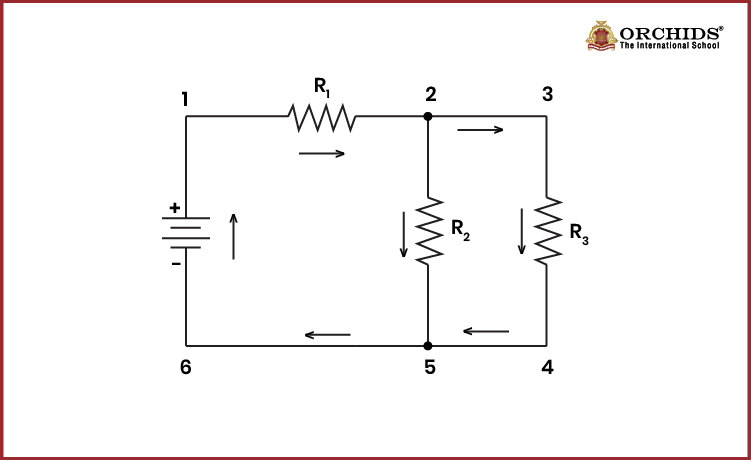
A combination circuit is also known as a series-parallel circuit. Combines both series and parallel connections in a circuit. This type of circuit is used when different voltage and current values are required from the same voltage source.
In the circuit diagram below, we can see that resistance and are connected in series, and is connected in parallel.
Properties of a Series-Parallel Circuit
- The same potential difference (voltage) is applied across all the resistances that are connected in parallel.
- The total current from the source gets divided among the parallel branches, with each branch carrying a portion of the current depending on its resistance.
- The total resistance of a series-parallel circuit is calculated by adding the series resistances directly, and then adding the equivalent resistance of the parallel section, which is obtained using the reciprocal formula for parallel resistances.
Difference between Series and Parallel Circuit
Here are the major differences between series and parallel circuits,
|
Basis of Comparison |
Series Circuit |
Parallel Circuit |
|
Path of Current |
There is only one path for the current to flow through all components. |
There are multiple paths available for the current to flow. |
|
Flow of Current |
The same current flows through every component in the circuit. |
The current splits into different paths depending on resistance. |
|
Effect on Voltage vs Current |
Voltage is divided among the components, while current remains the same. |
Voltage remains the same across each branch, while current divides. |
|
Daily-Life Impact |
If one component fails, the entire circuit stops working (e.g., old decorative lights). |
If one component fails, others continue to work (e.g., household wiring). |
Other Types of Circuits
Apart from series and parallel circuits, there are a few more types of circuits you may come across. These additional circuit types are explained below:
There are so many types of electric circuits used to represent electrical circuits. Let's discuss them one by one,
- An AC circuit uses alternating current, where the current and voltage change direction and magnitude continuously, making it ideal for long-distance power transmission.
- A DC circuit allows current to flow only in one direction, with a constant voltage, commonly used in batteries, solar cells, and electronic devices.
- An open circuit has a broken or incomplete path, so no current flows, like when a flashlight is switched off.
- A closed circuit has a complete path for current to flow, representing the “on” state of devices.
- A series-parallel circuit combines features of both series and parallel circuits to improve efficiency.
- A linear circuit has elements whose values remain constant regardless of changes in voltage or current.
- A non-linear circuit has elements whose characteristics change with changes in voltage or current.
- A unilateral circuit allows current to flow in only one direction, like in a diode rectifier.
So far, you have learned that electric circuits are the routes that allow electricity to flow and help our devices work. Series circuits have only one path, while parallel circuits offer multiple paths and are commonly used in real-life wiring.
Frequently Asked Questions on Types of Circuits
1. What is an electric circuit?
An electric circuit is a closed path through which electric current flows. It connects a power source, wires, and components so that electricity can move and make devices work.
2. What is a circuit in simple words?
A circuit is a path that allows electricity to travel from the power source to a device and back. When the path is complete, current flows; when it is open, current stops.
3. What are the main types of electrical circuits?
The five important types of electrical circuits are series circuits, parallel circuits, series-parallel circuits, AC circuits, and DC circuits. Each type controls the flow of current in a different way.
4. What are series and parallel circuits?
A series circuit has only one path for current to flow, so the same current passes through every component. A parallel circuit has multiple paths, allowing current to split and flow through different branches.
5. What is a series circuit diagram?
A series circuit diagram shows components connected one after another in a single line. It helps you understand how current flows through every component without splitting.
6. Why does a series circuit stop working if one component fails?
In a series circuit, all components lie on the same path. If one component breaks or disconnects, the entire path opens, and the current cannot flow, so the whole circuit stops working.
7. Why are parallel circuits used in home wiring?
Homes use parallel circuits because each appliance gets its own path for current flow. This ensures that if one device stops working, the others continue to operate safely and independently.
Science isn't just a subject, it's the way of seeing the world. Curious how Orchids The International School teaches it that way? Talk to our admissions team.
Admissions Open for 2026-27
What type of concept pages would you prefer?
CBSE Schools In Popular Cities
- CBSE Schools in Bangalore
- CBSE Schools in Mumbai
- CBSE Schools in Pune
- CBSE Schools in Hyderabad
- CBSE Schools in Chennai
- CBSE Schools in Gurgaon
- CBSE Schools in Kolkata
- CBSE Schools in Indore
- CBSE Schools in Sonipat
- CBSE Schools in Delhi
- CBSE Schools in Rohtak
- CBSE Schools in Bhopal
- CBSE Schools in Aurangabad
- CBSE Schools in Jabalpur
- CBSE Schools in Jaipur
- CBSE Schools in Jodhpur
- CBSE Schools in Nagpur
- CBSE Schools in Ahmednagar
- CBSE School In Tumkur











Orchids The International School is one of India's leading chains of CBSE and ICSE schools, with 130+ schools across the country.