

Composite Volcano
A Composite Volcano is a steep-sided, symmetrical cone of large dimensions that is made up of lava, ash, pumice, blocks, and tephra. Have you ever wondered why some volcanoes look like tall, sharp mountains while others are wide and flat? Imagine standing near a mountain that has been built slowly, layer by layer, over thousands of years. Sounds mysterious, right?
This article is a perfect guide to learn about composite volcanoes, their structure, and formation, with important characteristics.
Table of Contents
- What is a Composite Volcano?
- Characteristics of Composite Volcano
- Structure of Composite Volcano
- Formation of Composite Volcano
- Life Cycle of Composite Volcano
- Frequently Asked Questions on Composite Volcano

What is a Composite Volcano?
A composite volcano, also called a stratovolcano, is a tall, cone-shaped volcano made of alternating layers of lava, ash, pumice, tephra, and other volcanic materials. Its lava is thick and sticky, which is why it forms steep sides rather than spreading out like a shield.
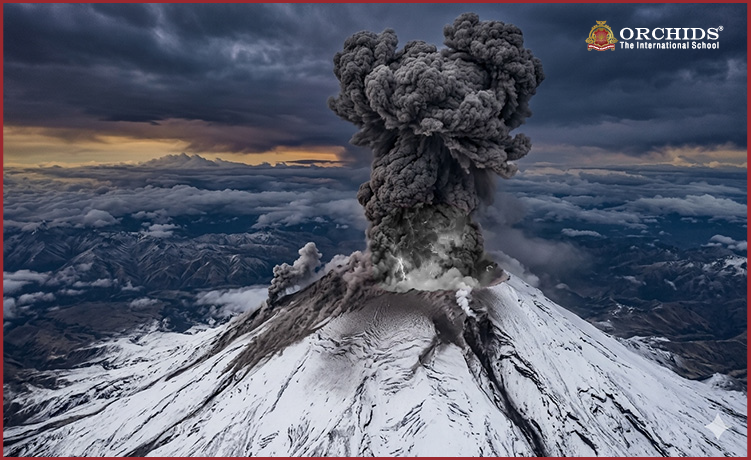
The Real-life composite volcano examples areMount Fuji (Japan), Mount Cotopaxi (Ecuador), Mount Hood (Oregon), and Mount St. Helens (Washington) are all famous composite volcanoes.
Now we know what a composite volcano is, so let's discuss what the composite structure of volcanoes looks like.
Characteristics of Composite Volcano
- Composite volcanoes are built from alternating layers of ash and hardened lava.
- Their eruptions are often violent, caused by high amounts of trapped gas in their thick magma.
- They have a classic cone-shaped appearance with steep sides.
- Their lava is highly viscous, meaning it is thick and does not flow easily, which helps build their tall, steep structure.
Structure of Composite Volcano
A composite volcano is built like a tall, layered mountain with a complex internal “plumbing system” that carries magma from deep underground to the surface. Its structure is what gives it its classic cone shape and makes it one of the most powerful among the types of volcanoes.
To understand a composite volcano, imagine slicing the mountain in half. Here is a composite volcano diagram for your reference.
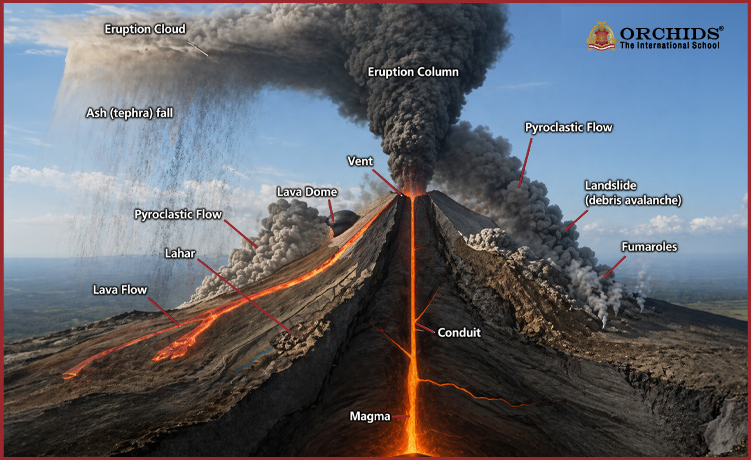
- At the summit, most composite volcanoes have a crater, a bowl-shaped depression formed by explosive eruptions. Beneath this crater lies the central vent, which is the main pathway through which magma rises to the surface.
- Composite volcanoes are made of alternating layers of hardened lava, ash, pumice, and volcanic rocks. These layers build up over many eruptions, making the volcano taller and stronger over time.
- The slopes of a composite volcano aresteep near the top and gently curved, which is almost like the sides of an ice-cream cone. This shape forms because the lava is thick and does not travel far before hardening.
- If the main vent becomes blocked, magma finds other pathways. This creates side vents and fissures on the slopes. Lava domes or small cones may also form on the flanks of the volcano.
- Deep inside, a Conduit System Inside the Volcano, which is a network of channels through which magma moves upward. This system connects the magma chamber below to the central and side vents above.
- The magma chamber sits far beneath the volcano and works like a reservoir that feeds molten rock upward. Every eruption draws magma from this chamber through the conduit system.
- Over time, solidified lava in cracks acts like supporting ribs, strengthening the cone from within. This helps the volcano hold its shape even after many eruptions.
Formation of a Composite Volcano
A composite volcano does not appear all at once; it slowly grows through thousands of years of repeated eruptions. Each eruption adds a new layer, shaping the volcanoes into the tall and steep mountains we see today.
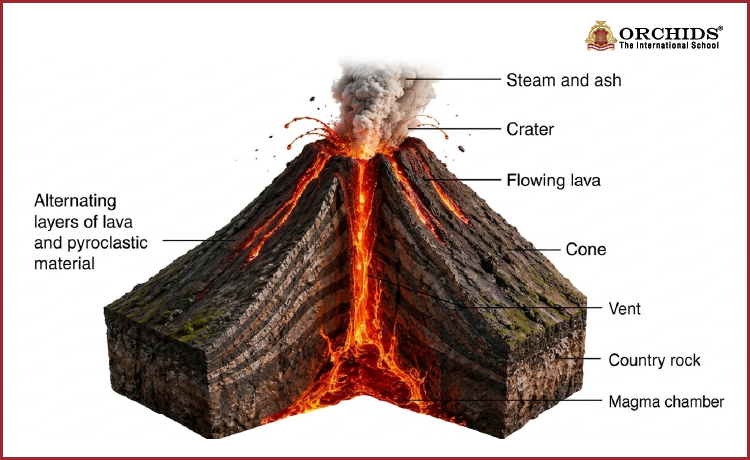
Let's try to understand the formation step by step.
- In the first step, magma rises from deep underground. Beneath the crust of Earth, a reservoir of molten rock (magma) begins to move upward. It travels through a conduit system that leads toward the Earth’s surface.
- In the next one, repeated explosive eruptions build layers. When the volcanic eruption happens, it releases lava, ash, pumice, and rock fragments. Some eruptions send out thick lava flows, while others blast out clouds of ash and debris. These materials settle and harden in layers.
- Later in the third step, the cone grows taller and steeper because the lava from a composite volcano is thick and sticky, so it doesn’t travel far. Instead, it piles up near the vent. Over time, these repeated layers of lava and ash build a high, steep-sided cone.
- In the fourth step formation of lava domes and side vents. Sometimes the thick lava forms lava domes in or around the crater. If the central vent becomes blocked, magma finds new paths and erupts from side vents on the volcano’s slopes.
- After a massive eruption, the volcano may lose so much material that the top collapses inward, forming a large bowl-shaped depression called a caldera. This caldera can later become the starting point for new volcanic activity.
- At last,most composite volcanoes are born at subduction zones, where one tectonic plate slides underneath another. This melting of the sinking plate produces magma that feeds the volcano.
You may wonder after knowing that, the regions like the Pacific Ring of Fire and parts of the Mediterranean are full of these volcanoes.
Life Cycle of a Composite Volcano
- The Rise of Magma: Deep inside the Earth, hot molten rock (magma) begins to rise through a narrow pathway called the conduit system.
When it reaches the surface, it erupts and starts forming the first layers of a volcanic cone.
As lava flows outward, it spreads over the surrounding land, slowly building the volcano’s base.
- Active Volcanic Activity: The interesting fact about this is the busy, dramatic stage among all! The volcano continues to erupt again and again over hundreds or even thousands of years. Each eruption adds new layers of lava, ash, and rock, helping the volcano grow taller and wider.
As the layers pile up, a high, steep cone forms, and lava flows create a broad plateau around the base.
- Eroding Cone: Eventually, the volcano becomes quiet. When eruptions stop, nature takes over. Wind, rain, rivers, and weather slowly begin to wear down the cone. Over thousands of years, the sides of the volcano erode and reveal the strong, hardened volcanic plug inside the conduit.
During this long resting phase, nearby streams widen their valleys and cut through the old lava layers, reshaping the entire landscape.
- Final Remains: After a very long time, erosion removes almost all traces of the original cone.
Only the exposed volcanic plug, small remaining pieces of the old volcano, and the lava plateau that once supported it.
So far, we have learntlearned that composite Volcanoes are among the most fascinating and powerful landforms on Earth. Built slowly over thousands of years, they rise as towering, cone-shaped mountains made from alternating layers of lava, ash, pumice, and volcanic debris. Their unique structure, explosive nature, and long life cycle make them both awe-inspiring and important to study.
Frequently Asked Questions on Composite Volcano
1. What is a composite volcano?
A composite volcano is a tall, cone-shaped mountain made of layered ash and solidified lava. It forms through repeated, powerful eruptions over thousands of years.
2. What are some composite volcano examples?
Famous composite volcano examples include Mount Fuji, Mount St. Helens, and Mount Rainier. These volcanoes are known for their steep sides and explosive histories.
3. What does a composite volcano diagram show?
A composite volcano diagram usually shows the central vent, crater, magma chamber, and layered structure. It helps students understand how lava, ash, and rocks build the volcano over time.
4. What is the difference between a composite and shield volcano?
A composite volcano has steep sides and explosive eruptions because its lava is thick and sticky. A shield volcano has gentle slopes and quiet eruptions since its lava flows easily and spreads far.
5. What are three famous composite volcanoes?
Three well-known composite volcanoes are Mount Fuji in Japan, Mount St. Helens in the USA, and Mount Cotopaxi in Ecuador. All of them are tall, cone-shaped mountains built from layers of lava and ash.
6. What are the 5 characteristics of composite volcanoes?
Composite volcanoes have steep sides, thick lava, explosive eruptions, layered structure, and long periods of dormancy. Their cone-shaped form grows through repeated eruptions of lava, ash, and rocks.
Science isn't just a subject, it's the way of seeing the world. Curious how Orchids The International School teaches it that way? Talk to our admissions team.
Admissions Open for 2026-27
What type of concept pages would you prefer?
CBSE Schools In Popular Cities
- CBSE Schools in Bangalore
- CBSE Schools in Mumbai
- CBSE Schools in Pune
- CBSE Schools in Hyderabad
- CBSE Schools in Chennai
- CBSE Schools in Gurgaon
- CBSE Schools in Kolkata
- CBSE Schools in Indore
- CBSE Schools in Sonipat
- CBSE Schools in Delhi
- CBSE Schools in Rohtak
- CBSE Schools in Bhopal
- CBSE Schools in Aurangabad
- CBSE Schools in Jabalpur
- CBSE Schools in Jaipur
- CBSE Schools in Jodhpur
- CBSE Schools in Nagpur
- CBSE Schools in Ahmednagar
- CBSE School In Tumkur











Orchids The International School is one of India's leading chains of CBSE and ICSE schools, with 130+ schools across the country.