

Refraction and Dispersion of Light through a Prism
The Refraction and Dispersion of Light through a prism are among the most important phenomena in physics. These phenomena help us understand the true nature of light and explain why sunlight splits into a spectrum of colours.
To us, white light looks like a single colour. But when it passes through a prism, it spreads out into seven bright colours, just like a mini rainbow! This simple prism trick helps explain how light travels, bends, and creates colourful effects in nature.
This article is a complete guide to learn about the refraction of light, how it bends when moving between media, and how a prism can separate white light into its seven different colours in detail.
Table of Contents
- What is Refraction of Light?
- Refraction of Light Through a Glass Prism
- Dispersion of Light Through a Prism
- Understanding Visible Light Spectrum
- Newton's Prism Experiment
- Frequently Asked Questions on Refraction and Dispersion of Light through a Prism

What is the Refraction of Light?
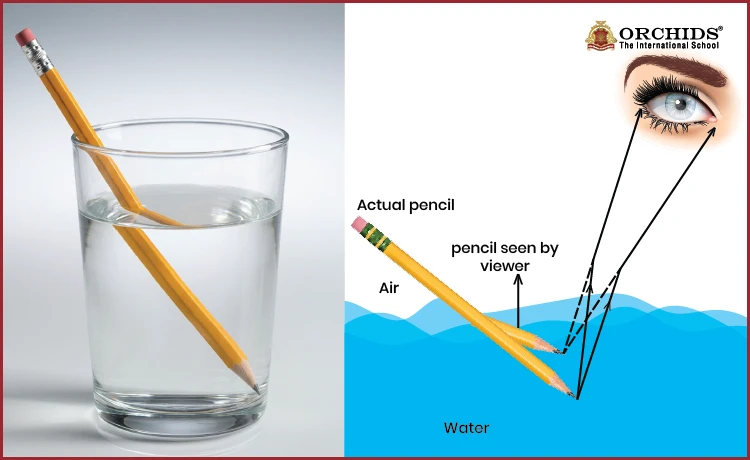
Have you ever wondered why light suddenly changes direction when it enters water, glass, or even a prism? This bending happens because light changes its speed when it moves from one medium to another. And this change in speed causes the light ray to bend. This phenomenon is known as the Refraction of light.
Refraction of Light Through a Glass Prism
A glass prism is a transparent solid with two triangular bases and three rectangular sides, tilted at specific angles.
When a beam of light enters the prism, something interesting happens. Let's try to understand this by using a ray diagram,
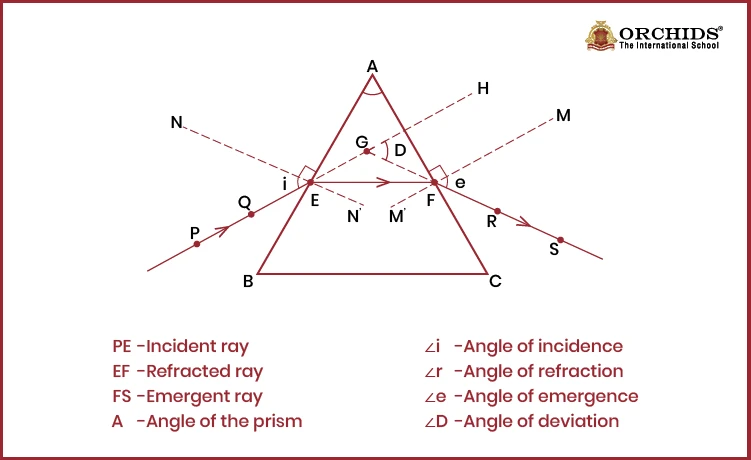
According toSnell’s law, in the above ray diagram, we can see, light bends towards the normal when it moves from a rarer medium (air) to a denser medium (glass).
So, when the incident ray PE enters the prism, it bends towards the normal NE.
Inside the prism, the ray travels to the second surface. As it moves from glass back into air, the emergent ray FS bends away from the normal.
The angle between the original incident ray and the final emergent ray is called the angle of deviation (∠HDS). When the angle of incidence equals the angle of emergence, this deviation becomes minimum. In this condition, ∠PEN = ∠MES, and the refracted ray EF becomes parallel to side BC.
Now that you have understood how light bends, let’s see what happens when white light passes through a prism.
Dispersion of Light Through a Prism
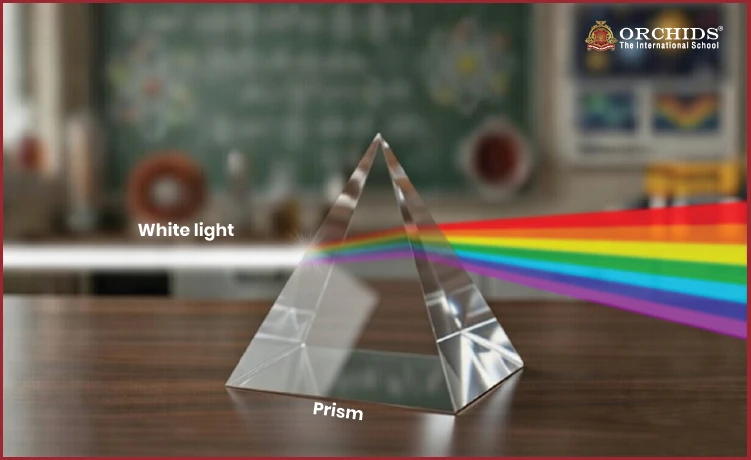
In very simple language, Dispersion is the process of splitting white light into seven colours that is violet, indigo, blue, green, yellow, orange, and red (VIBGYOR) due to refraction. There are many ways to understand this phenomenon, but mostly commonly it can be achieved through dispersion in a prism.
Going further, the question arises: Why Does White Light Split into Seven Colours?
Light splits into various colours as the speed of light changes when light passes from one medium to another. Every colour has its own different wavelength. Interesting!
As it is observed from the above ray diagram, Violet colour bends the most, and red colour bends the least.
Since every colour bends by a different amount, they slowly spread apart inside the prism. By the time they emerge, the white light has separated into its seven components.
That’s how a simple glass prism reveals the hidden rainbow inside white light. Interesting!
Understanding Visible Light Spectrum
You might wonder why white light splits into a rainbow of colours in a prism but not in a glass slab?
Interestingly, light does experience a tiny amount of dispersion even in a glass slab, but we usually can’t see it clearly. To understand why, let’s recall a key concept:
The refractive index of a material is not constant; it changes slightly for different colours (or wavelengths) of light.
Let's discuss refraction in a glass slab vs a prism
When white light enters either a prism or a glass slab, it undergoes refraction twice, first when it moves from air into glass, and then again when it exits back into air.
- In a glass slab, both surfaces are parallel. So, while the colours spread slightly inside, they all recombine as the light exits, making the emerging light appear white again.
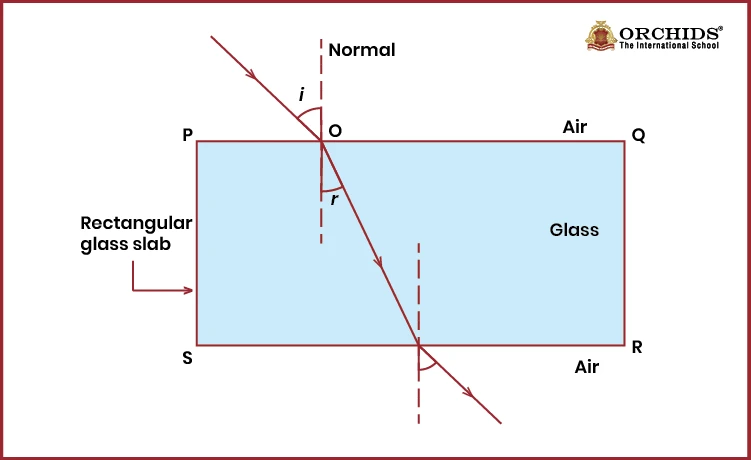
- In a prism, however, the two surfaces are not parallel. Because of this angled structure, the light rays don’t overlap perfectly when they exit. Instead, they spread out in different directions, forming a beautiful spectrum of seven colours.
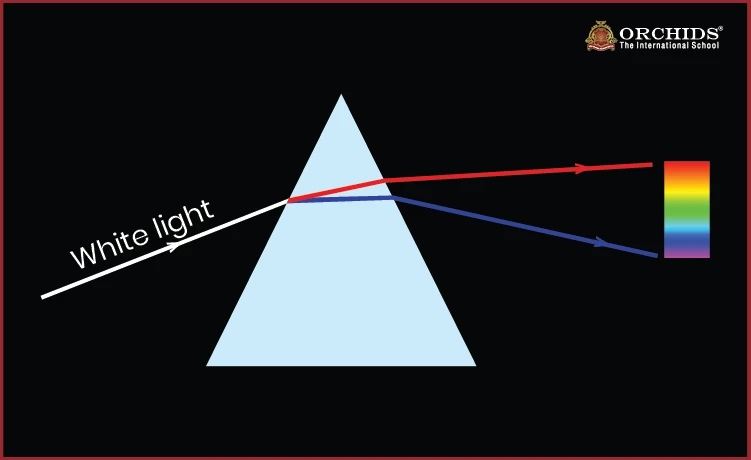
But why do We See a Spectrum in a Prism?
We already know that when white light passes through a prism, it gets dispersed into a wide range of colours. Each colour has a specific wavelength, as you can see in the image below:
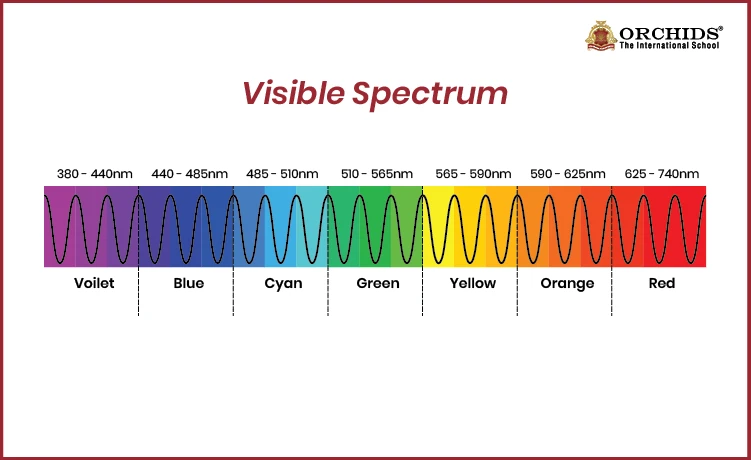
This is why you see dispersion clearly in a prism but not in a glass slab; it’s all about the geometry of the surfaces and how each colour bends at a different angle.
- The glass slab has Parallel surfaces, so Colours recombine and produce white light that emerges
- Prism has Angled surfaces, so colours diverge and the Visible spectrum forms
Understanding this helps explain why prisms are used in optics experiments and spectroscopy, while glass slabs simply transmit light without producing a rainbow effect.
From this, it can be concluded that when light passes from one medium to another, it bends due to a change in its speed; this phenomenon is called refraction.
On the other hand, dispersion happens when white light splits into its constituent colours because different wavelengths bend by different amounts. So, while refraction bends a single ray, dispersion spreads it into multiple colours.
Now there is a question: how did it all begin? Who was the first to uncover the reason behind the colourful phenomenon of nature?
Newton's Prism Experiment
In the 17th century, Sir Isaac Newton was the first to demonstrate the dispersion of light using a prism.
Newton initially noticed that white light splits into many colours when it passes through a prism. Curious about this result, he wanted to confirm whether these colours were produced by the prism itself or were already present in the light.
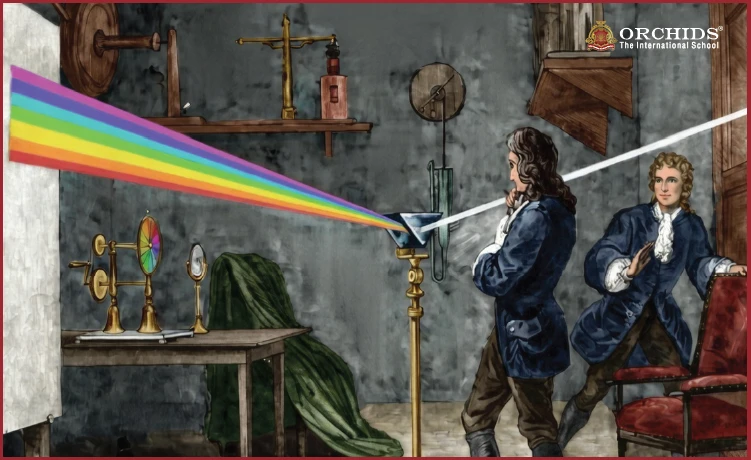
To test this, he allowed only a single colour from the dispersed spectrum to pass through another prism by narrowing the slit of light. This time, the ray did not split any further; it only bent, showing that each colour of light is pure and has its own wavelength.
From this, Newton concluded that different colours of light bend by different amounts while passing through a prism. Violet light, having the shortest wavelength, bends the most, while red light, with the longest wavelength, bends the least.
This experiment opened the door to the world of modern optics by helping us to know how light really works.
In this article, so far, we have learned that refraction and dispersion of light through a prism beautifully demonstrate the wave nature of light. When light passes through different media, it refracts, and when it passes through a prism, it splits into its constituent colours due to dispersion.
Frequently Asked Questions on Refraction and Dispersion of Light through a Prism
1. Why does violet light bend more than red light in a prism?
Violet light has a shorter wavelength, so it slows down more in glass, resulting in a greater angle of deviation.
2. Can dispersion occur in media other than prisms?
Yes, dispersion occurs in any medium where light travels at different speeds depending on its wavelength, such as water droplets or thin films.
3. What is the importance of Newton's prism experiment?
It showed that white light is not pure but a mixture of colours, leading to a better understanding of optics and the visible spectrum.
4. How is the refractive index related to dispersion?
The refractive index varies with wavelength. A higher refractive index for shorter wavelengths (violet) causes them to bend more, producing dispersion.
5. What is the refraction and dispersion of light by a prism?
Refraction is the bending of light as it passes from one transparent medium to another due to a change in its speed. Dispersion, on the other hand, refers to the splitting of white light into its component colours when it passes through a prism.
Science isn't just a subject, it's the way of seeing the world. Curious how Orchids The International School teaches it that way? Talk to our admissions team.
Admissions Open for 2026-27
What type of concept pages would you prefer?
CBSE Schools In Popular Cities
- CBSE Schools in Bangalore
- CBSE Schools in Mumbai
- CBSE Schools in Pune
- CBSE Schools in Hyderabad
- CBSE Schools in Chennai
- CBSE Schools in Gurgaon
- CBSE Schools in Kolkata
- CBSE Schools in Indore
- CBSE Schools in Sonipat
- CBSE Schools in Delhi
- CBSE Schools in Rohtak
- CBSE Schools in Bhopal
- CBSE Schools in Aurangabad
- CBSE Schools in Jabalpur
- CBSE Schools in Jaipur
- CBSE Schools in Jodhpur
- CBSE Schools in Nagpur
- CBSE Schools in Ahmednagar
- CBSE School In Tumkur











Orchids The International School is one of India's leading chains of CBSE and ICSE schools, with 110+ schools across the country.