

What is Mechanical Energy and Its Examples for Class 5
Mechanical Energy plays an important role in our daily lives, from the movement of vehicles to the energy stored in objects at a height. It helps us understand how objects move and how energy is stored and used.
We come across mechanical energy in many real-life situations, making it an important concept to learn. In this article, we will understand what is mechanical energy, its forms, and mechanical energy examples.
Table of Contents
- What is Mechanical Energy?
- Forms of Mechanical Energy
- Real-Life Mechanical Energy Examples
- Frequently Asked Questions on Mechanical Energy

What is Mechanical Energy?
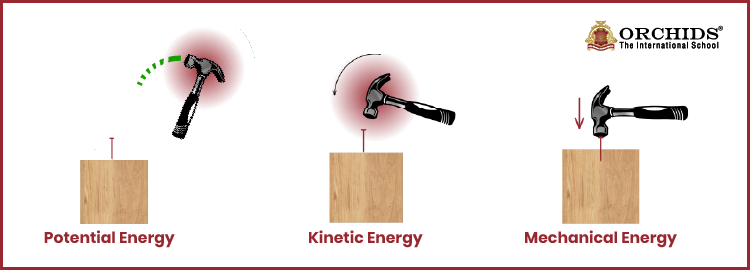
Mechanical energy is the sum of an object's kinetic (motion) and potential (stored) energy. It shows how an object can do work.
The energy in our muscles, the energy possessed by a moving object, and the energy of an object kept at some height from the surface of the Earth are some examples of mechanical energy.
Forms of Mechanical Energy
Mechanical energy can be divided into different types based on how the energy is stored or used. Let’s understand its main forms. There are two Forms of Mechanical energy:
- Kinetic energy
- Potential energy
Let's discuss them in detail.
Kinetic Energy
The energy possessed by moving objects is called kinetic energy.
The word kinetic means to move and hence energy possessed by an object due to its movement is called kinetic energy. Moving cars, rolling balls, running people, etc. all possess kinetic energy.
Potential Energy
When an object is raised to some height from the surface of the earth, energy gets stored in it.
Similarly, when we pull a rubber band or compress a spring, energy gets stored in them. This stored energy which originates due to the position of the object is called potential energy.
The word potential means to have the ability to do an action. As the energy stored in the objects has the ability to apply force, the energy stored in them is called potential energy.
Real-Life Mechanical Energy Examples
Some common examples of mechanical energy are a swinging pendulum, a moving vehicle, a stretched bowstring, flowing water, a falling object, and a spinning flywheel.
- Roller Coaster: At the top of the hill, it has high potential energy. As it moves down, this changes into kinetic energy.
- Moving Vehicle: A car driving on the road has kinetic energy because it is moving.
- Wrecking Ball: A wrecking ball lifted up has stored (potential) energy.
- Pendulum: A swinging pendulum keeps changing between potential and kinetic energy.
- Windmills: Moving air (wind) turns the blades and creates mechanical movement.
- Hammering a Nail: A moving hammer has kinetic energy that helps push the nail into the surface.
So far, we have learned that mechanical energy is one of the most common forms of energy we see in our daily lives. It includes both the energy of moving objects (kinetic energy) and the energy stored in objects due to their position (potential energy). From a moving car to a ball placed on a height, mechanical energy is always working around us.
Frequently Asked Questions on Mechanical Energy
1. What is mechanical energy in simple terms?
Mechanical energy is the energy possessed by an object due to its motion or position.
2. What are the forms of mechanical energy?
The two main forms of mechanical energy are kinetic energy and potential energy.
3. What is kinetic energy in easy language?
Kinetic energy is the energy possessed by an object due to its motion.
4. What is potential energy?
Potential energy is the stored energy in an object due to its position or condition.
5. What are some examples of mechanical energy?
Examples include a moving car, a rolling ball, a running person, and an object placed at a height.
Science isn't just a subject, it's the way of seeing the world. Curious how Orchids The International School teaches it that way? Talk to our admissions team.
Admissions Open for 2026-27
What type of concept pages would you prefer?
CBSE Schools In Popular Cities
- CBSE Schools in Bangalore
- CBSE Schools in Mumbai
- CBSE Schools in Pune
- CBSE Schools in Hyderabad
- CBSE Schools in Chennai
- CBSE Schools in Gurgaon
- CBSE Schools in Kolkata
- CBSE Schools in Indore
- CBSE Schools in Sonipat
- CBSE Schools in Delhi
- CBSE Schools in Rohtak
- CBSE Schools in Bhopal
- CBSE Schools in Aurangabad
- CBSE Schools in Jabalpur
- CBSE Schools in Jaipur
- CBSE Schools in Jodhpur
- CBSE Schools in Nagpur
- CBSE Schools in Ahmednagar
- CBSE School In Tumkur











Orchids The International School is one of India's leading chains of CBSE and ICSE schools, with 110+ schools across the country.