

Refraction of Light: Definition, Laws, Examples and Applications
Refraction of light is the most important and interesting phenomenon of physics. Have you ever wondered how you see the world so clearly? Or why does a rainbow appear in the sky after rain? When light enters our eyes, it bends through the cornea and lens to form a sharp image. Without this bending, everything would look blurry. Refraction also creates beautiful effects like rainbows. When sunlight passes through tiny water droplets, it bends and splits into seven colours, forming the bright arc we see after rain.
This article provides insight into the refraction of light, its laws, types, real-time examples, and applications. But first of all, let's see what it actually is!
Table of Contents
- What is Refraction of Light?
- Refraction of Light through a Rectangular Glass Slab
- What are the Causes of Refraction?
- Understanding Refractive Index
- Real-Life Examples of Refraction of Light
- Frequently Asked Questions on Refraction of Light

What is Refraction of Light?
The fact about the phenomenon is that the change in the direction of a light ray when it passes from one medium to another is due to the change in the speed of light, which is known as Refraction of light.”
Take a straw and put it in an empty glass. Now slowly, slowly pour water into the glass. Now have a look at the straw from the side, not from the top. Surprised?
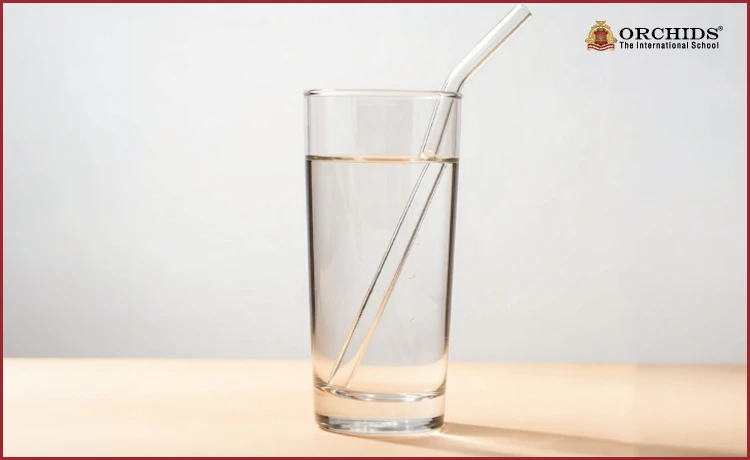
When you take a look at it from the side, it seems broken at the surface of the water! It's not magic, it happens because of the refraction of light!
When the straw is partly dipped in water, the part inside the water looks displaced. This happens because the light coming from the submerged part changes direction as it moves from water into air. Our eyes simply follow these bent rays backward, making the straw appear as if it is at a different position.
Now imagine replacing the water with kerosene or turpentine. The straw will still appear shifted, but not by the same amount. Different substances bend light differently, which is why the displacement changes each time.
From this, it can be concluded that light does not travel in the same way through all materials.
When a ray of light travels from one medium to another, its speed changes. Because of this change in speed, the light ray bends.
- When light enters a denser medium, it bends towards the normal.
- When it enters a rarer medium, it bends away from the normal.
Refraction of Light Through Rectangular Glass Slab
Let’s understand how refraction of light works with a simple and fun activity. To make it simple, let’s take a rectangular glass slab as an example. This will help you clearly see how the light ray changes its path when it moves from air to glass and then back to air again.
- Take a white sheet of paper and place a rectangular glass slab on it.
- Trace the outline of the slab and label it ABCD.
- Now take two pins, say E and F, and fix them upright near side AB.
- Move to the opposite side of the slab and try to look at the images of pins E and F through the glass.
- To match their images, place two more pins, G and H, in such a way that pin G, pin H, and the images of E and F appear to lie in one straight line.
- Once you have aligned them properly, gently remove all the pins and lift the glass slab.
- Join the points E and F, and extend the line until it touches side AB. Mark this point as O.
- Now do the same with points G and H. Extend their line back to side CD and mark the point where it meets as O’.
- Finally, join O to O’ to show the path of the light ray through the slab.
What Does This Activity Show?
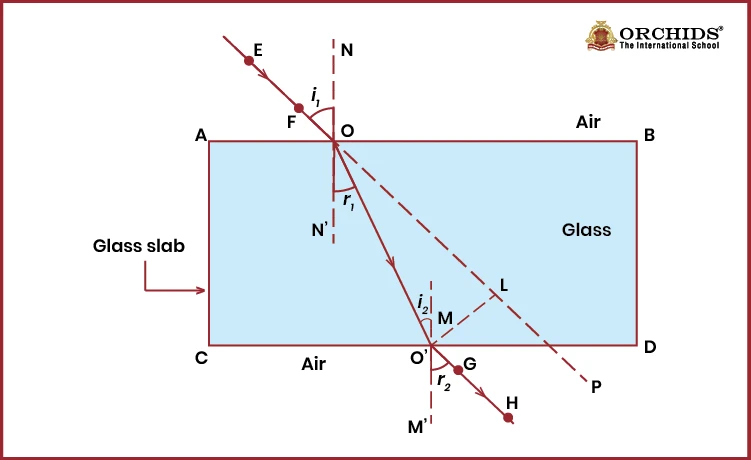
In the above setup, the light ray coming from pin E towards the glass slab is called the incident ray. Here we can clearly see, as soon as the incident ray reaches point O, the ray bends! What is the reason behind this? Because it is moving from air into glass. So, it bends towards the normal.
When the ray reaches point O’ on the other side, it leaves the glass and moves back into the air. Here it bends again, but this time away from the normal, because it is moving from a denser medium to a rarer one.
In the diagram:
- EO is the incident ray
- OO’ is the refracted ray inside the glass
- O’H is the emergent ray
The emergent ray (O’H) is parallel to the incident ray (EO), even though it got bent twice!
This simple activity shows that refraction happens because the speed of light changes when it travels from one transparent material to another. Now that we’ve seen how light behaves when it passes through a convex mirror, let’s take a closer look at the laws that are responsible for the reflection.
Laws of Refraction of Light
The laws of refraction of light are:
- The incident ray, the refracted ray, and the normal all lie in the same plane.
- The ratio of the sine of the angle of incidence and the angle of refraction is constant.
Where, i = angle of incidence,
r =angle of refraction
This second law is more commonly known as Snell’s Law, which provides a quantitative relationship between the angles of incidence and refraction for light passing from one medium to another.
Snell’s Law can be expressed as,
where, i = angle of incidence
r = angle of refraction,
n = refractive index
refractive index of medium 1
refractive index of medium 2
= speed of light in medium 1
speed of light in medium 2
Now, we know that refraction is a natural phenomenon, but certain factors cause it to occur. Let's discuss what exactly they are.
What are the Causes of Refraction?
Here are some of the main causes behind the refraction of light.
- Refraction happens when light enters a new medium at an angle with a different refractive index.
- It occurs when the refracted ray is weaker than the incident ray.
- Light bends because its speed and wavelength change in the new medium.
Have you ever wondered why light changes direction differently depending on where it travels? Let’s look at the types of refraction that explain this behaviour.
Understanding Refractive Index
The refractive index measures how much light bends when it enters a medium.
Refractive index is a ratio of the speed of light in a vacuum, ‘c’, to the speed of light in a medium, ‘v’. Refractive index is denoted by ‘n’.
Read More: Refractive Index
Have you ever wondered how nature plays with the laws of refraction? To know how it plays, keep reading!
Real-Life Examples of Refraction of Light
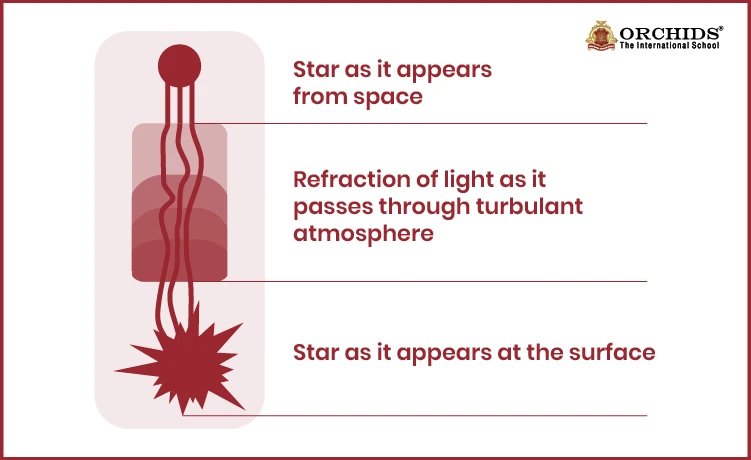
- Twinkling of Stars happens when the light coming from stars undergoes several refractions before reaching the Earth.
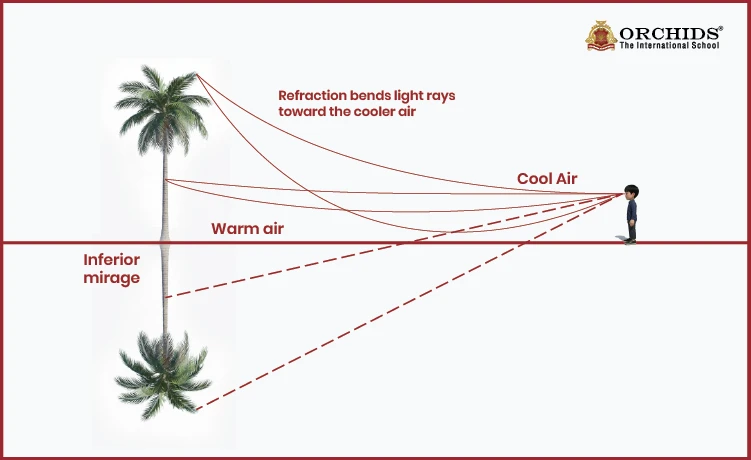
- Mirage is a naturally occurring illusion caused by the refraction of light in a layer of hot air, which makes water appear shimmering.
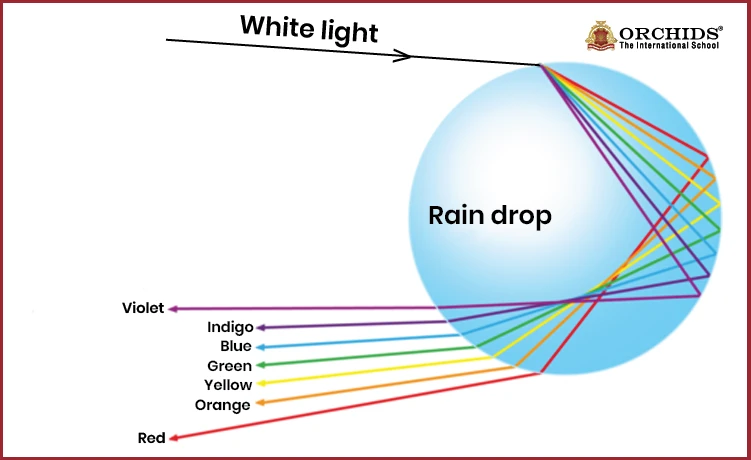
- At the time of the formation of a rainbow, sunlight enters through raindrops, it refracts, reflects inside the droplet, and emerges as a spectrum.
Real-Life Examples of Refraction of Light
- Optical instruments, like cameras, microscopes, binoculars, and telescopes, rely on lenses to focus light.
- Eyeglasses and contact lenses Correct vision by bending light appropriately.
- In Fiber Optics, Light bends inside cables, enabling high-speed data transmission.
Till now, you have learned that refraction is not just a classroom concept; it shapes technologies, natural phenomena, and even our daily vision.
Frequently Asked Questions on Refraction of Light
1. What is Refraction of Light?
Refraction of light is the bending of light rays when they pass from one medium to another due to a change in the speed of light.
2. How many types of refraction are there?
There are mainly two types of refraction:
- From rarer to denser medium when light bends toward the normal.
- From denser to rarer medium when light bends away from the normal.
3. What are the best examples of refraction?
Common examples include: A straw appears bent in water, the twinkling of stars, the formation of rainbows, and Mirages on hot roads.
4. Why does light bend when passing from one medium to another?
Because its speed changes depending on the density of the medium, causing the light ray to change direction.
5. What is the difference between reflection and refraction?
- Reflection: Light bounces off a surface.
- Refraction: Light bends as it passes through a medium.
6. Why does a straw appear broken in water?
Light bends at the surface of the water, making the submerged part of the straw appear displaced.
7. How is refractive index related to refraction?
The refractive index shows how much light bends when entering a medium. A higher refractive index means light slows down and bends more.
Science isn't just a subject, it's the way of seeing the world. Curious how Orchids The International School teaches it that way? Talk to our admissions team.
Admissions Open for 2026-27
What type of concept pages would you prefer?
CBSE Schools In Popular Cities
- CBSE Schools in Bangalore
- CBSE Schools in Mumbai
- CBSE Schools in Pune
- CBSE Schools in Hyderabad
- CBSE Schools in Chennai
- CBSE Schools in Gurgaon
- CBSE Schools in Kolkata
- CBSE Schools in Indore
- CBSE Schools in Sonipat
- CBSE Schools in Delhi
- CBSE Schools in Rohtak
- CBSE Schools in Bhopal
- CBSE Schools in Aurangabad
- CBSE Schools in Jabalpur
- CBSE Schools in Jaipur
- CBSE Schools in Jodhpur
- CBSE Schools in Nagpur
- CBSE Schools in Ahmednagar
- CBSE School In Tumkur











Orchids The International School is one of India's leading chains of CBSE and ICSE schools, with 110+ schools across the country.