

Right Hand Thumb Rule in Physics: Description and Applications Explained with Diagram
The right-hand thumb rule helps us find the direction of the magnetic field produced by an electric current. The strength and direction of this magnetic field depend on the amount and direction of the current. Have you ever wondered how electric motors, generators, and electromagnets know which way their magnetic fields should point? Interestingly, the magnetic field lines form concentric circles around the conductor and remain perpendicular to it.
This article explains Maxwell's right-hand thumb rule, who invented the right-hand thumb rule, its working, applications, and examples in easy-to-follow language.
Table of Contents
- What is the Right-Hand Thumb Rule
- How to Apply the Right-Hand Thumb Rule
- Applications of the Right-Hand Thumb Rule
- Frequently Asked Questions on Right-Hand Thumb Rule

What is the Right-Hand Thumb Rule
The right-hand thumb rule, which is also known as Maxwell's right-hand thumb rule, is a simple method for determining the direction of the magnetic field around a current-carrying conductor.
According to the right-hand thumb rule,
|
“If a current-carrying conductor is held in the right hand such that the thumb points in the direction of current, then the curled fingers indicate the direction of the magnetic field lines around the conductor.” |
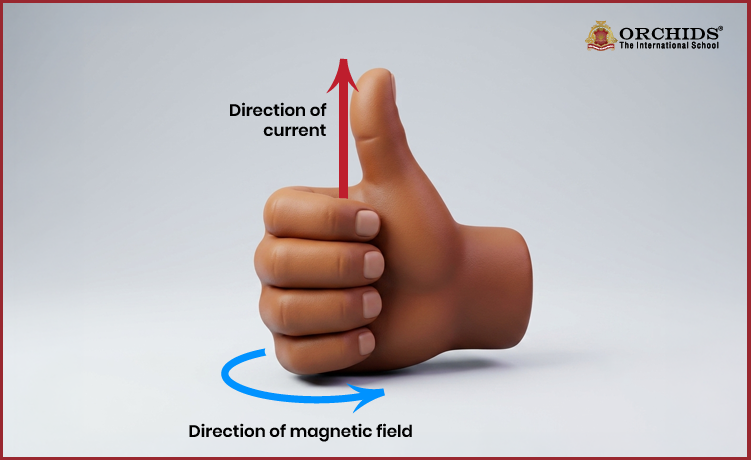
So, it is simply a rule that connects the direction of the electric current with the direction of the magnetic field produced around the conductor.
Who Invented the Right-Hand Thumb Rule
The right-hand thumb rule was not invented by a single scientist. It is a scientific convention developed from the study of electromagnetism by several physicists over time. The foundation of this concept was laid by Hans Christian Ørsted, who discovered that an electric current produces a magnetic field. Later, André-Marie Ampère studied the relationship between electricity and magnetism in detail.
The work of Scottish physicist James Clerk Maxwell further developed the theory of electromagnetism and helped standardise directional rules used in physics.

Today, the right-hand thumb rule is used to determine the direction of the magnetic field around a current-carrying conductor.
How to Apply the Right-Hand Thumb Rule
Applying the right-hand thumb rule is very simple. Follow these steps,
- Hold the conductor with your right hand.
- Point your thumb in the direction of the electric current.
- Curl your fingers around the conductor.
- The direction of the curled fingers gives the direction of the magnetic field lines.
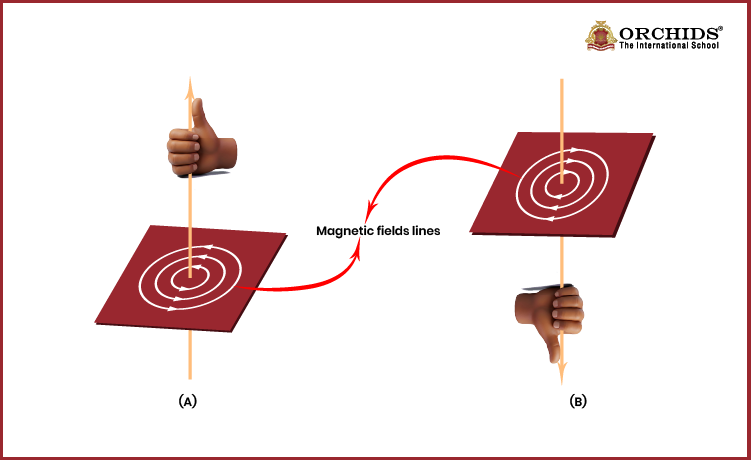
What do Figures (A) and (B) Show?
- Figure (A): Current flows upward through the conductor. The magnetic field circles the wire in an anticlockwise direction when viewed from above.
- Figure (B): Current flows downward through the conductor. The magnetic field direction follows the curled fingers according to the right-hand rule.
The image also shows that,
- The magnetic field lines are concentric circles around the wire.
- These circles lie in a plane perpendicular (90°) to the conductor.
- The conductor passes through the common centre of all the magnetic field circles.
So, in simple words,
- Thumb → Direction of current
- Curled fingers → Direction of magnetic field lines
The fact is that magnetic field lines always form concentric circles around a straight conductor.
Applications of the Right-Hand Thumb Rule
The right-hand thumb rule is widely used to determine the direction of the magnetic field produced by an electric current. When the thumb of the right hand points in the direction of the current, the curled fingers show the direction of the magnetic field lines around the conductor.
Important Applications of the Right-Hand Thumb Rule
- Finding the magnetic field around a straight conductor: It helps determine whether the magnetic field around a current-carrying wire is clockwise or anticlockwise.
- Studying circular loops and solenoids: The rule is used to find the direction of the magnetic field inside a circular loop or a solenoid and to identify the north and south poles of an electromagnet.
- Designing and analysing electromagnets: Engineers use this rule while designing devices such as electric bells, relays, and magnetic cranes.
- Working of electric motors and generators: The rule helps explain the relationship between current and magnetic fields in electrical machines.
- Solving numerical and directional problems in magnetism: Many problems involving current-carrying conductors, coils, and magnetic fields use the right-hand thumb rule.
- Understanding magnetic effects of current: The rule explains how electricity produces magnetism and forms the basis of several concepts in electromagnetism.
- Applications in vector physics: It is also used to determine the direction of vector quantities such as magnetic force, torque, and angular momentum.
In this article, we learned that Maxwell's right-hand thumb rule is a simple method for finding the direction of magnetic field lines around a current-carrying conductor. We also explored its applications in straight wires, circular loops, solenoids, and vector physics.
Frequently Asked Questions on Right-Hand Thumb Rule
1. What is the right-hand thumb rule in physics?
The right-hand thumb rule states that when the thumb points in the direction of current, the curled fingers show the direction of the magnetic field around the conductor.
2. Who invented the right-hand thumb rule?
The rule is commonly associated with James Clerk Maxwell, while Hans Christian Oersted discovered the connection between electricity and magnetism.
3. Why do we use the right-hand thumb rule?
The right-hand thumb rule helps determine the direction of magnetic field lines produced by electric current in wires, loops, and solenoids.
4. Can the left hand be used instead of the right hand?
No. Using the left hand gives the opposite direction and produces an incorrect result.
5. Does the right-hand thumb rule work for solenoids?
Yes. In a solenoid, the curled fingers follow the current and the thumb points toward the magnetic field inside the coil.
6. What is the shape of magnetic field lines around a straight conductor?
The magnetic field lines form concentric circles around the conductor.
7. Where is the right-hand thumb rule used in daily life?
The rule is useful in electric motors, generators, loudspeakers, and electromagnets used in many electrical devices.
Science isn't just a subject, it's the way of seeing the world. Curious how Orchids The International School teaches it that way? Talk to our admissions team.
Admissions Open for 2026-27
What type of concept pages would you prefer?
CBSE Schools In Popular Cities
- CBSE Schools in Bangalore
- CBSE Schools in Mumbai
- CBSE Schools in Pune
- CBSE Schools in Hyderabad
- CBSE Schools in Chennai
- CBSE Schools in Gurgaon
- CBSE Schools in Kolkata
- CBSE Schools in Indore
- CBSE Schools in Sonipat
- CBSE Schools in Delhi
- CBSE Schools in Rohtak
- CBSE Schools in Bhopal
- CBSE Schools in Aurangabad
- CBSE Schools in Jabalpur
- CBSE Schools in Jaipur
- CBSE Schools in Jodhpur
- CBSE Schools in Nagpur
- CBSE Schools in Ahmednagar
- CBSE School In Tumkur











Orchids The International School is one of India's leading chains of CBSE and ICSE schools, with 110+ schools across the country.