

Difference Between Lagging and Leading Strand
The difference between lagging and leading strands is one of the most important topics to understand in DNA replication. DNA replication is central to the flow of genetic information, allowing cells to copy and pass on DNA during division. As the double helix unwinds, each original strand separates and acts as a template for building a new complementary strand.
This article explains how this happens and what is the difference between leading and lagging strands in detail.
Table of Contents
- What is DNA Replication?
- Difference Between Lagging and Leading Strand
- Frequently Asked Questions On Difference Between Lagging and Leading Strand

What is DNA Replication?
Just think, how do new cells end up with the same genetic instructions as the original cell?
And this happens because of DNA; it’s a bit interesting, right?
So, how does a cell make a perfect copy of its DNA before dividing? Let’s discuss.
This is done through DNA replication.
Enzymes like helicase and topoisomerase help unwind the double helix, forming a replication fork, a Y-shaped site where the new DNA strands begin to form.
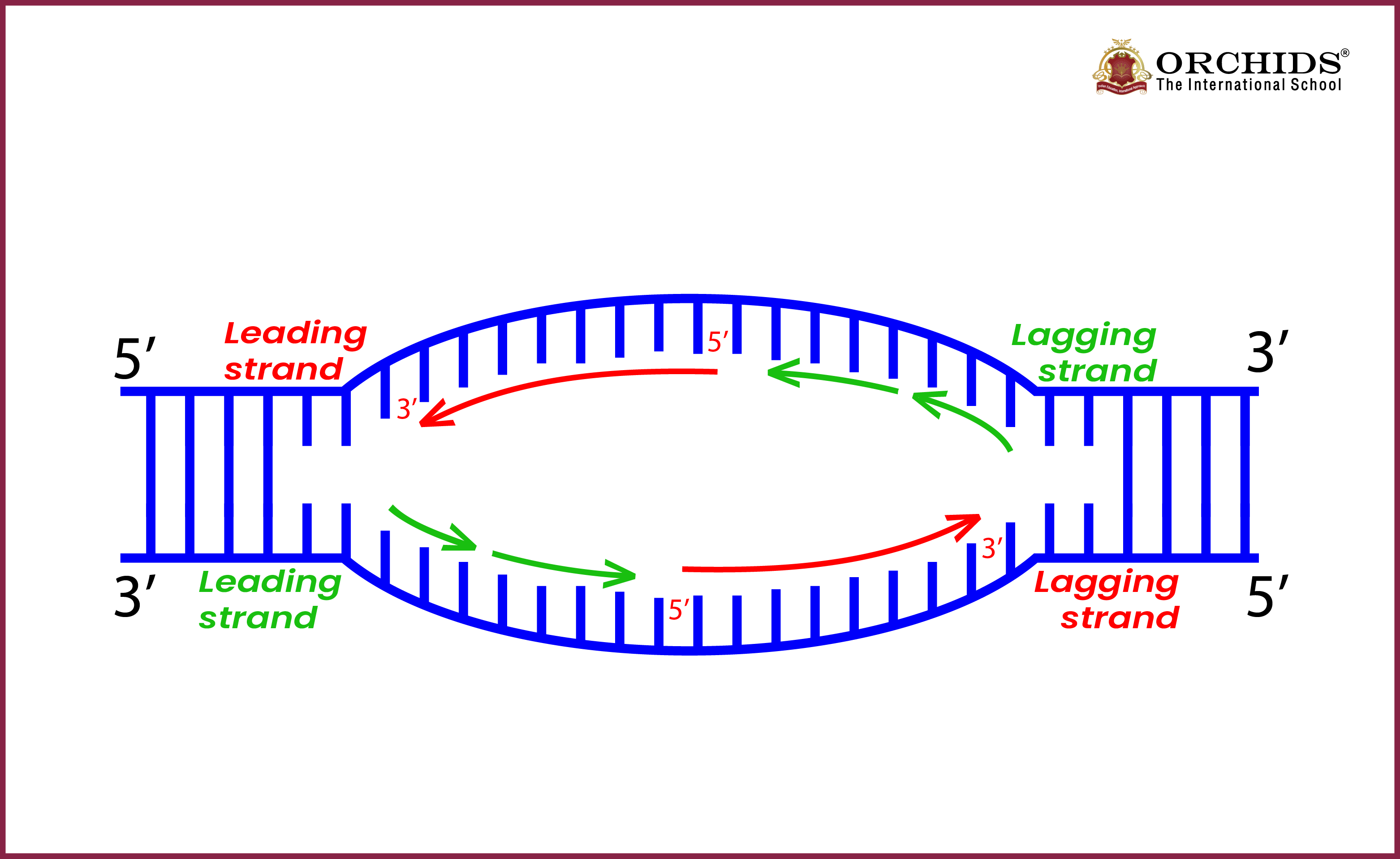
And what happens next? One strand, called the leading strand, is built continuously in the 5’ to 3’ direction, following the unwinding DNA.
Interestingly!! It starts with a single RNA primer, and DNA polymerase adds nucleotides smoothly, almost like laying bricks in a straight line, without much help from DNA ligase.
But what about the other strand?
That’s the lagging strand, and it can’t be made all at once. Its template runs opposite to the direction DNA polymerase works, so it’s built in short segments called Okazaki fragments.
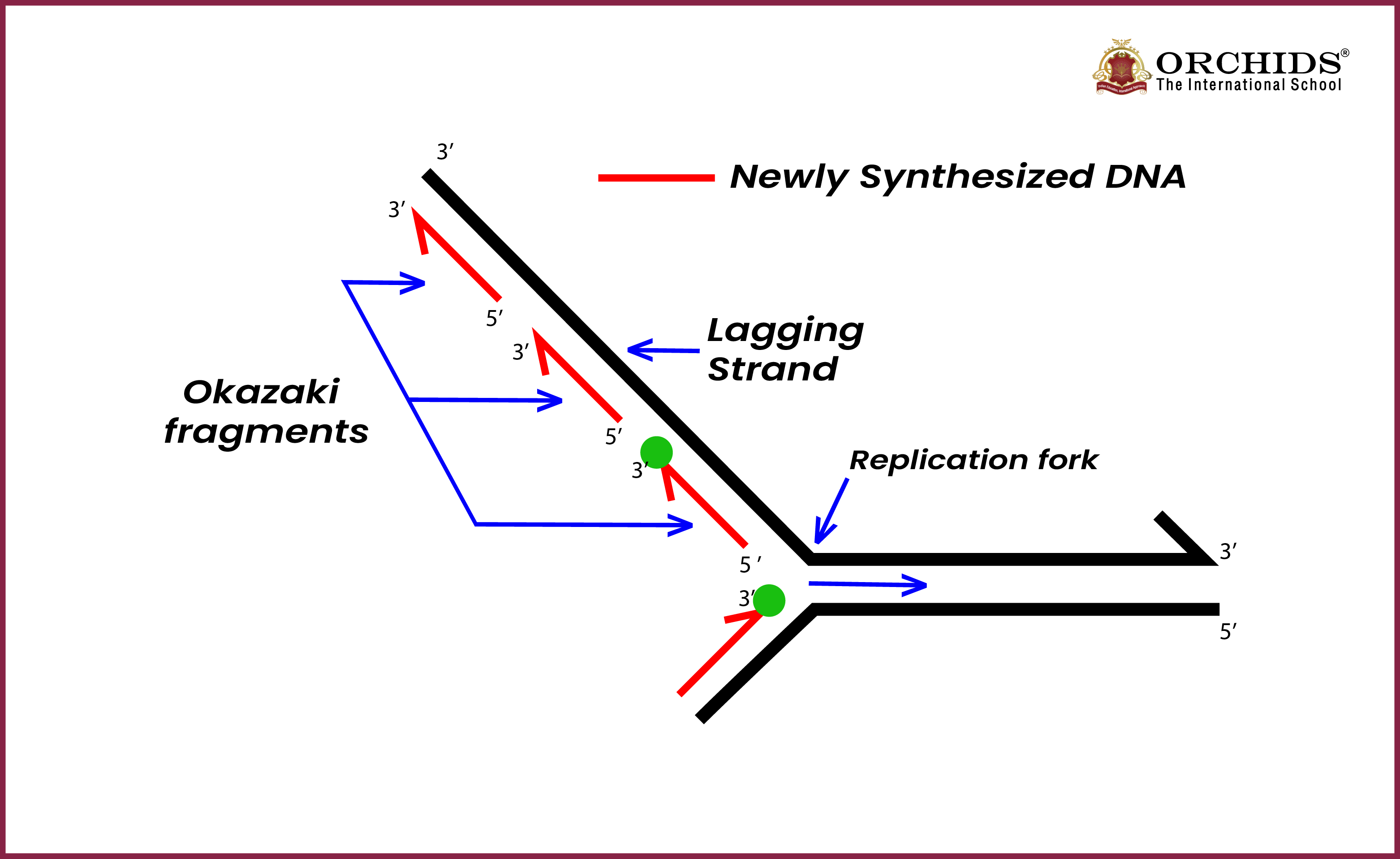
Each fragment begins with an RNA primer, and DNA polymerase assembles them away from the replication fork. Later, DNA ligase joins these fragments into a continuous strand.
So, why is this important?
Let’s find out.
Because through this careful and coordinated process, the cell produces two identical DNA molecules, each carrying the complete genetic code.
DNA replication ensures that every new cell receives an exact copy of DNA, keeping the genetic instructions intact and life continuing smoothly from one generation to the next.
Difference Between Lagging and Leading Strand
Here’s a simple comparison table that highlights the difference between lagging and leading strands during DNA replication:
|
Feature |
Leading Strand |
Lagging Strand |
|
Direction of Synthesis |
Synthesised continuously in the 5’ → 3’ direction |
Synthesised discontinuously in the 3’ → 5’ direction (as Okazaki fragments) |
|
Template Orientation |
3’ → 5’ template strand |
5’ → 3’ template strand |
|
Replication Mode |
Continuous |
Discontinuous |
|
Primer Requirement |
Needs only one RNA primer |
Requires multiple RNA primers |
|
DNA Polymerase Movement |
Moves toward the replication fork |
Moves away from the replication fork |
|
Okazaki Fragments |
Absent |
Present |
|
Ligase Requirement |
Rarely needed |
Required to join fragments |
|
Replication Speed |
Faster |
Slower |
|
Complexity |
Simple and smooth |
Complex and stepwise |
|
Direction of Growth |
Toward the replication fork |
Away from the replication fork |
To learn about what is the difference between leading and lagging strands, take a look at the visual given below.
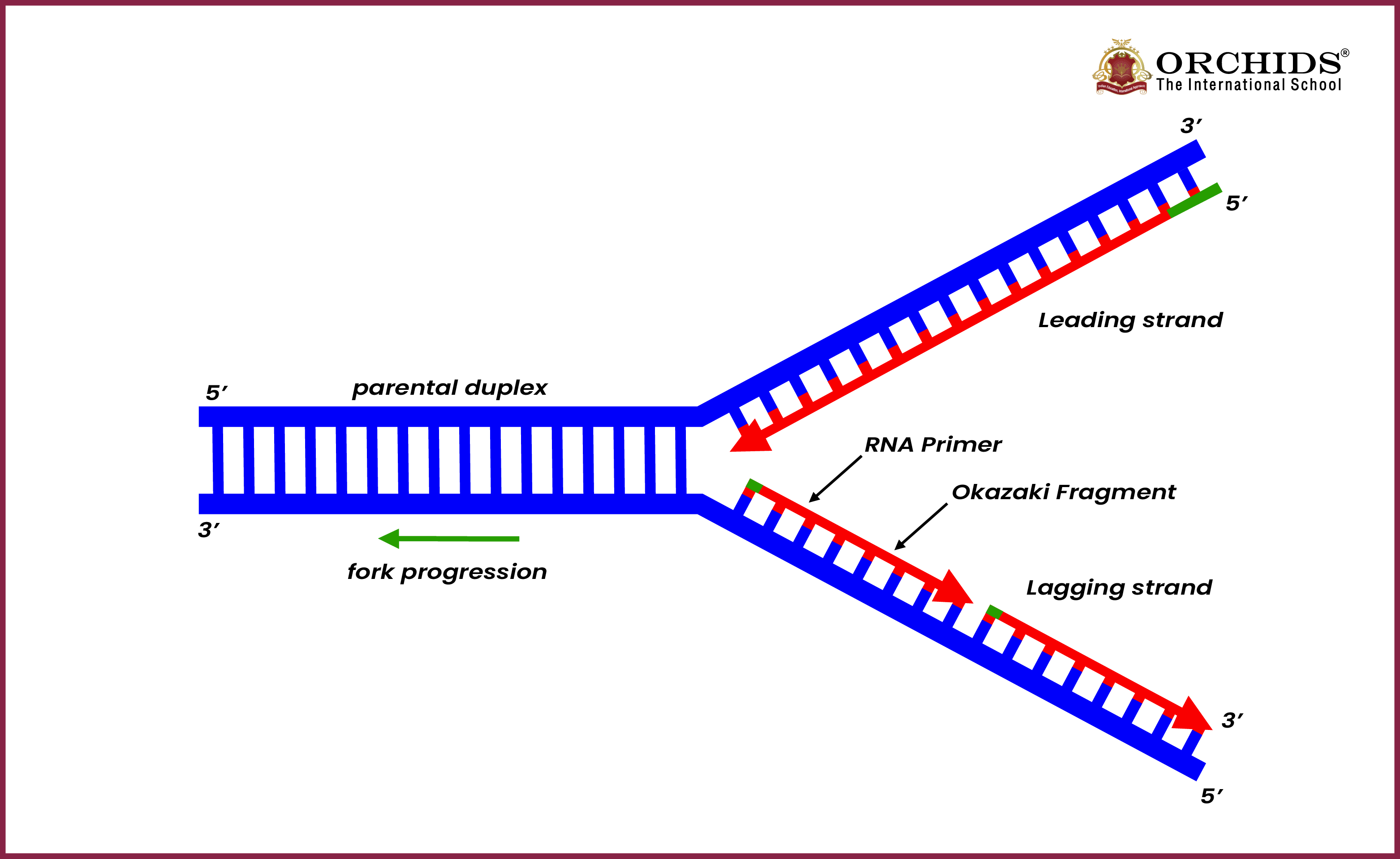
So far in this article, we have learnt what is the difference between leading and lagging strands and how it helps you see finely coordinated and precise DNA replication truly is.
While the leading strand moves smoothly toward the replication fork, the lagging strand works in a step-by-step manner to catch up. Together, they ensure that DNA is copied accurately, allowing cells to divide with the correct genetic information every single time.
Frequently Asked Questions On Difference Between Lagging and Leading Strand
1. What is the difference between leading and lagging strand?
The leading strand is synthesised continuously toward the replication fork, while the lagging strand is synthesised discontinuously away from the fork in short Okazaki fragments.
2. Why is the leading strand continuous?
The leading strand is continuous because DNA polymerase can move in the same direction as the replication fork, i.e., 5’ to 3’.
3. Why is the lagging strand discontinuous?
Because DNA polymerase can only synthesise in one direction, it has to keep starting over as more of the lagging template is exposed, creating Okazaki fragments.
4. Lagging vs leading strand: Why is understanding the difference important?
It helps explain how DNA replication maintains genetic accuracy and how enzymes coordinate to ensure complete DNA synthesis.
5. Does the lagging strand need multiple primers?
Yes, each Okazaki fragment needs a new RNA primer to start synthesis.
6. What role does DNA ligase play in the lagging strand?
DNA ligase seals the gaps between Okazaki fragments to form a continuous strand.
7. Lagging vs leading strand: which strand is replicated faster?
The leading strand is replicated faster because it proceeds continuously.
Science isn't just a subject, it's the way of seeing the world. Curious how Orchids The International School teaches it that way? Talk to our admissions team.
Admissions Open for 2026-27
What type of concept pages would you prefer?
CBSE Schools In Popular Cities
- CBSE Schools in Bangalore
- CBSE Schools in Mumbai
- CBSE Schools in Pune
- CBSE Schools in Hyderabad
- CBSE Schools in Chennai
- CBSE Schools in Gurgaon
- CBSE Schools in Kolkata
- CBSE Schools in Indore
- CBSE Schools in Sonipat
- CBSE Schools in Delhi
- CBSE Schools in Rohtak
- CBSE Schools in Bhopal
- CBSE Schools in Aurangabad
- CBSE Schools in Jabalpur
- CBSE Schools in Jaipur
- CBSE Schools in Jodhpur
- CBSE Schools in Nagpur
- CBSE Schools in Ahmednagar
- CBSE School In Tumkur











Orchids The International School is one of India's leading chains of CBSE and ICSE schools, with 110+ schools across the country.