

Diagram of Stomata
A diagram of stomata helps us learn the detailed insights of how plants breathe. Just like humans exchange gases through their lungs, plants do the same through tiny openings called stomata.
These minute pores might look simple, but they perform one of the most important tasks in plants, regulating the exchange of gases like carbon dioxide and oxygen and controlling water loss through transpiration.
In this article, you’ll learn about the diagram of stomata, its structure, types, and functions, explained in simple and clear ways.
Table of Contents
- What is Stomata?
- How To Draw a Labelled Diagram of Stomata
- Draw a Diagram of Open and Closed Stomata
- Frequently Asked Questions On Diagram of Stomata

What is Stomata?
In simple words, stomata are tiny openings on the surface of leaves that help plants breathe and stay alive. You can think of them as little mouths that open and close depending on the plant’s needs.
So, what exactly do they do?
Let’s understand.
When stomata open, they allow carbon dioxide to enter the leaf for photosynthesis, the process that helps plants make food. At the same time, oxygen , which is produced during photosynthesis, is released into the air.
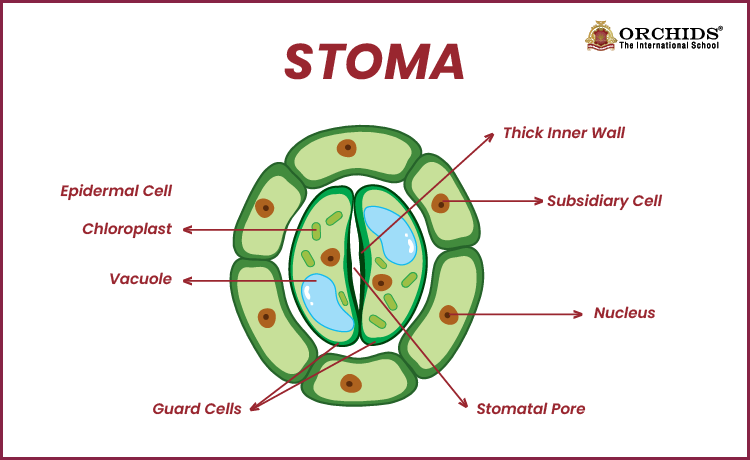
But that’s not all; water vapour also escapes through these pores, helping in cooling and water balance.
If we trace the process in a simple line, it goes like this:
goes in → Photosynthesis happens → and water vapour go out
Here’s a fun fact: a single leaf can have thousands of stomata, mostly on the lower surface, to prevent too much water loss.
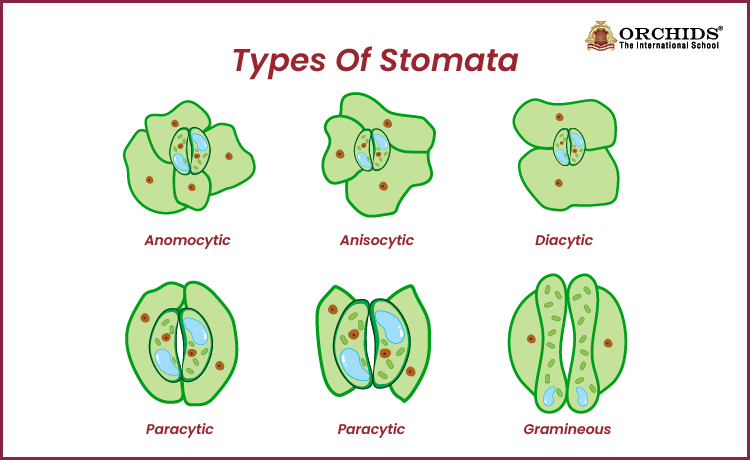
And depending on how the surrounding cells are arranged, stomata come in five main types:
-
Anomocytic stomata have no clearly defined surrounding cells and are commonly found in Ranunculaceae plants.
-
Anisocytic stomata, surrounded by three unequal subsidiary plant cells, are often seen in Cruciferae.
-
Paracytic stomata have two subsidiary cells positioned parallel to the opening and are typically found in Acanthaceae.
-
Diacytic stomata feature two subsidiary cells placed at right angles to the pore, seen in Caryophyllaceae.
-
Gramineous stomata are recognised by their unique dumbbell-shaped guard cells, which are a key feature in grasses.
Now the next question is: how to draw a labelled diagram of stomata to show this process clearly?
How To Draw a Labelled Diagram of Stomata
Here’s the simple way to think about how to draw a labelled diagram of stomata:
When you draw a stomata diagram, imagine you’re zooming in on the surface of a leaf to see how plants actually breathe.
What looks like a tiny dot to the eye is, in fact, a small opening surrounded by special cells that work together to manage air and moisture.
To get a clear picture, take a look at a labelled diagram of stomata. it shows each part neatly marked, helping you understand how gas exchange and water control happen at the cellular level.
Now, let’s break down each part in the order you’d label it in your diagram:
1. Epidermal Cells, which form the outer protective layer of the leaf. You can think of them as the plant’s natural shield, reducing water loss and keeping internal tissues safe.
2. Subsidiary Cells, found next to the guard cells, these act as supporting units. They help the guard cells function properly by maintaining water and ion balance during the opening and closing of stomata.
3. Guard Cells, these are the key components that surround the pore. In dicot plants, they are kidney-shaped, while in monocots, they appear dumbbell-shaped. Guard cells are unique because they contain chloroplasts, which allow them to produce energy.
When they absorb water, they swell and pull apart, opening the pore. When they lose water, they shrink, causing the pore to close. This mechanism helps the plant balance photosynthesis and transpiration.
5. Stomatal Pore, this is the central opening between the guard cells, the main gateway for air and moisture movement.
Through this pore, carbon dioxide enters for photosynthesis, and oxygen and water vapour exit during the day. At night, the pore closes to prevent water loss.
So, the stomata diagram is not just about lines and labels, it’s a snapshot of how plants breathe, exchange gases, and stay healthy even under changing weather conditions.
Next, let’s look at how open and closed stomata look different and why this simple movement plays such a big role in a plant’s survival.
Draw a Diagram of Open and Closed Stomata
Let’s understand both clearly.
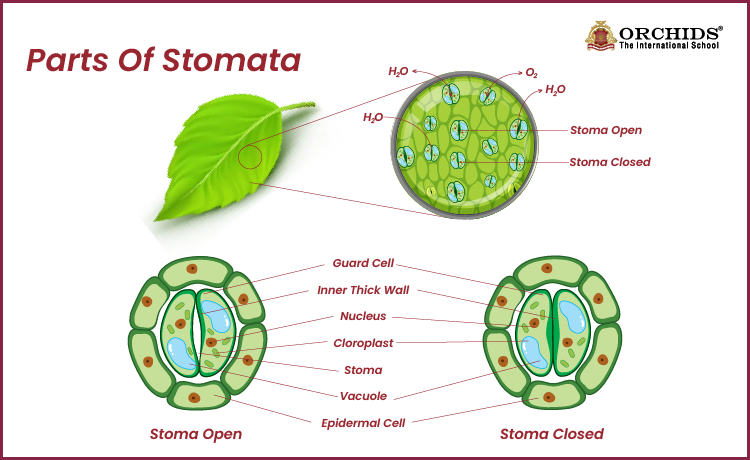
1. Open Stomata, in daylight or humid conditions, guard cells absorb water and become turgid (swollen). This happens because water enters the cells through osmosis, making their inner walls stretch outward and open the pore wide.
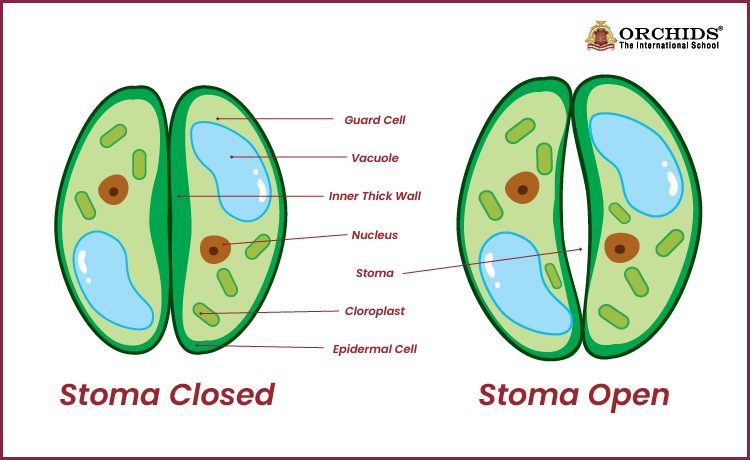
At this point, carbon dioxide enters the leaf for photosynthesis, while oxygen and water vapour move out. This open state ensures active gas exchange and energy production in the plant.
2. Closed Stomata, at night or during hot, dry weather, guard cells lose water and become flaccid (soft and shrunken). The thick inner walls then move closer, sealing the pore.
This prevents unnecessary water loss through transpiration, helping the plant stay hydrated even in stressful conditions.
To visualise this easily, picture it like this:
-
Morning: Stomata open → in, out, water vapour escapes.
-
Night: Stomata closed → no exchange, water conserved.
Practice Time:
Look carefully at the diagram of open and closed stomata below. These tiny pores on leaves may look small, but they help the plant breathe and save water.
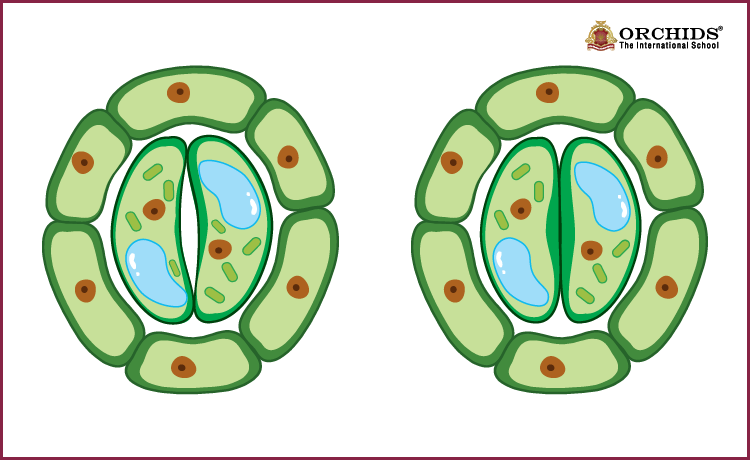
Your task is to label the main parts in both diagrams. Start by marking:
-
Turgid guard cells
-
Flaccid guard cells
-
Stomatal pore
-
Epidermal and subsidiary cells
Tip: Think of the stomata like small doors on a leaf. When the plant needs air for photosynthesis, the doors open. When it needs to save water, they close. This idea will help you tell which one is open and which is closed.
Now, try these practice questions to test your understanding of the stomata diagram:
-
Draw and label a diagram of open and closed stomata.
-
Mark the guard cells and stomatal pore.
-
Show the turgid and flaccid states clearly.
-
Label the epidermal and subsidiary cells.
By practising this, you’ll see how this small action of opening and closing keeps the plant alive by balancing air exchange and water loss.
In this article, we discussed how to draw a diagram of stomata, the structure of open and closed stomata, and how each part helps the plant maintain its balance.
This is why studying the diagram of stomata is not just about labeling parts; it helps us understand how plants “breathe” and survive different weather conditions by simply opening and closing tiny pores on their leaves.
Frequently Asked Questions On Diagram of Stomata
1. What is a stomata diagram?
It’s a labelled drawing showing the structure of stomata, including guard cells, subsidiary cells, and the stomatal pore that helps in understanding gaseous exchange.
2. Where are stomata found in plants?
Stomata are mostly found on the underside of leaves, though they can also be present on stems and other green plant organs.
3. What is the main function of stomata?
Their main function is to control the exchange of gases (CO₂ and O₂) and regulate water loss through transpiration.
4. Why do stomata close at night?
At night, photosynthesis stops due to the absence of sunlight, so stomata close to conserve water.
5. What is the role of guard cells?
Guard cells control the opening and closing of the stomatal pore by changing their turgidity.
6. Do all plants have stomata?
Yes, all green plants have stomata, though their number, shape, and placement may differ depending on species and environment.
Science isn't just a subject, it's the way of seeing the world. Curious how Orchids The International School teaches it that way? Talk to our admissions team.
Admissions Open for 2026-27
What type of concept pages would you prefer?
CBSE Schools In Popular Cities
- CBSE Schools in Bangalore
- CBSE Schools in Mumbai
- CBSE Schools in Pune
- CBSE Schools in Hyderabad
- CBSE Schools in Chennai
- CBSE Schools in Gurgaon
- CBSE Schools in Kolkata
- CBSE Schools in Indore
- CBSE Schools in Sonipat
- CBSE Schools in Delhi
- CBSE Schools in Rohtak
- CBSE Schools in Bhopal
- CBSE Schools in Aurangabad
- CBSE Schools in Jabalpur
- CBSE Schools in Jaipur
- CBSE Schools in Jodhpur
- CBSE Schools in Nagpur
- CBSE Schools in Ahmednagar
- CBSE School In Tumkur











Orchids The International School is one of India's leading chains of CBSE and ICSE schools, with 130+ schools across the country.