

Chloroplasts: Structure, Function and Role in Photosynthesis Explained
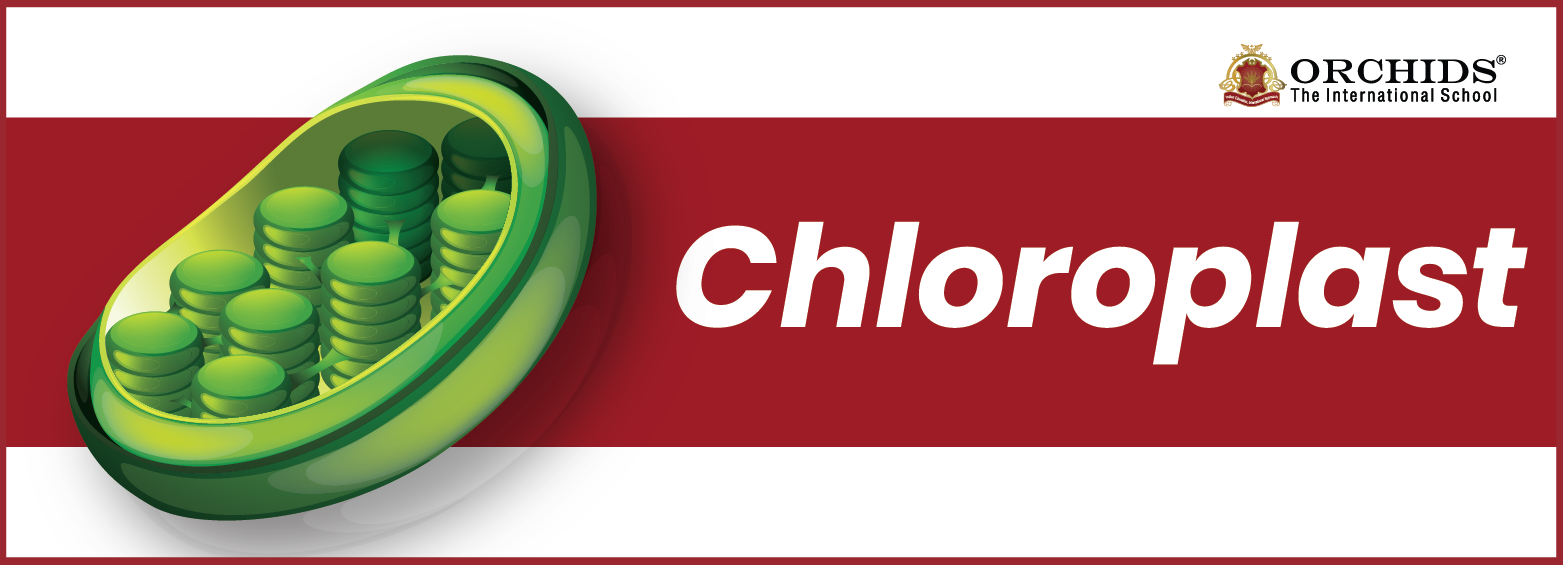
Chloroplasts are found only in plant cells and are completely absent in animal cells. These structures trap sunlight and convert it into energy through photosynthesis. In simple words, chloroplasts are the kitchen of plant cells where food is made, which is why they are called producers. The secret behind this special ability lies inside a tiny yet powerful cell organelle known as the chloroplast.
This article provides everything about the chloroplast definition, structure, function, and diagram, explained clearly and simply.
Table of Contents
- What is a Chloroplast
- Structure of Chloroplast
- Diagram of Chloroplast
- Functions of Chloroplast
- Frequently Asked Questions on Chloroplasts

What is a Chloroplast?
Chloroplasts are special structures found inside the cells of green plants and algae. They are mainly present in the mesophyll cells of leaves, where photosynthesis takes place.
These organelles contain a green pigment called chlorophyll, which captures sunlight and helps in preparing food for the plant.
An interesting fact is that chloroplasts have their own DNA and ribosomes. Because of this, scientists say chloroplasts are semi-autonomous, just like mitochondria, meaning they can make some of their own proteins and membranes.
The chloroplast definition goes like this:
“Chloroplast is an organelle that contains the photosynthetic pigment chlorophyll that captures sunlight and converts it into useful energy, thereby releasing oxygen from water.”
So, we can say that chloroplasts help plants capture sunlight, produce glucose, release oxygen, and generate energy in the form of ATP and NADPH, making them essential for the survival and growth of plants.
Have you ever wondered how plants make their own food or store energy for later? Or why are some plants green while others have bright colours like red or yellow?
The answer lies in special structures inside plant cells called plastids.
Let’s take a closer look at the different types of plastids and what they do.
Plastids are double-membrane organelles in plant cells, and each type plays a distinct role in the plant’s life. Knowing them helps us see how plants manage energy, storage, and colour.
- First, chloroplasts are green plastids that carry out photosynthesis. They capture sunlight and convert it into food and energy, keeping the plant alive and thriving.
- Next, chromoplasts give plants their bright colours. Found in fruits and flowers, they produce red, yellow, and orange hues, which help attract pollinators and assist in seed dispersal.
- Finally, leucoplasts are colourless plastids mainly used for storage. They store essential nutrients such as starch, proteins, or fats, ensuring the plant has energy and resources when needed.
Altogether, these plastids show how plants efficiently balance energy production, nutrient storage, and reproduction, making them vital for survival and growth.
After learning about the chloroplast definition, let’s look at their structure and function.
Structure of Chloroplast
Chloroplasts are tiny, oval-shaped organelles found in the cytoplasm of leaf cells, and they are the main sites where photosynthesis takes place.
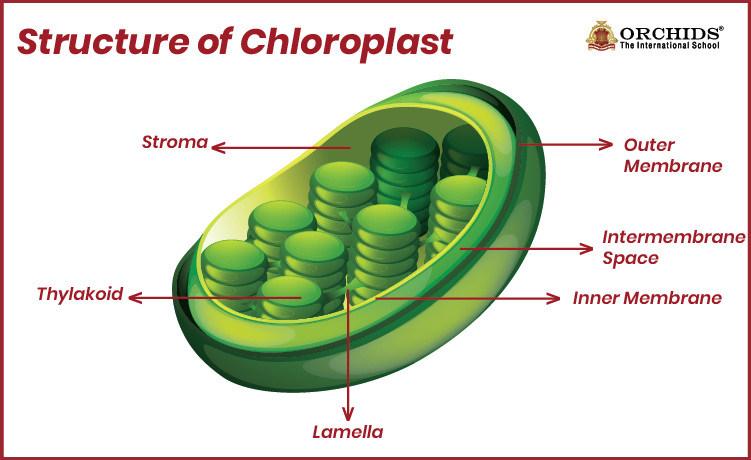
Measuring about 4 to 6 micrometres in diameter and 1to 3 micrometres in thickness, they are perfectly designed to capture sunlight and convert it into energy for the plant.
- Each chloroplast is enclosed by a double membrane called the membrane envelope.
- The outer membrane provides protection, while the inner membrane carefully controls what enters and leaves the chloroplast.
- Between these two membranes lies the intermembrane space, a narrow area separating them.
- Inside the chloroplast, the main structure is the thylakoid system, which is organised into stacks called grana.
- Each granum contains 10 to 20 disc-shaped thylakoids that hold chlorophyll, the green pigment that captures sunlight. This is where the light-dependent reactions of photosynthesis occur. You can think of the grana as tiny solar panels, absorbing sunlight and producing the energy the plant needs.
- Surrounding the grana is the stroma, a fluid-filled space that contains enzymes, DNA, and ribosomes. This is where the Calvin Cycle, or light-independent reactions, happens.
Here, the energy captured by the grana is used to convert carbon dioxide and water into glucose, the plant’s food.
So, if we put it together, sunlight is first captured by the grana, then energy is produced in the thylakoids, and finally, the stroma uses that energy to make sugar.
Isn’t it amazing how every part of the chloroplast works together to keep the plant alive and growing?
Diagram of Chloroplast
Chloroplasts are important organelles in plant cells, usually oval or biconvex in shape, found in the cytoplasm of leaf cells.
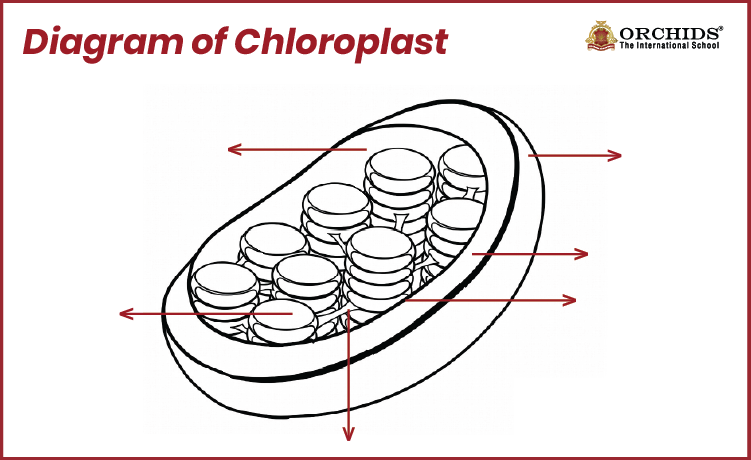
And here are some pointers for easy understanding:
- First, observe the outer and inner membranes, which form the chloroplast envelope and control what enters and leaves.
- The intermembrane space lies between these membranes.
- Inside are thylakoids, disc-shaped sacs containing chlorophyll, where the light-dependent reactions of photosynthesis take place.
- Thylakoids are stacked into grana, increasing the surface area for capturing sunlight efficiently.
- Lamellae connect the grana, maintaining structure and helping in the transport of molecules.
- Surrounding these structures is the stroma, a fluid-filled space containing enzymes, DNA, and ribosomes, where the Calvin cycle, or dark reactions, occurs.
Looking at a labelled diagram of a chloroplast helps you understand how each part of the chloroplast contributes to photosynthesis. This makes learning easier and prepares you well for exams.
Functions of Chloroplast
Have you ever wondered how plants manage to make their own food and support life on Earth?
That’s all thanks to chloroplasts, the little powerhouses inside plant cells. Their main job is photosynthesis, the process of converting sunlight into chemical energy.
So, how exactly do they do this?
First, chloroplasts capture sunlight and use it to produce ATP, the energy currency of the cell, and NADPH, another energy-rich molecule.
During this process, water is split in a reaction called photolysis, releasing oxygen into the air, which we, of course, need to breathe!
Then comes the Calvin cycle, where chloroplasts use carbon dioxide and the energy stored in ATP and NADPH to create glucose, the plant’s food. In other words, chloroplasts are not just making food for the plant; they are generating energy, food, and oxygen for the entire ecosystem.
So far, in this article, we understood the importance of chloroplasts. Think of it like this: chloroplasts take sunlight, water, and CO₂, and turn them into the essentials that keep both plants and animals alive.
Frequently Asked Questions on Chloroplasts
1. Where does photosynthesis occur in plant cells?
Photosynthesis takes place inside the chloroplast, mainly on the thylakoid membranes, where chlorophyll absorbs sunlight to start making food.
2. What are the main parts of a chloroplast?
A chloroplast has an outer membrane, an inner membrane, an intermembrane space, a fluid-filled stroma, and disc-shaped thylakoids that form stacks called grana.
3. What is the main function of a chloroplast?
The chloroplast makes food for the plant using sunlight, carbon dioxide, and water through the process of photosynthesis.
4. Why are chloroplasts green in colour?
Chloroplasts look green because chlorophyll reflects green light while absorbing red and blue light.
5. How many types of plastids are found in plant cells?
There are three types of plastids: chloroplasts for photosynthesis, chromoplasts for colour, and leucoplasts for storage.
6. What are stacks of thylakoids called?
Stacks of thylakoids are called grana, and they help increase the surface area for capturing sunlight.
7. Why are grana important in photosynthesis?
Grana contain chlorophyll and provide a large surface area, which helps absorb more light and improves food production.
Science isn't just a subject, it's the way of seeing the world. Curious how Orchids The International School teaches it that way? Talk to our admissions team.
Admissions Open for 2026-27
What type of concept pages would you prefer?
CBSE Schools In Popular Cities
- CBSE Schools in Bangalore
- CBSE Schools in Mumbai
- CBSE Schools in Pune
- CBSE Schools in Hyderabad
- CBSE Schools in Chennai
- CBSE Schools in Gurgaon
- CBSE Schools in Kolkata
- CBSE Schools in Indore
- CBSE Schools in Sonipat
- CBSE Schools in Delhi
- CBSE Schools in Rohtak
- CBSE Schools in Bhopal
- CBSE Schools in Aurangabad
- CBSE Schools in Jabalpur
- CBSE Schools in Jaipur
- CBSE Schools in Jodhpur
- CBSE Schools in Nagpur
- CBSE Schools in Ahmednagar
- CBSE School In Tumkur











Orchids The International School is one of India's leading chains of CBSE and ICSE schools, with 110+ schools across the country.