

Small Intestine: The Silent Worker Behind Your Energy Levels
The small intestine is where most of the digestive process reaches its final stage. After food leaves the stomach, it enters the small intestine, where it is carefully broken down into simpler nutrients that the body can use.
As food moves through, it mixes with digestive juices from the liver and pancreas, helping to complete digestion. The inner walls are lined with tiny finger-like structures called villi, which absorb nutrients into the bloodstream.
This is how the body gets the energy and nutrients needed to stay active and healthy. In this article, we will understand how the small intestine works, explore its structure, and learn why it is so important in the digestive system.
Table of Contents
- Structure and Parts of the Small Intestine
- Main Functions of the Small Intestine
- Frequently Asked Questions on Small Intestine

Structure and Parts of the Small Intestine
The small intestine is a long, narrow, and coiled tube-like organ that is 6-7 m long and connects the stomach to the large intestine. It is the part where maximum digestion and absorption takes place.
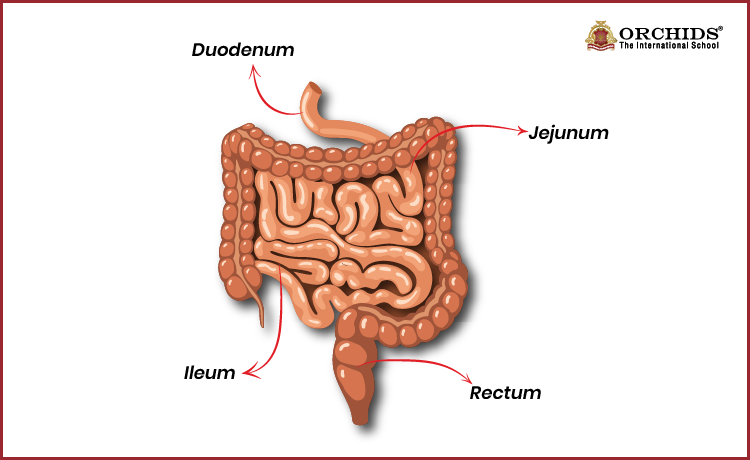
The small intestine is divided into three parts: the duodenum, jejunum, and Ileum.
a. Duodenum
The duodenum is the shortest part of the small intestine. It is about 10 inches in length and is C–shaped. It has the widest diameter. Ducts from the liver, gallbladder, and pancreas enter the duodenum to provide juices that help to digest proteins, carbohydrates, and fats that are present in chyme received from the stomach.
b. Jejunum
The jejunum is the middle part of the small intestine. It is about 2.5 metre long. It is the site where the maximum absorption of nutrients takes place.
c. Ileum
The ileum is the last part of the small intestine that is about 3.5 metres long. Remaining nutrients that were not absorbed by the jejunum are absorbed here. It joins the large intestine.
Main Functions of the Small Intestine
Now that we have learned about its structure and parts, let’s understand the main functions of the small intestine. It plays a key role in finishing digestion and delivering nutrients to the body.
-
Completes the digestion of food with the help of digestive juices
-
Breaks down carbohydrates, proteins, and fats into simpler substances
-
Absorbs nutrients into the bloodstream with the help of villi
-
Supplies energy and supports growth and overall body functions
The small intestine plays an essential role in making sure the body gets the nutrients it needs to stay healthy and active.
So far, we have learned that the small intestine completes digestion and absorbs nutrients into the bloodstream. Its structure and functions help the body get the energy and nourishment needed to stay healthy.
Frequently Asked Questions on Small Intestine
1. What role does the small intestine play in digestion?
The small intestine completes most of the digestion process and absorbs nutrients like glucose, amino acids, fatty acids, vitamins, and minerals into the bloodstream.
2. How is the small intestine adapted for absorption?
The inner lining of the small intestine has millions of tiny finger-like projections called villi, which greatly increase the surface area and help in efficient absorption of nutrients.
3. What happens to food in the small intestine?
In the small intestine, food mixes with digestive juices from the liver and pancreas, where it is further broken down into simpler substances that the body can absorb.
4. What are the three parts of the small intestine and their functions?
The small intestine consists of the duodenum (where digestion begins), jejunum (where most absorption occurs), and ileum (which absorbs remaining nutrients and passes waste to the large intestine).
5. Why is the small intestine important for the body?
The small intestine is important because it ensures that the body gets essential nutrients from food, which are needed for energy, growth, repair, and overall health.
Science isn't just a subject, it's the way of seeing the world. Curious how Orchids The International School teaches it that way? Talk to our admissions team.
Admissions Open for 2026-27
What type of concept pages would you prefer?
CBSE Schools In Popular Cities
- CBSE Schools in Bangalore
- CBSE Schools in Mumbai
- CBSE Schools in Pune
- CBSE Schools in Hyderabad
- CBSE Schools in Chennai
- CBSE Schools in Gurgaon
- CBSE Schools in Kolkata
- CBSE Schools in Indore
- CBSE Schools in Sonipat
- CBSE Schools in Delhi
- CBSE Schools in Rohtak
- CBSE Schools in Bhopal
- CBSE Schools in Aurangabad
- CBSE Schools in Jabalpur
- CBSE Schools in Jaipur
- CBSE Schools in Jodhpur
- CBSE Schools in Nagpur
- CBSE Schools in Ahmednagar
- CBSE School In Tumkur











Orchids The International School is one of India's leading chains of CBSE and ICSE schools, with 110+ schools across the country.