

What is Adaptation: Categories, Real-Life Examples and Key Facts
What is adaptation? It is the reason camels can survive in hot deserts, polar bears can live on ice, and cactus plants can store water for long periods. Even changes like tanning in strong sunlight show how the body responds to its environment. Adaptation helps living organisms adjust to their surroundings so they can survive and grow.
This article explains what is adaptation, its different types, how it takes place over time, adaptation examples from various habitats, and why understanding adaptation makes learning about life science easier and more interesting.
Table of Contents
- What do you mean by adaptation
- How does adaptation happen?
- Adaptations in Plants and Animals: Categorised by Habitat
- Significance and Real-Life Applications of Adaptation
- Adaptation vs Acclimatisation: Key Differences
- Frequently Asked Questions on What is Adaptation

What Do You Mean By Adaptation
Adaptation in biology refers to the process through which a species or organism becomes better suited to its environment.
Simply put, over generations, organisms develop anatomical, physiological, or behavioural traits that improve their chances of survival and reproduction.
Have you ever wondered why camels survive harsh deserts while polar bears thrive in icy lands?
Or why do some plants store water in stems while others grow tall to reach sunlight?
These are examples of adaptation in action.
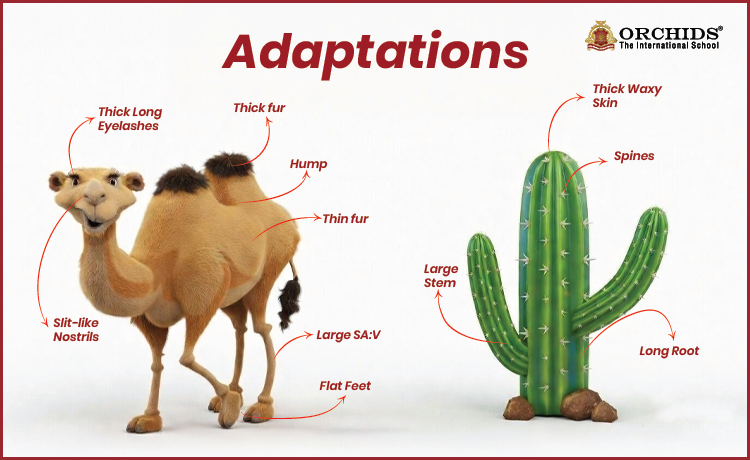
And adaptations can be grouped into three main types, each helping organisms face environmental challenges in unique ways:
1. Structural adaptation, these are physical features of the body, like thick fur, long roots, blubber, or specialised beaks, that directly support survival.
2. Physiological adaptation focuses on internal functions or chemical processes, such as venom production in snakes, efficient kidneys in desert animals, or the ability of some plants to photosynthesise in low light, allowing organisms to thrive under specific conditions.
3. Behavioural adaptations are based on actions or habits, like migration, hibernation, nocturnal activity, or specialised feeding patterns, and help organisms cope with environmental demands.
To make this clearer, consider some real-world adaptation examples:
-
For example, think about a cactus in the desert, which has thick, waxy stems, spines instead of leaves, and deep roots to store and conserve water.
-
Similarly, polar bears have white fur for camouflage, thick blubber for insulation, and wide paws to walk on ice.
-
In aquatic environments, fish extract oxygen from water through gills and swim efficiently with streamlined bodies.
-
Likewise, migratory birds travel long distances to find food and suitable breeding grounds.
-
Even humans adapt; those living at high altitudes develop more red blood cells to carry oxygen efficiently.
Even short-term adaptations are interesting. For instance, prolonged sun exposure causes tanning melanocytes to produce more melanin to protect DNA from UV damage, giving humans an advantage in strong sunlight.
Now that we understand what adaptation is, the next natural question is: how does it actually occur?
Let’s find out.
How Does Adaptation Happen?
Adaptation is a gradual process that allows species to survive and thrive in their environment. It doesn’t happen overnight but unfolds step by step across generations.
1. First, there is natural variation within a population, meaning that individuals are slightly different from one another.
2. Next, some of these differences provide advantages, such as better chances to find food, escape predators, or reproduce successfully.
3. Because of this, individuals with these beneficial traits are more likely to survive and pass them on to their offspring.
4. Over successive generations, these advantageous traits become more common, gradually shaping the population to be better suited to its environment.
5. Eventually, this process can result in noticeable evolutionary changes that distinguish one species from another.
And have you ever thought about how this explains the incredible diversity of life on Earth?
The answer lies in how each adaptation, small or large, is a step toward survival in a particular environment.
Adaptation in Plants and Animals: Categorised by Habitat
Adaptation helps plants and animals survive in different environments. Each habitat brings its own challenges, such as scorching deserts, icy polar regions, or dense rainforests. To cope, species develop special features and behaviours.
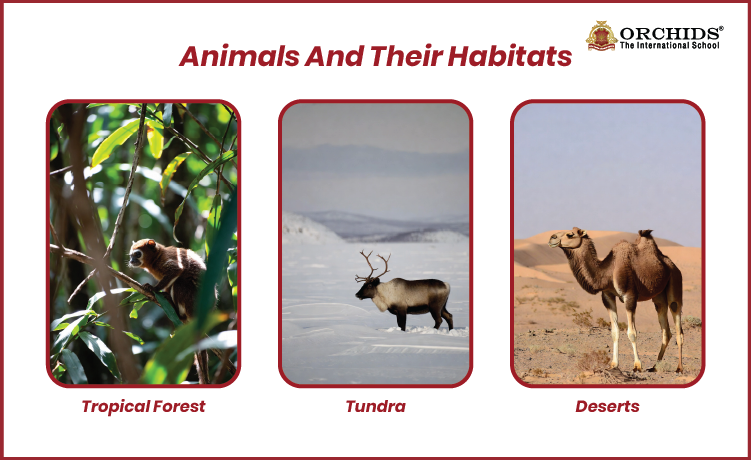
Take a look at the table below to see the different adaptations in plants and animals and their amazing survival strategies.
By looking at these adaptation examples, it’s clear how adaptation allows life to succeed even in extreme and varied conditions.
Significance and Real-Life Applications of Adaptation
Once we see adaptation in action, it’s easy to understand why it matters beyond biology class. Adaptation explains not just survival but also how organisms interact with their environment.
Interestingly!! It helps scientists understand survival, change, and development in living organisms across different conditions and environments:
1. When it comes to medicine, adaptation explains why some bacteria become resistant to antibiotics and why new treatments are needed over time.
2. Looking at agriculture, farmers apply ideas from adaptation to develop crops that can survive drought, pests, and changing weather, making food production more reliable.
3. From an environmental science point of view, understanding adaptation helps scientists predict how plants and animals may respond to climate change, which supports conservation efforts.
4. For human health, the concept helps people prepare for extreme conditions like high altitude, extreme heat, or cold by understanding how the body adjusts and where its limits lie.
Overall, adaptation shows how biology directly shapes health, food supply, and the future of ecosystems.
Adaptation vs Acclimatisation: Key Differences
Before going further, it is important to understand that adaptation is not the same as acclimatisation. Both help living organisms adjust to their environment, but they work in very different ways.
One happens slowly over many generations, while the other occurs quickly within a single individual.
To make this difference clear and easy to remember, the table below compares adaptation vs acclimatisation side by side:
And till now we have studied what is adaptation and how it is central to life on Earth; it explains adaptation in plants and animals, how organisms survive, reproduce, and fill ecological niches. From cactus spines to polar bear blubber and human physiological responses to altitude or sun, adaptations are the result of long-term interactions between organisms and their environments.
Frequently Asked Questions on What is Adaptation
1. What is adaptation in biology?
It is the process by which organisms develop traits that help them survive and reproduce in their environment.
2. What are the main types of adaptation?
Structural adaptations (body features), physiological adaptations (internal functions), and behavioural adaptations (actions or habits).
3. How does adaptation lead to evolution?
Traits that improve survival and reproduction become common over generations, gradually changing a species’ genetics.
4. Can adaptation be reversed?
Evolutionary adaptations are permanent, but short-term acclimatisation in individuals can reverse when conditions change.
5. How is adaptation useful in agriculture?
It helps develop crops and livestock with traits like drought resistance, pest tolerance, and higher productivity.
6. Why do animals camouflage or mimic others?
To avoid predators, sneak up on prey, or imitate harmful species for protection.
7. Can humans naturally adapt to extreme conditions?
Yes, for example, increased red blood cells at high altitudes or skin tanning in strong sunlight.
8. How do aquatic species adapt differently from land species?
They evolve gills, floating or submerged structures, and streamlined bodies to survive in water.
9. Does adaptation always ensure survival?
Not always; some traits help only in specific environments, and rapid changes can outpace adaptation.
Science isn't just a subject, it's the way of seeing the world. Curious how Orchids The International School teaches it that way? Talk to our admissions team.
Admissions Open for 2026-27
What type of concept pages would you prefer?
CBSE Schools In Popular Cities
- CBSE Schools in Bangalore
- CBSE Schools in Mumbai
- CBSE Schools in Pune
- CBSE Schools in Hyderabad
- CBSE Schools in Chennai
- CBSE Schools in Gurgaon
- CBSE Schools in Kolkata
- CBSE Schools in Indore
- CBSE Schools in Sonipat
- CBSE Schools in Delhi
- CBSE Schools in Rohtak
- CBSE Schools in Bhopal
- CBSE Schools in Aurangabad
- CBSE Schools in Jabalpur
- CBSE Schools in Jaipur
- CBSE Schools in Jodhpur
- CBSE Schools in Nagpur
- CBSE Schools in Ahmednagar
- CBSE School In Tumkur











Orchids The International School is one of India's leading chains of CBSE and ICSE schools, with 110+ schools across the country.