

What Is Decomposition: Key Factors, Importance and Real-Life Examples
What is decomposition? Decomposition is nature’s way of cleaning and renewing the Earth. It is the process by which dead plants and animals are broken down into simpler substances by tiny organisms like bacteria and fungi, returning nutrients to the soil and atmosphere. Though it happens quietly, decomposition is vital for life to continue.
Without it, the Earth would be buried under waste, and nutrients would never be reused. Every forest, field, and garden depends on this process to stay alive and healthy. This article explains how decomposition works and why it is so important for our planet.
Table of Contents
- What is Decomposition and Its Role in Nature
- Process of Decomposition
- 5 Factors Affecting Decomposition
- Why is Decomposition important
- Frequently Asked Questions on What Is Decomposition

What Is Decomposition and Its Role in Nature
You might think about what happens when a plant wilts or an animal decays and where it all goes
The answer lies in a natural process called decomposition, which literally means “to break down.”
In biology, decomposition refers to the process in which dead plants and animals are broken into simpler substances like carbon dioxide, water, and minerals. But this is not a random process, it is a vital metabolic activity where microorganisms use dead matter as raw material and turn it into useful nutrients.
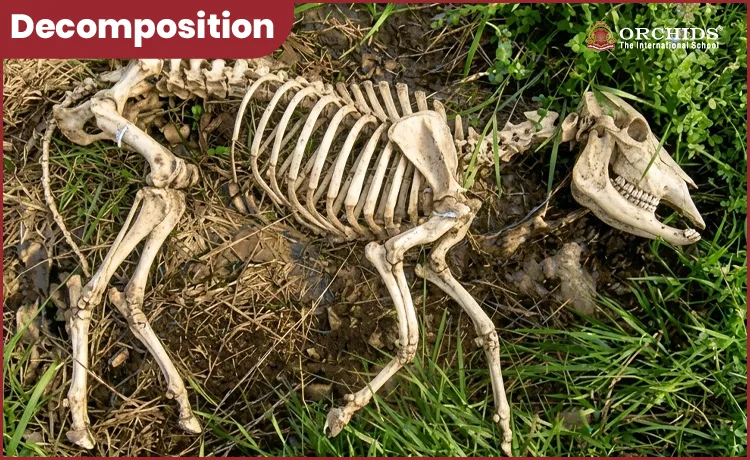
So, who does this invisible work?
Organisms like bacteria and fungi carry out decomposition and are called decomposers. They survive by feeding on dead remains, known as detritus, and such microbes are called saprophytes.
Long ago, people wondered why dead matter slowly disappeared. Today, we understand that nothing truly vanishes as nature is simply recycling through decomposition.
Before the discovery of microorganisms, people did not understand why dead matter vanished over time. Today, we know that this “disappearance” is actually nature at work through decomposition.
Process of Decomposition
Decomposition does not happen all at once. It takes place step by step through five important stages.
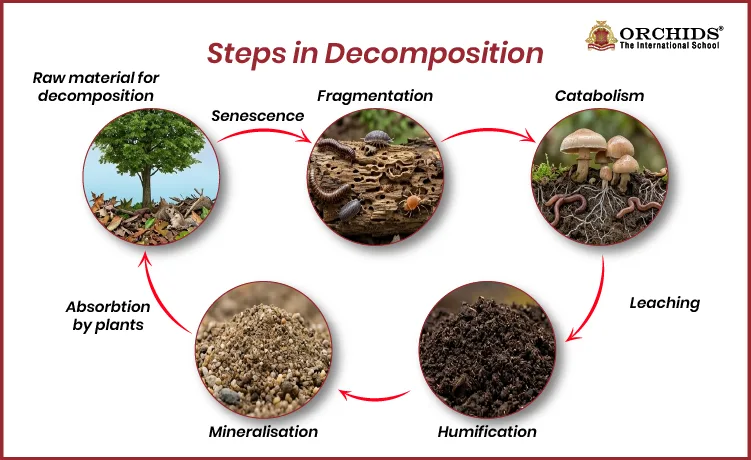
Each stage helps return nutrients back to the soil and keeps nature balanced and helps understand decomposition reaction.
- The process begins with fragmentation. In this stage, large pieces of dead plants and animals are broken into smaller parts by insects, worms, and beetles called detritivores. This makes it easier for microorganisms to act on the material.
- Next comes leaching. When rainwater passes through the soil, it dissolves water-soluble nutrients from the decaying matter and carries them deeper into the ground. These nutrients later become available for plants.
- After this, catabolism takes place. Here, bacteria and fungi release special enzymes that further break down the material into simpler substances. At this stage, complex organic matter starts changing into basic compounds.
- Then comes humification. A dark, sticky substance known as humus forms in the soil. Humus is important because it improves soil structure and stores nutrients, making the soil rich and fertile.
- Finally, the process ends with mineralisation. In this stage, humus is broken down into simple inorganic nutrients like nitrogen, phosphorus, and potassium. Plants absorb these nutrients through their roots to grow and stay healthy.
As a result, these steps recycle dead matter into useful nutrients that help soil stay fertile and support new plant growth acts as a major part in decomposition reaction.
5 Factors Affecting Decomposition
The speed at which decomposition happens is not the same everywhere. It depends on the surrounding environment and the conditions in which dead plants and animals break down.
1.One of the most important factors is litter quality. Materials that contain tough substances like lignin take a long time to decompose, while soft leaves and plant parts break down much faster.
2. Temperaturealso plays a big role. Warm conditions help microorganisms grow and work faster, which speeds up decomposition. In cold climates, their activity becomes slow, and so does the process of decay.
3. Another key factor is aeration, or the amount of oxygen in the soil. When soil has enough air, microbes can break down waste more quickly. But in waterlogged or flooded soil, where oxygen is limited, decomposition happens very slowly.
4. The pH of the soil matters too. If the soil is too acidic or too alkaline, microbes do not survive easily, which slows down the breakdown process.
5. Inorganic chemicals like calcium, potassium, and magnesium also influence decomposition because they affect microbial growth and activity in the soil.
6. Lastly, moisture is essential. Microorganisms need water to survive and function. When soil has the right amount of moisture, decay happens faster. If the soil is too dry or too wet, the process becomes slower.
Together, all these factors control how quickly nature recycles dead matter back into useful nutrients.
Why Is Decomposition Important?
When plants and animals break down, they don’t just vanish, they release nutrients, like nitrogen and carbon, back into the soil and air, giving new life the resources it needs to grow.
This process:
- Returns essential nutrients to the soil, supporting healthy plant growth
- Keeps the environment clean by preventing dead matter from piling up
- Maintains soil fertility, ensuring crops and forests can thrive
- Recycles elements like carbon and nitrogen, which are crucial for all living organisms
Without decomposition, the cycle of life would stall, and the Earth would struggle to sustain life. It’s a quiet, continuous process that makes growth, renewal, and survival possible.
In this article, we now understood that decomposition is one of nature’s most powerful recycling systems. By breaking down dead matter, it returns life-giving nutrients to the environment and helps ecosystems continue without interruption through decomposition reaction. Though invisible most of the time, decomposition silently supports every living organism on Earth.
Frequently Asked Questions on What Is Decomposition
1. What is decomposition in biology, and who performs it?
Decomposition is the natural process of breaking down dead plants and animals into simpler substances, mainly carried out by bacteria and fungi known as decomposers.
2. What are the five stages of decomposition?
The five stages are fragmentation, leaching, catabolism, humification, and mineralisation.
3. What is detritus, and what do detritivores do?
Detritus is dead organic matter, like leaves and animal remains, while detritivores break it into smaller pieces.
4. Which conditions slow down decomposition?
Low temperature, lack of oxygen, dry soil, and poor-quality litter slow down decomposition.
5. How does decomposition differ in rainforest and tundra?
Decomposition is faster in rainforests due to warmth and moisture, but much slower in tundra because of cold and frozen soil.
6. What is the difference between humification and mineralisation?
Humification forms humus, while mineralisation breaks humus into nutrients.
7. Why is humus important?
Humus improves soil fertility and retains nutrients and moisture.
8. What is the difference between decomposition and putrefaction?
Decomposition is overall decay by microbes, while putrefaction specifically refers to decay in the absence of oxygen.
Science isn't just a subject, it's the way of seeing the world. Curious how Orchids The International School teaches it that way? Talk to our admissions team.
Admissions Open for 2026-27
What type of concept pages would you prefer?
CBSE Schools In Popular Cities
- CBSE Schools in Bangalore
- CBSE Schools in Mumbai
- CBSE Schools in Pune
- CBSE Schools in Hyderabad
- CBSE Schools in Chennai
- CBSE Schools in Gurgaon
- CBSE Schools in Kolkata
- CBSE Schools in Indore
- CBSE Schools in Sonipat
- CBSE Schools in Delhi
- CBSE Schools in Rohtak
- CBSE Schools in Bhopal
- CBSE Schools in Aurangabad
- CBSE Schools in Jabalpur
- CBSE Schools in Jaipur
- CBSE Schools in Jodhpur
- CBSE Schools in Nagpur
- CBSE Schools in Ahmednagar
- CBSE School In Tumkur











Orchids The International School is one of India's leading chains of CBSE and ICSE schools, with 110+ schools across the country.