

Diagram of Ear: Structure, Components and Simple Tips to Practice
The diagram of ear helps us understand why this small organ plays such a crucial role in our daily lives. Even though we often take hearing for granted, the real power of the ear lies in its carefully designed parts, which work together to capture sound and send it to the brain. Interestingly, this is why the ear is one of the most complex and important sensory organs in the human body.
This article provides insights on drawing a diagram of ear with labelling, how they function together, and why understanding a labelled diagram can make it easier to learn and remember how we hear.
Table of Contents
- What Do You Mean By Diagram of Ear
- Importance and Function of the Human Ear
- How to Draw a Diagram of Human Ear
- Frequently Asked Questions on Diagram of Ear

What Do You Mean By Diagram of Ear?
Simply put, the ear is a remarkable organ that lets us hear sounds around us while also helping us keep our balance and sense of orientation.
So, how does it actually work?
Let’s break it down:
Sound first enters through the outer ear (pinna) and is guided along the auditory canal to the eardrum.
The eardrum vibrates, and these vibrations are passed through the three tiny bones of the middle ear (ossicles), which amplify the sound.
The inner ear, specifically the cochlea, then converts these vibrations into electrical signals, which travel via the auditory nerve to the brain.
At the same time, the vestibular system, including the semicircular canals and vestibule, detects head and body movements to help maintain balance.
If we trace the path step by step, it looks like this:
Sound waves → Pinna collects → Auditory canal channels → Eardrum vibrates → Ossicles transmit and amplify → Cochlea converts → Auditory nerve sends signals → Brain interprets → Vestibular system maintains balance
Importance and Function of the Human Ear
And it’s a fact that the human ear is a crucial organ that not only enables hearing but also helps maintain balance and spatial awareness.
It captures sound waves and directs them to the inner ear, where the cochlea transforms vibrations into electrical signals that the brain can interpret.
Simultaneously, the vestibular system, including the semicircular canals, tracks body movements to support equilibrium.
This seamless coordination allows effective communication, spatial orientation, and proper posture, while understanding ear anatomy aids in the early detection and management of hearing or balance disorders.
This brings us to the natural next question: how can we draw a labelled diagram of the human ear to visualise this process clearly?
How to Draw a Diagram of Ear?
The answer lies here:
When asked how to draw a diagram of ear, the easiest approach is to think of the ear as a layered structure built to capture sound and maintain balance.
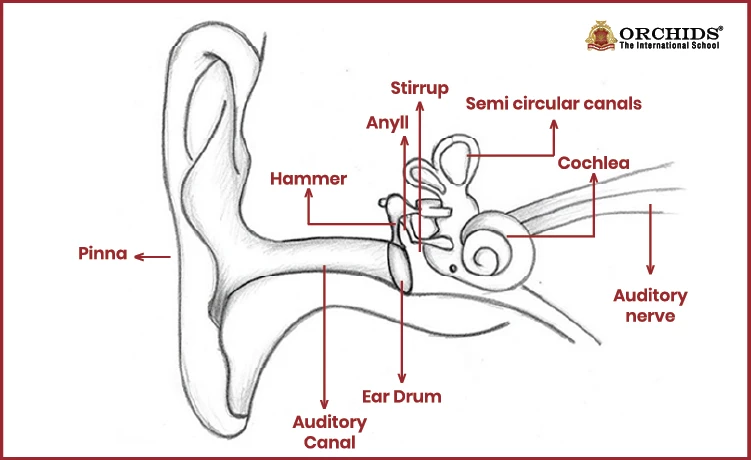
The ear is divided into three main sections: the external ear, the middle ear, and the inner ear. Each section has its own parts, which work together to help us hear and stay steady.
To understand this better, take a look at a labelled diagram of the human ear, which shows how each component functions in harmony.
Now, let us walk through the ear step by step, in the same order sound travels:
First, the external parts and why they are needed:
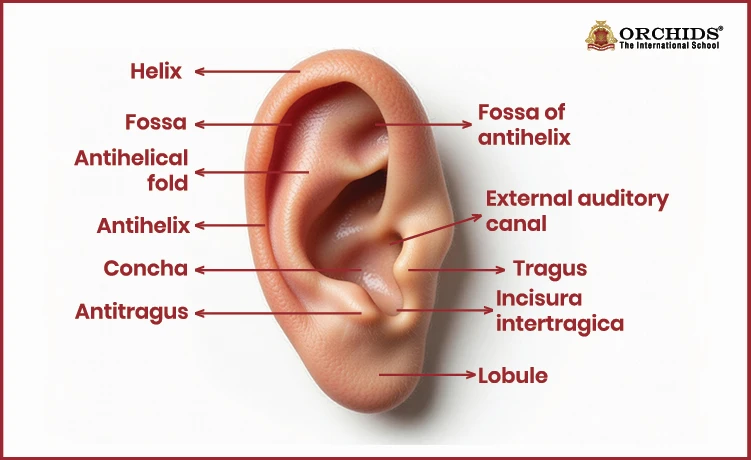
-
Pinna (Auricle), the visible outer part of the ear that collects sound waves from the environment. Think of it as a funnel that directs sound inward.
-
The external auditory canal is a narrow tube that channels sound waves toward the eardrum. It protects the ear by slightly filtering dust and foreign particles.
-
The tympanic membrane (Eardrum) is a thin, flexible membrane that vibrates when sound waves hit it, transmitting these vibrations into the middle ear.
Next, the middle ear, which amplifies and passes on the sound:
-
Ossicles (Malleus, Incus, and Stapes), these three tiny bones form a chain that carries and amplifies vibrations from the eardrum to the inner ear.
-
Eustachian tube, a small canal connecting the middle ear to the throat. It balances air pressure on both sides of the eardrum, ensuring proper vibration.
Finally, the inner ear, where sound is converted and balance is maintained:
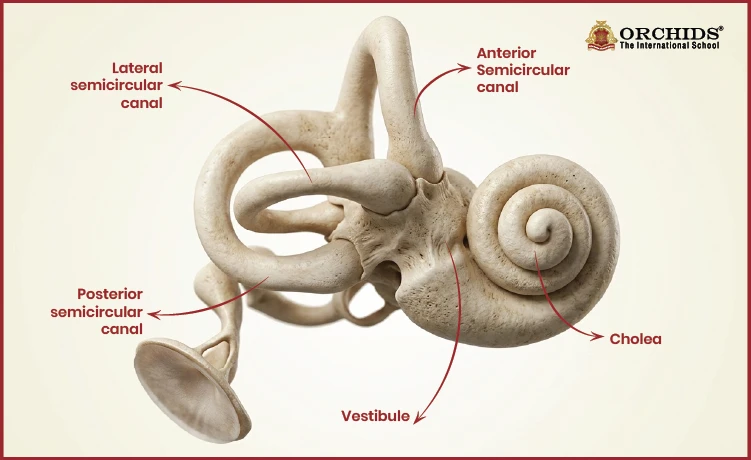
-
Cochlea, a spiral-shaped organ that converts sound vibrations into electrical signals, which the brain interprets as sound.
-
Vestibule detects linear movements and helps the body maintain balance when moving forward, backward, or side-to-side.
-
Semicircular canals are three looped canals that sense rotational movements, providing information about head orientation.
-
Auditory nerve transmits electrical signals from the cochlea to the brain, completing the hearing process.
Interestingly, the ear doesn’t only let us hear; it also constantly monitors our body’s position in space. The vestibular system in the inner ear sends feedback to the brain so we can stay balanced, walk, run, or perform activities without losing equilibrium.
Drawing a diagram of ear with labelling is not just a visual exercise; it is a simplified representation of how hearing and balance work together to help us perceive the world and understand it safely.
Now, take a look at the diagram of the ear given below and label its parts.
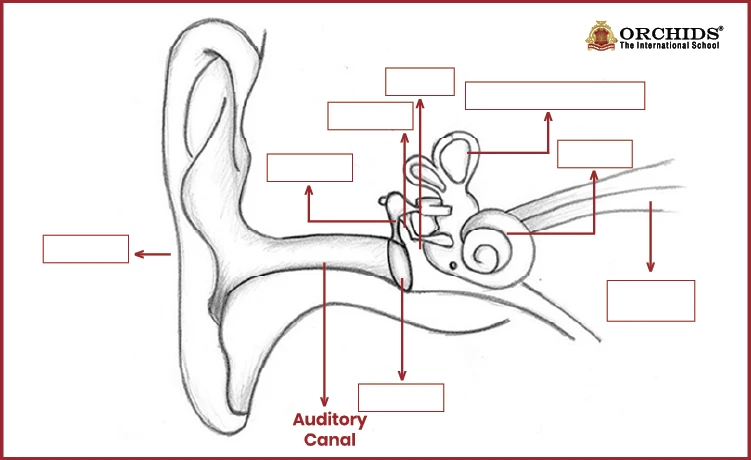
With a clear understanding of the ear, let us now look at some common exam questions.
Practice Time:
-
Draw a diagram of the ear
-
Draw a labelled diagram of the ear
-
Draw a well-labelled diagram of the ear
In this article, we learnt that the diagram of the ear is more than just an illustration; it clearly explains how hearing and balance work together. And when you draw a labelled diagram of ear helps students understand the structure and function of the outer, middle, and inner ear.
A good diagram of ear also shows how sound travels to the brain and how the vestibular system controls balance, making it easier to remember concepts and perform well in exams.
Frequently Asked Questions on Diagram of Ear
1. What are the external parts of the ear?
The external ear consists of the pinna (auricle), external auditory canal, and the tympanic membrane, which together capture and direct sound waves inward.
2. What are the middle ear components?
The middle ear contains three tiny bones called ossicles (malleus, incus, stapes) and the Eustachian tube, which amplify sound and maintain air pressure balance.
3. What are the internal parts of the ear?
The internal ear includes the cochlea, vestibule, semicircular canals, and auditory nerve, which are responsible for hearing and balance.
4. What is the function of the cochlea?
The cochlea converts sound vibrations into electrical signals that the brain can interpret as distinct sounds.
5. What role do the semicircular canals play?
The semicircular canals detect rotational movements and help the body maintain balance and spatial orientation.
6. How does the tympanic membrane work?
The tympanic membrane vibrates when sound waves hit it, transmitting these vibrations to the ossicles for further amplification.
7. What is the Eustachian tube for?
The Eustachian tube equalises air pressure between the middle ear and the throat, ensuring proper vibration of the eardrum.
8. How can one draw a diagram of the human ear?
A simple diagram can be drawn by sketching the outer, middle, and inner ear and labelling the pinna, ear canal, eardrum, ossicles, cochlea, semicircular canals, and auditory nerve.
9. How does the ear maintain balance?
The vestibule and semicircular canals detect movements and send signals to the brain to help maintain equilibrium.
Science isn't just a subject, it's the way of seeing the world. Curious how Orchids The International School teaches it that way? Talk to our admissions team.
Admissions Open for 2026-27
What type of concept pages would you prefer?
CBSE Schools In Popular Cities
- CBSE Schools in Bangalore
- CBSE Schools in Mumbai
- CBSE Schools in Pune
- CBSE Schools in Hyderabad
- CBSE Schools in Chennai
- CBSE Schools in Gurgaon
- CBSE Schools in Kolkata
- CBSE Schools in Indore
- CBSE Schools in Sonipat
- CBSE Schools in Delhi
- CBSE Schools in Rohtak
- CBSE Schools in Bhopal
- CBSE Schools in Aurangabad
- CBSE Schools in Jabalpur
- CBSE Schools in Jaipur
- CBSE Schools in Jodhpur
- CBSE Schools in Nagpur
- CBSE Schools in Ahmednagar
- CBSE School In Tumkur











Orchids The International School is one of India's leading chains of CBSE and ICSE schools, with 110+ schools across the country.