

Parasitic Nutrition: Definition, Types and Features
Parasitic nutrition is a way in which some living things get their food by depending on other living organisms. The organism that feeds is called a parasite, and the one it feeds on is called the host. Parasites take their food from the host and may harm it while surviving.
In this article, you will learn about parasitic nutrition, the different types of parasites, examples in plants and animals, and how it affects the host and the environment.
Table of Contents
- What is Parasitic Nutrition
- Characteristics of Parasitic Nutrition
- Types of Parasitic Nutrition
- Types of Parasitic Plants
- Difference Between Ectoparasitic and Endoparasitic Nutrition
- Frequently Asked Questions on Parasitic Nutrition

What is Parasitic Nutrition
Parasitic nutrition is a mode of nutrition in which one organism obtains its food and nutrients from another living organism, called the host. The organism that depends on the host for nourishment is known as a parasite. Instead of preparing its own food, the parasite derives nutrients from the host to survive, grow, and reproduce.
In this relationship, the parasite benefits, while the host is usually harmed. Depending on the type of parasite, the host may lose nutrients, become weak, or suffer from diseases. Parasites may live either on the surface of the host's body or inside its body.
Examples: Cuscuta (Amarbel), tapeworm, lice, leeches, and Plasmodium.
Characteristics of Parasitic Nutrition
Every mode of nutrition has certain features that distinguish it from others. Parasitic nutrition is characterised by a close relationship between the parasite and its host, where the parasite depends on the host for its survival.
Here are some key characteristics of parasitic nutrition:
- The parasite depends on a living host for its food and nourishment.
- The host supplies water, nutrients, or prepared food required by the parasite.
- The parasite benefits from this relationship, while the host is usually harmed.
- Parasites may live outside the host (ectoparasites) or inside the host (endoparasites).
- Many parasites have specialised structures that help them attach to the host and absorb nutrients.
Types of Parasitic Nutrition
Not all parasites obtain food in the same way. Some live on the outside of their host, while others survive inside the host's body.
Based on where they live and obtain nourishment, parasitic nutrition is classified into two main types: ectoparasitic nutrition and endoparasitic nutrition.
1. Ectoparasitic Nutrition (Exoparasitism)
In ectoparasitic nutrition, the parasite lives on the outer surface of the host's body and derives nourishment without entering the body. These parasites are known as ectoparasites or exoparasites. They usually feed on the host's blood, skin, or body fluids and may cause irritation or discomfort.
Examples:
- Lice on the human scalp
- Leeches
- Bed bugs
- Ticks
2. Endoparasitic Nutrition (Endoparasitism)
Compared to ectoparasites, some parasites spend their entire life inside the host's body. This type of nutrition is known as endoparasitic nutrition. These parasites, called endoparasites, obtain nourishment from the host's tissues, organs, or body fluids and may affect the host's health if left untreated.
Examples:
- Tapeworm in the human intestine
- Roundworm
- Plasmodium (malaria parasite)
Now that we understand the different types of parasitic nutrition, let us explore the types of parasitic plants, which are classified according to how much they depend on their host for food and nutrients.
Also Read: Symbiotic Nutrition
Types of Parasitic Plants
Parasitic Plants are plants that cannot get all their food on their own. They depend on other plants, called hosts, to get water, nutrients, and sometimes minerals. Some parasitic plants fully rely on their host, while others can make a little of their own food.
Now that we understand how parasitic plants survive, let’s see the different types of parasitic plants.
1. Total parasite
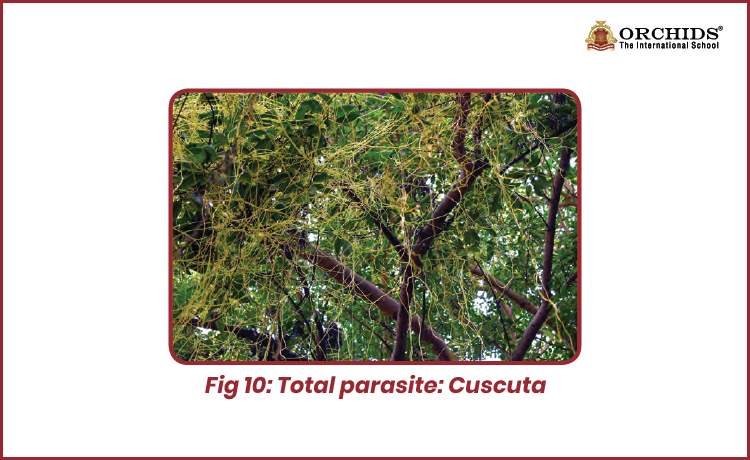
A total parasite is completely dependent on the host for its nourishment. Cuscuta (Dodder or Amarbel) is an example of a total parasite.
It can be seen in the form of yellow tubular structures twining around the stems and branches of the plant. It lacks chlorophyll and hence cannot prepare its own food. It is totally dependent on the host on which it grows for its nourishment. As it weakens the growth of its host plant, the agriculturists consider Cuscuta as a ‘destructive weed’.
2. Partial parasite
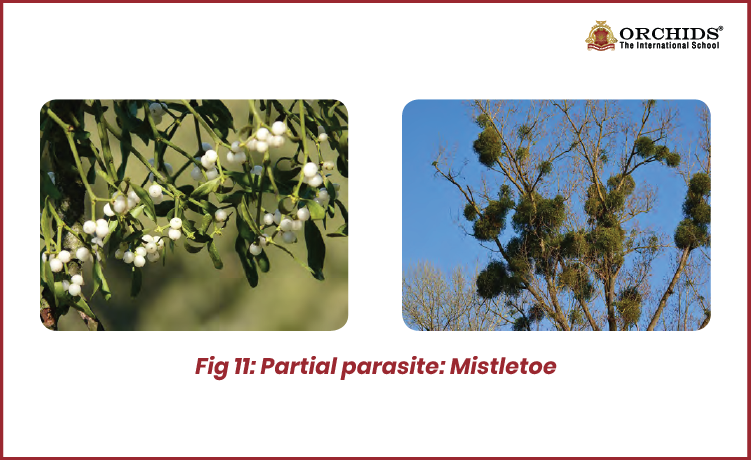
A partial parasite is partially dependent on the host for its nourishment. Mistletoe (Viscum) is an example of the partial parasite. It has chlorophyll and hence can prepare its own food.
It is dependent on the host (example: Western Australian Christmas tree) for getting water and minerals. Viscum is attached to the roots of host plants with the help of haustoria (root-like structure) to get water and minerals.
Difference Between Ectoparasitic and Endoparasitic Nutrition: Key Comparisons
Although both ectoparasites and endoparasites depend on a living host for nourishment, they differ in where they live, how they obtain food, and the effect they have on the host.
The table below compares these two types of parasitic nutrition.
|
Basis of Comparison |
Ectoparasitic Nutrition |
Endoparasitic Nutrition |
|
Location |
Parasite lives on the outer surface of the host's body. |
Parasite lives inside the host's body. |
|
Source of Nutrition |
Obtains nourishment from the host's skin, blood, or body fluids externally. |
Obtains nourishment from the host's tissues, organs, or body fluids internally. |
|
Effect on the Host |
Usually causes irritation, itching, or skin damage. |
May affect internal organs, reduce nutrient absorption, or cause diseases. |
|
Visibility |
Generally visible on the host's body. |
Usually not visible without medical examination. |
|
Examples |
Lice, leeches, bed bugs, ticks |
Tapeworm, roundworm, Plasmodium |
As we learned, parasitic nutrition is when living things get their food from other organisms. Some parasitic plants, like Cuscuta and Mistletoe, depend on their host for nutrients. Even though they may harm the host, they show how living things survive and depend on each other.
Frequently Asked Questions on Parasitic Nutrition
1. How do parasites get their food?
Parasites get their food by living on or inside another living organism (the host) and absorbing nutrients directly from it, often harming the host in the process.
2. What roles do parasite and host play in feeding?
The parasite is the one that takes food, while the host is the one that provides food and shelter. The parasite depends on the host to survive.
3. What makes parasitic nutrition different from other ways of eating?
Unlike plants that make their own food or organisms that eat dead material, parasites rely entirely on a living host for their nutrition.
4. Are there any plants that feed like parasites?
Yes! Plants like Cuscuta (dodder) attach to other plants and take water and nutrients from them instead of making their own food.
Science isn't just a subject, it's the way of seeing the world. Curious how Orchids The International School teaches it that way? Talk to our admissions team.
Admissions Open for 2026-27
What type of concept pages would you prefer?
CBSE Schools In Popular Cities
- CBSE Schools in Bangalore
- CBSE Schools in Mumbai
- CBSE Schools in Pune
- CBSE Schools in Hyderabad
- CBSE Schools in Chennai
- CBSE Schools in Gurgaon
- CBSE Schools in Kolkata
- CBSE Schools in Indore
- CBSE Schools in Sonipat
- CBSE Schools in Delhi
- CBSE Schools in Rohtak
- CBSE Schools in Bhopal
- CBSE Schools in Aurangabad
- CBSE Schools in Jabalpur
- CBSE Schools in Jaipur
- CBSE Schools in Jodhpur
- CBSE Schools in Nagpur
- CBSE Schools in Ahmednagar
- CBSE School In Tumkur











Orchids The International School is one of India's leading chains of CBSE and ICSE schools, with 110+ schools across the country.