

Aerobic Respiration: Stages, Examples and Diagram
Aerobic respiration is the process by which our cells make energy using oxygen. It is how the food we eat, especially glucose, is broken down to release energy in the form of ATP. This energy helps our body carry out all daily activities.
Even though we cannot see it happening, aerobic respiration is taking place inside our cells every second. It allows us to walk, run, think, breathe, and even sleep. Our heart keeps beating and our brain keeps working because this process provides a steady supply of energy. Without aerobic respiration, our body would not get enough energy to function properly. In this article, you will learn how aerobic respiration works, its main stages, how much energy it produces, and why it is so important for life.
Table of Contents
- What Is Aerobic Respiration and Why Do We Need It
- 4 Main Stages of Aerobic Respiration
- Some Common Examples of Aerobic Respiration
- Difference Between Breathing, Aerobic Respiration, and Anaerobic Respiration
- Frequently Asked Questions on Aerobic Respiration

What Is Aerobic Respiration and Why Do We Need It?
Have you ever wondered where your body gets the energy to move, think, or even breathe? The answer lies in a process called aerobic respiration.
Aerobic respiration is the process by which cells use oxygen to break down glucose and release energy. During this process, glucose is converted into carbon dioxide and water, and the energy released is stored as ATP.
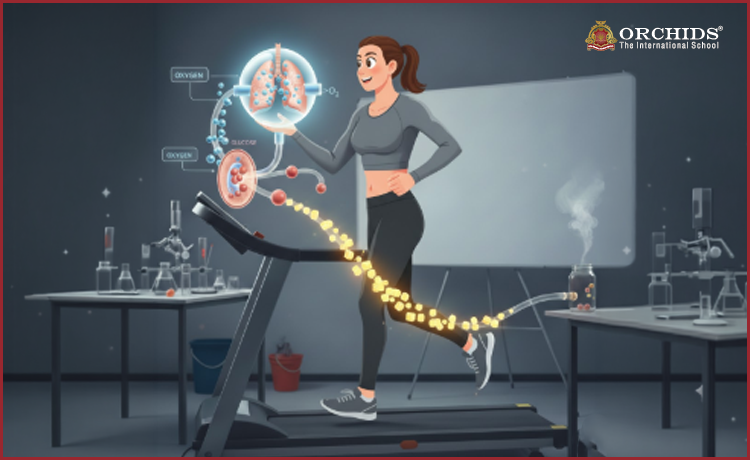
ATP is known as the energy currency of the cell because it powers almost every activity inside the body.
In simple terms:
Cells + Glucose + Oxygen → Energy for life activities
This continuous production of energy allows the body to grow, repair tissues, move muscles, and keep organs functioning properly. Without aerobic respiration, cells would simply not have the energy required to survive.
To understand the process more clearly, scientists express it using a balanced aerobic respiration equation:
C₆H₁₂O₆ + 6O₂ → 6CO₂ + 6H₂O + Energy (ATP)
But what does this aerobic respiration equation actually tell us?
- One molecule of glucose reacts with six molecules of oxygen
- Carbon dioxide and water are formed as products
- Energy is released in the form of ATP
In simple words, this aerobic respiration equation shows the complete breakdown of glucose in the presence of oxygen. Because the breakdown is complete, a large amount of energy is released.
Now that we understand what is aerobic respiration, the next question is: why is it so important?
Aerobic respiration is essential because it:
- Provides energy required for survival
- Supports growth and repair of cells
- Keeps the heart, brain, and other organs functioning
- Enables physical activities such as walking and running
- Helps maintain proper metabolism
Without this steady supply of ATP, complex life forms like humans would not be able to survive.
So, where exactly does aerobic respiration take place inside the cell? Let’s discuss.
You might also wonder where this entire process happens.
Aerobic respiration occurs in different parts of the cell in a step by step manner:
- Glycolysis takes place in the cytoplasm
- The link reaction, Krebs cycle, and electron transport chain occur inside the mitochondria
The mitochondria are often called the powerhouse of the cell because this is where most ATP is produced.
4 Main Stages of Aerobic Respiration
Aerobic respiration does not happen in just one step. Instead, it takes place through a series of carefully connected stages. Each stage plays a specific role in breaking down glucose and releasing energy.
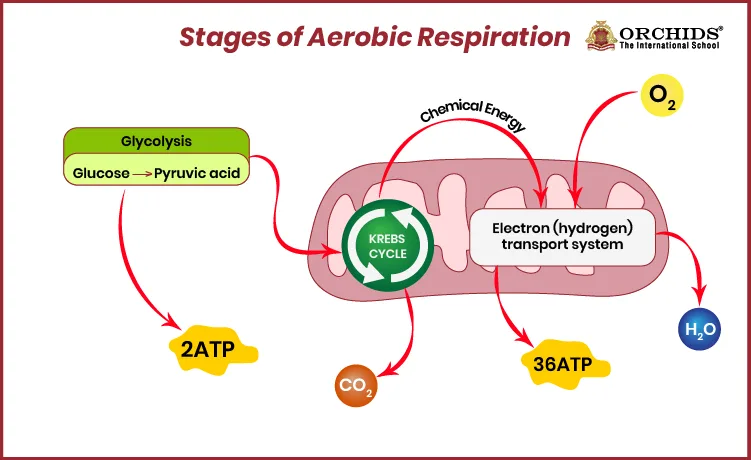
Let us understand them one by one in a simple way.
1. The process begins with glycolysis, which takes place in the cytoplasm of the cell. This stage does not require oxygen, but it prepares the glucose molecule for the steps that follow.
During glycolysis:
- One molecule of glucose splits into two smaller molecules called pyruvate
- A small amount of energy in the form of 2 ATP is produced
- NADH, an energy carrying molecule, is formed
Although glycolysis produces only a little ATP, it is extremely important because it starts the entire process of energy release.
2. After glycolysis, the two pyruvate molecules move into the mitochondria. Here, they undergo a small but important change known as the link reaction.
In this stage:
- Pyruvate is converted into a molecule called acetyl CoA
- Carbon dioxide is released as a waste product
- NADH is produced
This step acts like a bridge. It connects glycolysis to the next major stage, ensuring the process continues smoothly.
3. Now the real breakdown of the molecule continues in the Krebs cycle, which takes place in the mitochondrial matrix.
During this stage:
- Acetyl CoA is further broken down
- Carbon dioxide is released
- High energy carriers like NADH and FADH₂ are produced
- A small amount of ATP is formed directly
While the ATP produced here is limited, the main purpose of the Krebs cycle is to generate NADH and FADH₂, which are crucial for the final stage.
4. Finally, we reach the most important stage, the electron transport chain. This stage occurs in the inner membrane of the mitochondria and produces the majority of ATP.
Here is what happens:
- NADH and FADH₂ release their stored electrons
- These electrons pass through a series of proteins
- Oxygen acts as the final electron acceptor
- A large amount of ATP is produced
This stage is responsible for generating most of the 36 to 38 ATP molecules. Without oxygen, this step cannot occur, which is why aerobic respiration depends on oxygen.
So, now the question is: how many ATP molecules are produced during aerobic respiration?
Let’s discuss.
From one molecule of glucose, aerobic respiration produces approximately 36 to 38 ATP molecules.
Here is a simple breakdown:
- Glycolysis produces 2 ATP
- The Krebs cycle produces 2 ATP
- The electron transport chain produces about 32 to 34 ATP
This high energy output makes aerobic respiration very efficient. In comparison, anaerobic respiration produces only 2 ATP per glucose molecule.
Because aerobic respiration completely breaks down glucose in the presence of oxygen, it provides much more usable energy for the cell.
or in the electron transport chain. Without oxygen:
- The electron transport chain stops
- NADH cannot release electrons
- ATP production drastically reduces
- Cells switch to anaerobic respiration
Thus, oxygen ensures continuous and efficient energy production.
And what happens if oxygen is not available? Let’s understand:
- Cells perform anaerobic respiration
- Only 2 ATP molecules are produced
- Lactic acid accumulates in muscles
This is why muscles feel tired or cramped during intense exercise when oxygen supply is insufficient.
Some Common Aerobic Respiration Examples
Aerobic respiration is not something that happens occasionally. It is taking place inside your body every second of the day. Whether you are resting, studying, or exercising, your cells are constantly using oxygen to release energy from glucose.
Let us look at some everyday aerobic respiration examples where aerobic respiration plays an important role.
1. When you walk, run, or swim, your muscles need a steady supply of energy. This energy is produced through aerobic respiration because these activities rely on oxygen to keep you moving for longer periods.
2. Even simple actions like climbing stairs require your body to increase oxygen intake so that more ATP can be produced to power your muscles.
3. Interestingly, aerobic respiration is not limited to movement. Your heart muscle continuously contracts to pump blood throughout your body. This constant activity depends heavily on aerobic respiration because the heart requires a continuous and reliable energy supply.
4. Your brain also relies on aerobic respiration. Thinking, concentrating, solving problems, and even reading this sentence require energy produced by your cells using oxygen.
5. Plants, too, perform aerobic respiration. Although they produce glucose during photosynthesis in the daytime, they break it down using oxygen both day and night to release energy for growth and repair.
In simple words, any activity that requires sustained, long lasting energy depends on aerobic respiration. It is the reason living organisms can perform complex and continuous functions efficiently.
Difference Between Breathing, Aerobic Respiration, and Anaerobic Respiration
Many students often get confused between breathing and respiration. At first glance, they may seem similar because both involve oxygen. However, they are very different processes. In fact, breathing is just one small part of the larger energy-producing system inside the body.
To understand this clearly, let us compare breathing, aerobic respiration, and anaerobic respiration side by side.
|
Feature |
Breathing |
Aerobic Respiration |
Anaerobic Respiration |
|
Type of Process |
Mechanical process |
Chemical process |
Chemical process |
|
Where It Occurs |
In the lungs |
Inside cells, mainly in mitochondria |
Inside cells in the cytoplasm |
|
Oxygen Required |
Yes, inhaled from the air |
Yes |
No |
|
Main Function |
Takes in oxygen and removes carbon dioxide |
Breaks down glucose using oxygen to release energy |
Breaks down glucose without oxygen to release energy |
|
ATP Produced |
Does not produce ATP |
36 to 38 ATP |
2 ATP |
|
End Products |
Oxygen enters, carbon dioxide leaves |
Carbon dioxide and water |
Lactic acid in humans or alcohol in yeast |
|
Efficiency |
Not related to energy production |
High efficiency |
Low efficiency |
|
Example |
Inhaling and exhaling |
Walking, running, and heart functioning |
Intense exercise when oxygen supply is low |
This clear comparison makes it easy to understand why aerobic respiration is more efficient and essential for sustained energy production.
Till now, we know that aerobic respiration is the process by which cells use oxygen to break down glucose and produce energy in the form of ATP. From daily activities to vital organ functions, aerobic respiration provides the continuous energy required for life, making it essential for survival.
Frequently Asked Questions on Aerobic Respiration
1. What are the main stages of aerobic respiration?
The main stages are glycolysis, link reaction, Krebs cycle, and the electron transport chain. These stages work together to release energy from glucose.
2. What is the balanced aerobic respiration equation?
The balanced equation is:
C₆H₁₂O₆ + 6O₂ → 6CO₂ + 6H₂O + Energy (ATP)
3. How many ATP molecules are produced during aerobic respiration?
Aerobic respiration produces about 36 to 38 ATP molecules from one molecule of glucose.
4. Why is oxygen necessary for aerobic respiration?
Oxygen acts as the final electron acceptor in the electron transport chain, allowing the process to produce maximum energy.
5. What are some common aerobic respiration?
Examples include walking, running, swimming, and other activities where the body uses oxygen to release energy from food.
6. Where does aerobic respiration occur in the cell?
Glycolysis occurs in the cytoplasm, while the remaining stages take place in the mitochondria.
7. What happens if oxygen is not available for aerobic respiration?
If oxygen is not available, cells switch to anaerobic respiration, which produces less energy.
8. What is the difference between aerobic respiration and breathing?
Breathing is the physical process of inhaling and exhaling air, while aerobic respiration is the chemical process inside cells that uses oxygen to release energy.
Science isn't just a subject, it's the way of seeing the world. Curious how Orchids The International School teaches it that way? Talk to our admissions team.
Admissions Open for 2026-27
What type of concept pages would you prefer?
CBSE Schools In Popular Cities
- CBSE Schools in Bangalore
- CBSE Schools in Mumbai
- CBSE Schools in Pune
- CBSE Schools in Hyderabad
- CBSE Schools in Chennai
- CBSE Schools in Gurgaon
- CBSE Schools in Kolkata
- CBSE Schools in Indore
- CBSE Schools in Sonipat
- CBSE Schools in Delhi
- CBSE Schools in Rohtak
- CBSE Schools in Bhopal
- CBSE Schools in Aurangabad
- CBSE Schools in Jabalpur
- CBSE Schools in Jaipur
- CBSE Schools in Jodhpur
- CBSE Schools in Nagpur
- CBSE Schools in Ahmednagar
- CBSE School In Tumkur











Orchids The International School is one of India's leading chains of CBSE and ICSE schools, with 110+ schools across the country.