

Bones of Pelvis: Structure, Parts, and Their Role in Body Support
The bones of pelvis form a strong, ring-like structure at the base of the spine. They connect the upper body to the lower limbs, support internal organs, and play a major role in movement, posture, and childbirth. Although often described as a single unit, the pelvis is made up of multiple bones that fuse and work together as one coordinated system.
In this article, we will understand the structure, names, functions, features, and clinical importance of the pelvic bones in simple and clear terms.
Table of Contents
- What Are the Bones of Pelvis
- Main Bones of the Pelvis
- Structure of the Pelvis
- Functions of the Bones of Pelvis
- Key Differences Between Male and Female Pelvis
- Why Pelvic Bones Are Important
- Frequently Asked Questions on Bones of Pelvis

What Are the Bones of Pelvis?
The bones of pelvis form the sturdy framework at the base of the spine. They provide support for the upper body, protect vital organs, and connect the spine to the legs, allowing movement and balance
"The pelvis is the central bony ring of the lower trunk that supports the body and protects vital organs."
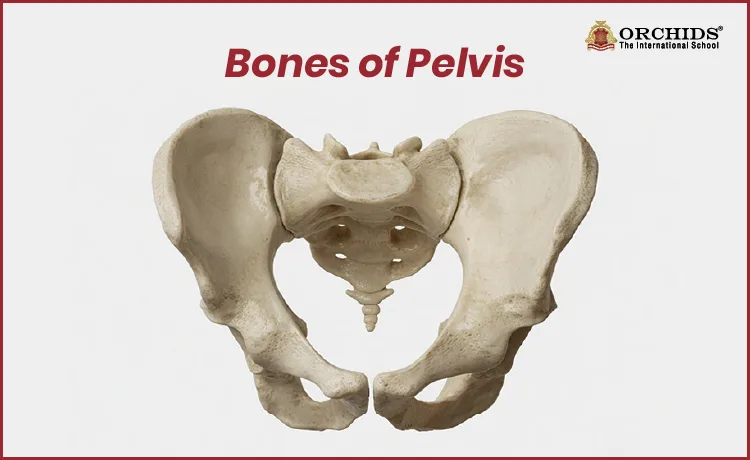
It is made up of four main bones: two hip bones, one sacrum, and one coccyx. These bones fit together like a strong, protective basin, forming the foundation that connects the spine to the legs.
So, how exactly do these bones work together? To understand their structure and function clearly, let’s look at the main types of pelvic bones in detail.
Main Bones of the Pelvis
Think of types of pelvic bones as a team, each has its own job, but they connect perfectly to support your body and let you move.
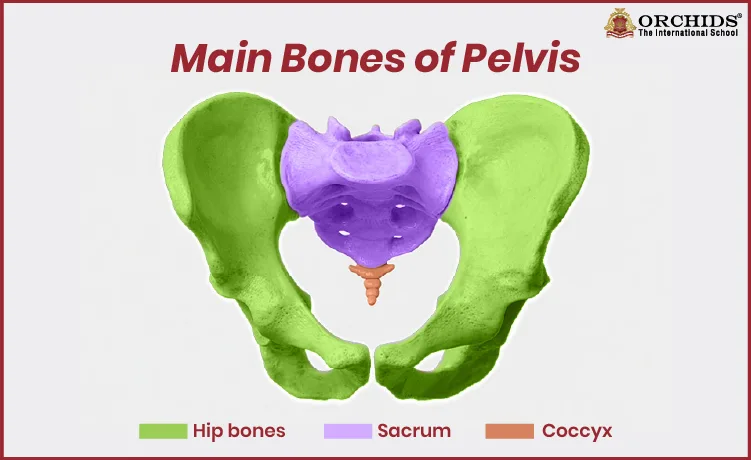
1. Hip Bones (Coxal Bones),the hip bones are pretty interesting because each one is actually made by joining three smaller bones. Together, they form the sides of your pelvis and create the socket for your hip joint.
2. Ilium, this is the broad, upper part. You can actually feel it at your waist, right around your hip.
3. Ischium, this part is at the lower back. It’s the bone that takes your weight when you’re sitting.
4. Pubis, that’s the front portion. The two pubic bones meet in the middle at the pubic symphysis, giving a little flexibility when needed.
All three meet at a cup-shaped area called the acetabulum. That’s where your thigh bone, the femur, fits in to form your hip joint. This joint is what lets you stand up, walk, run, or even dance!
5. Now, moving to the back, there’s the sacrum. It’s a triangular bone made by fusing five vertebrae. Basically, it’s the bridge connecting your spine to your hip bones. It forms the back wall of your pelvis and helps pass your body weight down to your legs. You can think of it as the backbone’s anchor for stability.
6. And right below that is the coccyx, or tailbone. It’s small but important. Made of fused tiny vertebrae, it gives attachments to ligaments and muscles in the pelvis. Plus, it helps you balance when you’re sitting.
Notice how all types of pelvic bones fit together? The pelvis is not just a collection of bones. It is a sturdy, flexible framework that shields your organs, holds your body upright, and helps you move with ease every day.
Also Read: Ball and Socket Joint
Structure of the Pelvis
Let’s take a closer look at the pelvis. Think of it as the body’s strong base, holding everything together while protecting the organs inside.
At the center, we have the pelvic cavity, which houses important organs like the bladder, reproductive organs, and parts of the intestines. The pelvic inlet at the top and the pelvic outlet at the bottom are like the entrances and exits that let everything function smoothly.
Now, the pelvis is split into two main regions:
- Greater (false) pelvis, this is the upper part. It supports the weight of your abdominal organs and connects your spine to your hips.
- Lesser (true) pelvis, this is the lower, more enclosed part. In women, it’s especially important because it forms the birth canal.
So basically, the pelvis isn’t just a bunch of bones. It’s a clever design that supports your body, protects vital organs, and lets you move comfortably. Everything works together, making sure you stay balanced and active in your daily life.
Functions of the Bones of Pelvis
The pelvic bones do much more than hold us upright. They work together to support the body, protect organs, and enable movement. But how exactly do they help us every day? Let’s learn each function step by step.
1. First, the pelvis acts as a solid base, supporting the weight of the upper body, whether we are standing, sitting, or moving. This strong foundation helps us maintain balance and good posture effortlessly.
2. Next, the pelvic bones form a protective shield around important organs. They keep the urinary bladder, reproductive organs, and parts of the intestines safe from injury. This shows how structure and safety are connected in the same system.
3. Movement, the pelvis also connects the spine to the legs, allowing smooth motion for walking, running, bending, and sitting. Without this link, our movements would be unsteady and less efficient.
4. Finally, in females, the pelvis is shaped to allow the baby to pass safely during childbirth. This highlights how the same bones provide strength, support, and adaptability for life events.
Every function of the pelvic bones is connected, forming a system that keeps the body strong, flexible, and protected in daily activities.
Key Differences Between Male and Female Pelvis
The male and female pelvis serve similar purposes, like supporting the body and protecting organs, but they also have important differences due to their specific functional needs.
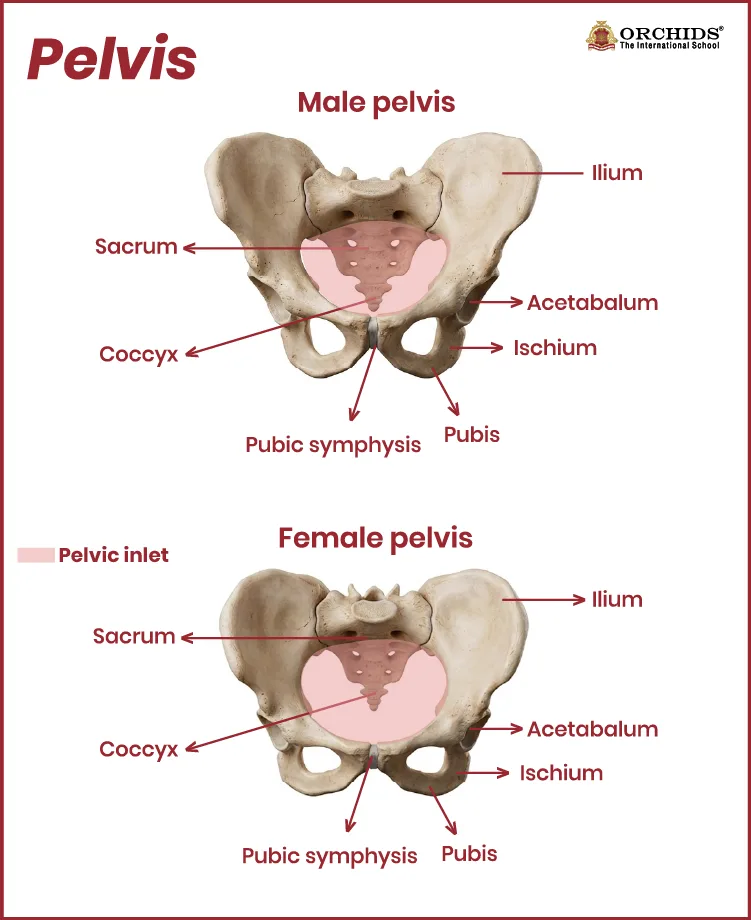
Before we look at the details, it’s helpful to see how these differences compare side by side:
|
Feature |
Male Pelvis |
Female Pelvis |
|
Shape |
Narrow and deep |
Wide and shallow |
|
Pelvic inlet |
Heart-shaped |
Oval or round |
|
Subpubic angle |
Smaller |
Wider |
|
Function |
Built for strength and stability |
Adapted for childbirth |
These variations explain why the female pelvis is generally wider and more circular, allowing for childbirth, while the male pelvis is narrower and stronger to support heavier musculature and body weight.
Also Read: Diagram of Neuron
Why Pelvic Bones Are Important?
The pelvic bones act as the central support of the body, holding up the upper body, protecting vital organs, and allowing smooth movement. Because the pelvis has so many roles, understanding its structure is essential for health, medicine, and daily activities. Its importance can be seen in several ways:
- They keep the body upright and balanced, helping us stand and move with stability.
- The hip bones, sacrum, and tailbone form a strong, protective frame for internal organs.
- Injuries or fractures in the pelvis can make walking, sitting, and other movements difficult.
- The shape and size of the pelvis are crucial during childbirth, allowing safe delivery.
- Hip joint pain and mobility issues are often linked to the structure of the pelvis.
- Nerve problems, such as sciatica, can arise due to pelvic misalignment or injury.
- Understanding the pelvis helps doctors plan treatments, surgeries, and maintain overall body strength.
Till now, we learnt that by understanding the structure and function of the pelvic bones, we gain a clearer view of how the human body maintains balance, strength, and stability every day.
Frequently Asked Questions on Bones of Pelvis
1. How many bones are in the pelvis?
The pelvis is made up of four main bones: two hip bones, one sacrum, and one coccyx. Each hip bone is formed by the fusion of the ilium, ischium, and pubis.
2. What are the three parts of the hip bone?
The hip bone consists of three fused bones: the ilium (upper part), ischium (back and lower part), and pubis (front part).
3. What is the main function of the bones of pelvis?
The bones of pelvis support body weight, protect internal organs, connect the spine to the lower limbs, and help in movement and childbirth.
4. What is the difference between male and female pelvis?
The female pelvis is wider and shallower to allow childbirth, while the male pelvis is narrower and heavier, built more for strength and stability.
5. Where is the pelvis located in the body?
The pelvis is located between the abdomen and the thighs. It forms the lower part of the trunk and connects the spine to the legs.
6. What is the acetabulum in the pelvis?
The acetabulum is a cup-shaped socket in the hip bone where the head of the femur (thigh bone) fits to form the hip joint.
7. What organs are protected by the pelvic bones?
The pelvic bones protect the urinary bladder, reproductive organs, and part of the large intestine.
8. Why are the bones of pelvis important in childbirth?
In females, the shape and size of the true pelvis form the birth canal, allowing the baby to pass during delivery.
Science isn't just a subject, it's the way of seeing the world. Curious how Orchids The International School teaches it that way? Talk to our admissions team.
Admissions Open for 2026-27
What type of concept pages would you prefer?
CBSE Schools In Popular Cities
- CBSE Schools in Bangalore
- CBSE Schools in Mumbai
- CBSE Schools in Pune
- CBSE Schools in Hyderabad
- CBSE Schools in Chennai
- CBSE Schools in Gurgaon
- CBSE Schools in Kolkata
- CBSE Schools in Indore
- CBSE Schools in Sonipat
- CBSE Schools in Delhi
- CBSE Schools in Rohtak
- CBSE Schools in Bhopal
- CBSE Schools in Aurangabad
- CBSE Schools in Jabalpur
- CBSE Schools in Jaipur
- CBSE Schools in Jodhpur
- CBSE Schools in Nagpur
- CBSE Schools in Ahmednagar
- CBSE School In Tumkur











Orchids The International School is one of India's leading chains of CBSE and ICSE schools, with 130+ schools across the country.