

Diagram of Neuron
A diagram of neuron helps us see how a nerve cell handles messages inside the body. We cannot watch this process happening with our eyes in real life, but when it is drawn on paper, the whole process becomes clear at one glance.
Interestingly, the same kind of tiny cells have been running the body’s signals from birth till now, and they keep doing the same work throughout life.
This article explains how to draw a neuron diagram and why this single picture makes the whole topic easy to understand and easy to remember.
Table of Contents
- What is a Neuron
- Draw a Diagram of Neuron and How You Actually Picture Them
- How Do Neurons Work?
- Frequently Asked Questions on Diagram of Neuron

What is a Neuron?
A neuron is basically a messenger cell inside our body. It picks up signals, carries them and hands them over to the next cell. These signals are in the form of tiny electrical and chemical messages.
Interestingly!! Neurons are present in the brain, in the spinal cord and in all the nerves that branch out to the rest of the body, and together they make the nervous system run.
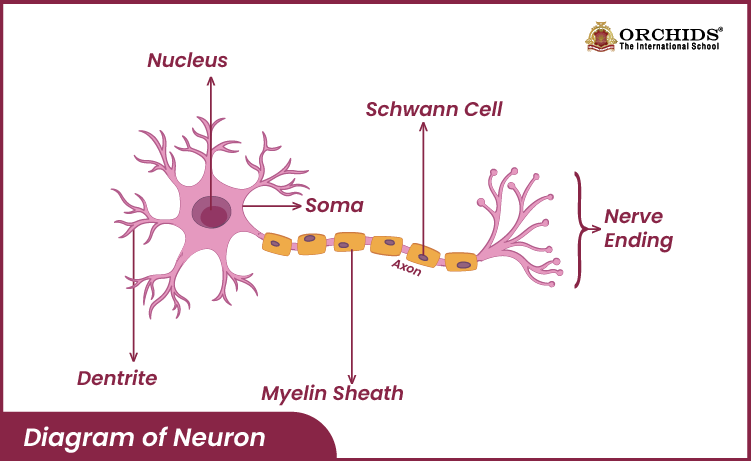
Just to get a sense of how many there are, the brain alone has nearly 86 billion of them.
Now, when it comes to studying this chapter, most people find that they do not remember long written notes for long.
What actually stays in the head is the picture of the neuron. Once you can clearly picture where the dendrites are, where the cell body lies and how the axon stretches out, the whole lesson begins to feel easy.
That is why the diagram becomes the anchor in the mind. When the picture is strong, the theory falls into place on its own.
Now that we know what a neuron is, the next natural doubt is: are all neurons the same?
The answer is no, there are different types of neurons. They look and work a little differently based on where they are and what job they do. We can look at them in two ways: by their shape and by their function.
First, let’s discuss the shape.
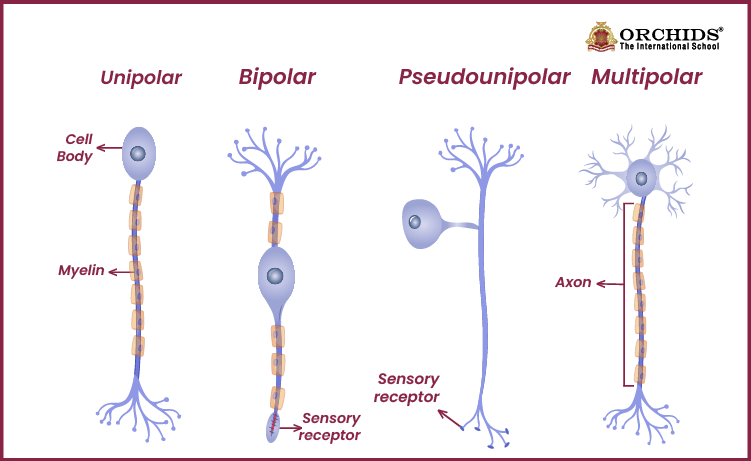
- Multipolar, this one has one long axon and many dendrites. These are the common ones we find in the brain and spinal cord.
- Bipolar, here there is just one axon and one dendrite. We mostly see these in the retina of the eye.
- Unipolar, this one has just one single branch leaving the cell body. They are more common in invertebrates.
- The pyramidal cell body looks like a triangle, and it has long dendrites. These sit in the cerebral cortex.
- Purkinje, these are the ones with huge, tree-like branching dendrites. They live in the cerebellum.
Once we look at the work they do, the group becomes even easier to understand.
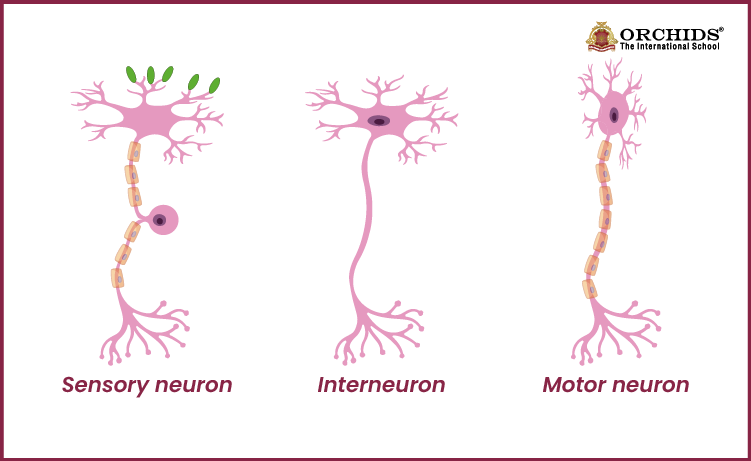
- Sensory neurons bring signals from sense organs to the brain. For example, the signal from your skin or eyes.
- Motor neurons carry the instructions from the brain to the muscles and glands, so the body can act.
- Interneurons work inside the brain and spinal cord and help connect neurons. They also help build reflex actions.
It is interesting to check that you can similarly learn to draw a well-labelled diagram of a motor neuron.
And once the basics about neuron diagrams are clear, let’s look at the core functions of a neuron.
Draw a Diagram of Neuron and How you Actually Picture Them
When you sit down to draw a labelled diagram of a neuron, the easiest way is to imagine how a message travels inside it and place the parts in that same order on the page.
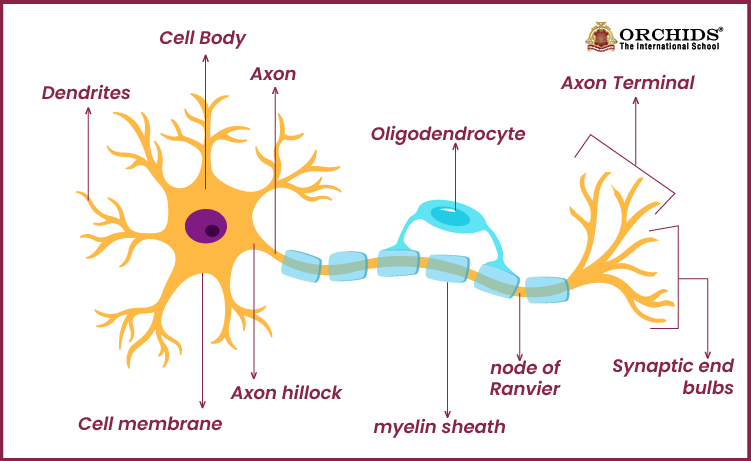
Let us go through the parts one by one.
- First is the Cell Body (soma).This part holds the nucleus and keeps the neuron alive and active.
In the diagram, you normally place this in the centre and write the label 'Cell Body' or 'Soma'.
- Next are the Dendrites. These look like short branches coming from the cell body. Their job is to receive messages from outside and bring them in.
On paper, you draw several short branches around the cell body and write the label Dendrites.
- After that comes the Axon. This is the long, tube-like part that carries the message away from the cell body. In the diagram, you pull a long line out from the cell body and label it as Axon.
- Along the axon sits the Myelin covering. This fatty layer helps the message travel faster and without loss. So in your drawing, you wrap the axon with small repeated blocks and write Myelin near it.
- Then you reach the Axon Terminals. These are the tiny ends of the axon that pass the message to the next cell.
And while drawing, you can split the end of the axon into small branches and write Axon Terminals.
- Finally comes the Synapse. This is the small space between two neurons where chemicals jump to pass the signal further.
You show this by leaving a tiny gap after the axon terminal and writing synapse near that gap.
After understanding the diagram and functions of a neuron, it becomes obvious how a neuron actually does its job.
Let’s break it down.
How Do Neurons Work?
First, the signal lands on the dendrites, those small branches that act like tiny antennas. From there, the message moves into the cell body, where it is checked and processed.
Once the cell decides to pass it on, the signal travels down the axon as an electrical impulse.
At the end of the axon, the signal reaches the terminals, and that is where chemicals are released into the synapse, the small gap between two neurons. The next neuron (or sometimes a muscle) picks up that chemical message and responds.
Depending on which chemical was released, the next cell may either get excited and start a signal of its own or slow down and stay quiet.
Practice Section:
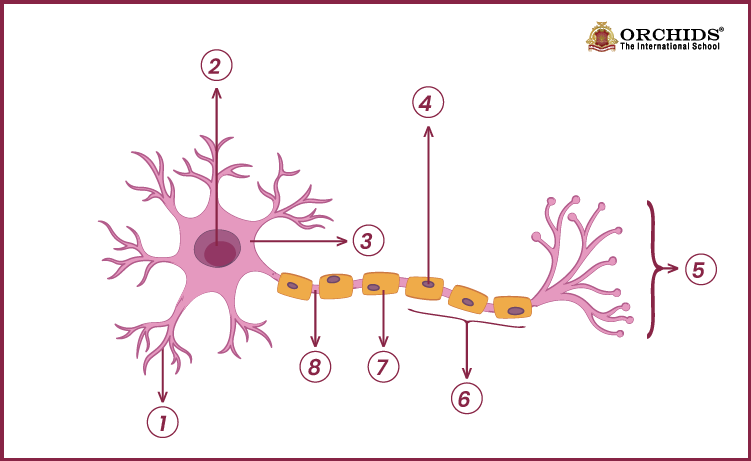
Observe the given neuron diagram carefully. Identify its major parts such as the cell body, dendrites, axon, myelin sheath, and axon terminals.
Now, try to label each part correctly in the spaces provided to test your understanding of the neuron’s structure and function.
After learning about the structure, you can test your understanding with these related questions on the diagram of a neuron.
- Draw a well-labelled diagram of a neuron.
- Draw a neat well well-labelled diagram of a neuron.
- Draw a well-labelled diagram of a motor neuron.
In this article, we learnt that the diagram of a neuron is a visual guide to understand how messages travel in our body through dendrites, axons, and synaptic terminals.
And remember, when you’re asked to draw a well-labelled diagram of a neuron or draw a neat well well-labelled diagram of motor neuron in exams, you’re not just sketching a cell, you’re showing how the nervous system communicates, controls actions, and connects every part of the body.
Frequently Asked Questions on Diagram of Neuron
1. What is a diagram of a neuron?
It is simply a labelled drawing that shows the main parts of a nerve cell, like the dendrites, the cell body, the axon and the synapse.
2. Why do teachers ask us to draw a well-labelled diagram of a neuron?
Because once you draw it with labels, the picture stays in your mind, and then the functions feel easier to remember in exams.
3. What are the must-have labels if we draw a neat well well-labelled diagram of a neuron?
You should at least mark dendrites, the cell body with the nucleus, the axon, the myelin covering, the axon terminals and the synapse.
4. Is a neuron only electrical or also chemical?
It works in both ways. The signal moves as electricity inside the neuron, and it jumps to the next cell using chemicals at the synapse.
5. Do all neurons look the same?
No, the basic plan is the same, but the shape changes with type and place, for example, the multipolar, bipolar, pyramidal or Purkinje neurons.
6. Where do we have neurons in our body?
They are found in the brain, the spinal cord and all the nerves that run through the rest of the body.
7. Can new neurons grow back if some are lost
Only a little. Some new neurons can form in special areas, but full natural replacement is rare, and scientists are still studying how to improve it.
Science isn't just a subject, it's the way of seeing the world. Curious how Orchids The International School teaches it that way? Talk to our admissions team.
Admissions Open for 2026-27
What type of concept pages would you prefer?
CBSE Schools In Popular Cities
- CBSE Schools in Bangalore
- CBSE Schools in Mumbai
- CBSE Schools in Pune
- CBSE Schools in Hyderabad
- CBSE Schools in Chennai
- CBSE Schools in Gurgaon
- CBSE Schools in Kolkata
- CBSE Schools in Indore
- CBSE Schools in Sonipat
- CBSE Schools in Delhi
- CBSE Schools in Rohtak
- CBSE Schools in Bhopal
- CBSE Schools in Aurangabad
- CBSE Schools in Jabalpur
- CBSE Schools in Jaipur
- CBSE Schools in Jodhpur
- CBSE Schools in Nagpur
- CBSE Schools in Ahmednagar
- CBSE School In Tumkur











Orchids The International School is one of India's leading chains of CBSE and ICSE schools, with 110+ schools across the country.