

Difference Between Gram-Positive and Gram-Negative Bacteria
The difference between Gram-positive and Gram-negative bacteria is one of the key foundations of microbiology. These two groups might sound similar because both are bacteria, but their structure, staining properties, and resistance to antibiotics make them quite different.
And have you ever thought why some bacteria respond easily to antibiotics while others are more difficult to treat? It is because of the cell wall composition.
This article focuses on what is the difference between Gram-positive and Gram-negative bacteria, how Gram staining helps identify them, and why understanding these two types is so important in medicine and microbiology.
Table of Contents
- Gram Staining and Bacterial Types
- Difference Between Gram-Positive and Gram-Negative Bacteria
- Frequently Asked Questions On Difference Between Gram-Positive and Gram-Negative Bacteria

Gram Staining and Bacterial Types
Have you ever wondered how scientists tell one type of bacteria from another?
The answer lies in Gram staining, a method developed by Hans Christian Gram. This technique uses a violet dye to see how bacteria react under a microscope.
So, what happens when bacteria are stained?
Let’s discuss.
Gram-positive bacteria hold on to the violet dye and appear purple, while Gram-negative bacteria do not, showing up pink or red after a counterstain.
And why does this happen?
It all comes down to their cell walls. Gram-positive bacteria have a thick peptidoglycan layer that traps the dye, but Gram-negative bacteria have a thin peptidoglycan layer with an outer membrane that lets the dye wash away.

But what does this mean for the bacteria themselves?
Let’s find out.
Gram-positive bacteria have a strong, single-layered wall made of peptidoglycan and teichoic acids, giving them rigidity.
On the other hand, Gram-negative bacteria have a thin wall plus an outer membrane made of lipoproteins, phospholipids, and lipopolysaccharides (LPS), which makes them tougher and more resistant to antibiotics.

By asking these questions, we can see why Gram staining is so useful in microbiology; it not only helps identify bacteria but also explains the difference between Gram-negative and Gram-positive bacteria.
Differences Between Gram-Positive and Gram-Negative Bacteria
It is interesting to learn the difference between Gram-positive and Gram-negative bacteria, as it lies in the structure of their cell walls, which affects how they respond to Gram staining and antibiotics.
|
Feature |
Gram-Positive Bacteria |
Gram-Negative Bacteria |
|
Cell Wall |
Single-layered and smooth |
Double-layered and uneven |
|
Cell Wall Thickness |
20–80 nm |
8–10 nm |
|
Peptidoglycan Layer |
Thick or multilayered |
Thin or single-layered |
|
Teichoic Acids |
Present |
Absent |
|
Outer Membrane |
Absent |
Present |
|
Porins |
Absent |
Present |
|
Morphology |
Cocci or spore-forming rods |
Non-spore-forming rods |
|
Flagella Structure |
Two rings in the basal body |
Four rings in the basal body |
|
Lipid Content |
Low |
20–30% |
|
Lipopolysaccharides (LPS) |
Absent |
Present |
|
Toxins Produced |
Exotoxins |
Endotoxins or Exotoxins |
|
Antibiotic Resistance |
More susceptible |
More resistant |
|
Examples |
Staphylococcus, Streptococcus |
E. coli, Salmonella |
|
Gram Staining Result |
Appears purple (retains stain) |
Appears pink (loses stain) |
Now, let’s look at a visual to get a clear picture of what is the difference between Gram-positive and Gram-negative bacteria.
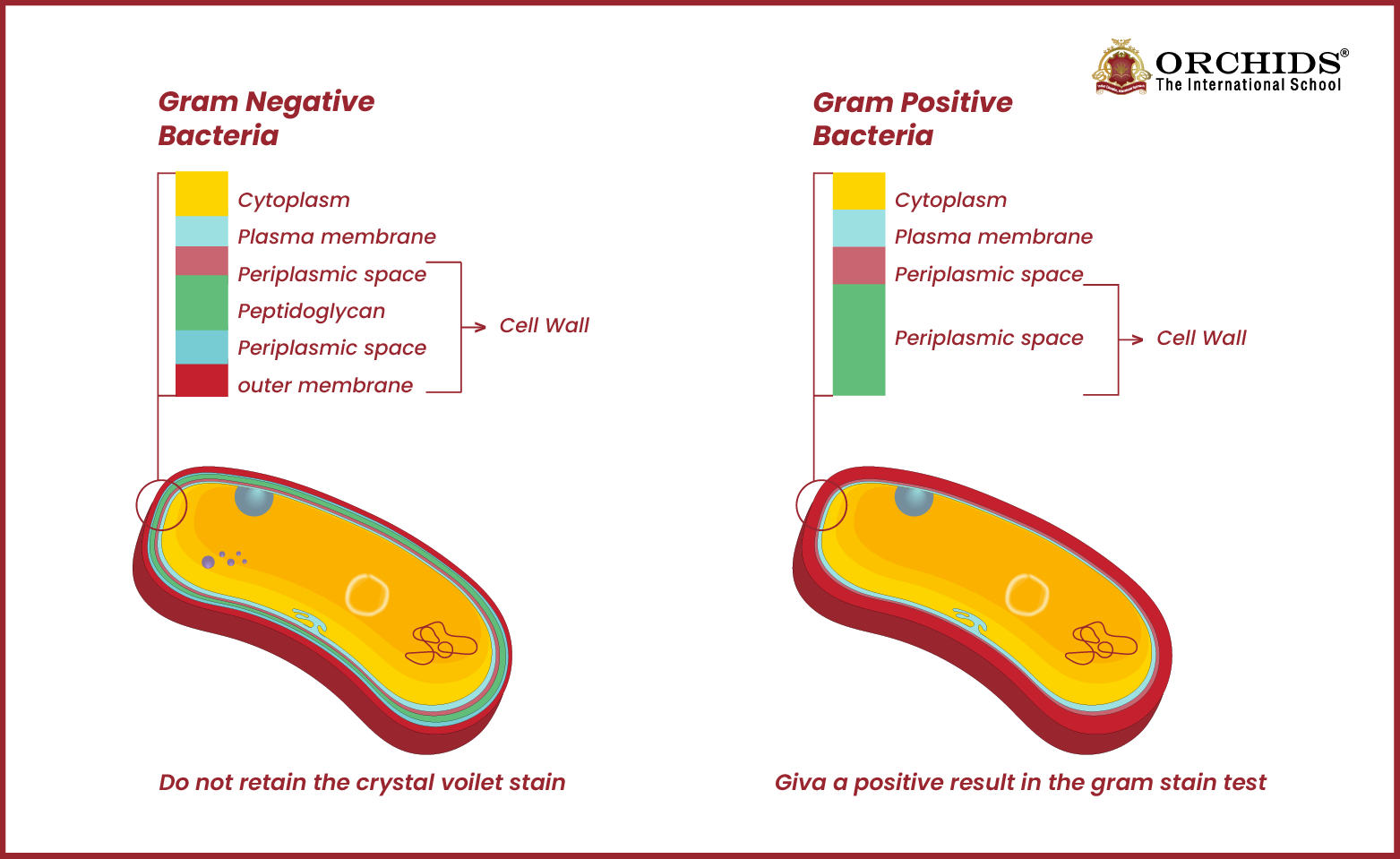
In this article, we discussed that Gram-positive bacteria have a thick cell wall and stain purple, while Gram-negative bacteria have a thin wall, stain pink, and are more resistant to antibiotics.
This simple structural difference between Gram-negative and Gram-positive bacteria makes a huge impact on how infections spread and how doctors treat them.
By understanding the difference between Gram-negative and Gram-positive bacteria, scientists and healthcare workers can diagnose diseases quickly, choose effective treatments, and protect public health more efficiently.
Frequently Asked Questions On Difference Between Gram-Positive and Gram-Negative Bacteria
1. Why do Gram-positive bacteria retain the violet stain?
They have a thick peptidoglycan layer that traps the violet dye even after washing with alcohol.
2. Gram-negative vs Gram-positive bacteria: Which bacteria are more resistant to antibiotics?
Gram-negative bacteria are more resistant because their outer membrane blocks many antibiotics.
3. What is the difference between Gram-positive and Gram-negative bacteria?
Gram-positive bacteria have thick peptidoglycan walls, while Gram-negative bacteria have thin walls and an extra outer membrane.
4. Gram-negative vs Gram-positive bacteria: Give two examples of each?
The examples of Gram-positive bacteria are Staphylococcus, Streptococcus and, contratsly the examples of Gram-negative bacteria are E. coli, Salmonella
5. Why are Gram-negative infections more difficult to treat?
Their outer membrane acts as a shield, preventing antibiotics and disinfectants from reaching the bacterial cell.
6. Who discovered the Gram staining method?
It was discovered by Hans Christian Gram in 1884 to classify bacteria based on how they react to dye.
7. Why is Gram staining important in microbiology?
It helps quickly identify bacterial types, guiding doctors to choose the right antibiotics for treatment.
Science isn't just a subject, it's the way of seeing the world. Curious how Orchids The International School teaches it that way? Talk to our admissions team.
Admissions Open for 2026-27
What type of concept pages would you prefer?
CBSE Schools In Popular Cities
- CBSE Schools in Bangalore
- CBSE Schools in Mumbai
- CBSE Schools in Pune
- CBSE Schools in Hyderabad
- CBSE Schools in Chennai
- CBSE Schools in Gurgaon
- CBSE Schools in Kolkata
- CBSE Schools in Indore
- CBSE Schools in Sonipat
- CBSE Schools in Delhi
- CBSE Schools in Rohtak
- CBSE Schools in Bhopal
- CBSE Schools in Aurangabad
- CBSE Schools in Jabalpur
- CBSE Schools in Jaipur
- CBSE Schools in Jodhpur
- CBSE Schools in Nagpur
- CBSE Schools in Ahmednagar
- CBSE School In Tumkur











Orchids The International School is one of India's leading chains of CBSE and ICSE schools, with 110+ schools across the country.