

Difference Between Fragmentation and Regeneration: Major Distinctions Explained
The difference between fragmentation and regeneration might sound quite simple when you first hear the words, and yes, their names explain a lot! Fragmentation happens when an organism literally breaks itself into pieces, and each piece grows into a new individual. On the other hand, regeneration occurs when an organism regrows a missing part of its body, such as a tail or limb, after it has been lost.
For instance, an octopus can regrow its arm if a predator bites it off. That’s regeneration in action, repairing itself, not creating a new organism.
This article explains what is the difference between fragmentation and regeneration, how they occur with easy examples.
Table of Contents
- Learn About Fragmentation vs Regeneration
- Difference Between Fragmentation and Regeneration
- Frequently Asked Questions on Difference Between Fragmentation and Regeneration

Learn About Fragmentation vs Regeneration
Is it possible for an organism to reproduce or repair itself without a partner?
Surprisingly, many do, and they rely on two amazing processes: fragmentation and regeneration
So, what exactly is fragmentation?
Let’s discuss.
It’s an asexual process where an organism breaks into parts, and each part develops into a new, complete individual. This is common in simple organisms like sponges, starfish, and flatworms.
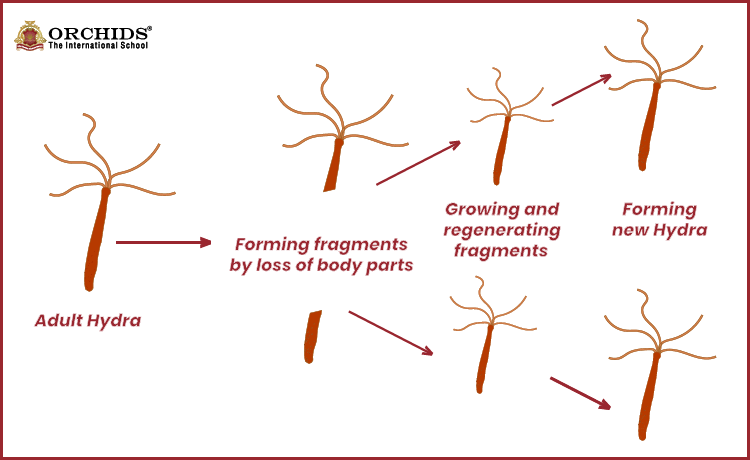
For instance, a lost starfish arm can sometimes grow into an entirely new starfish.
On the other hand, what about repairing instead of creating new individuals?
That’s where regeneration comes in.
It allows organisms to restore lost or damaged body parts. Lizards can regrow their tails, and planaria can even regenerate a full body from a small fragment. Special cells enable this by developing into different tissues.
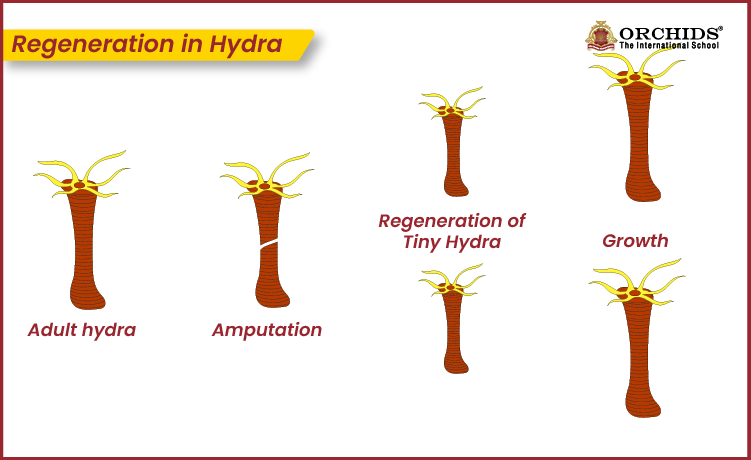
While lower organisms can regenerate fully, higher organisms, including humans, have limited abilities, such as healing wounds or repairing liver cells.
It is interesting to note that the main difference between regeneration and fragmentation highlights how organisms adapt to survive, grow, and repair themselves efficiently.
Difference Between Fragmentation and Regeneration
At first glance, both fragmentation and regeneration might seem similar since they both involve growth from body parts. But they serve very different purposes; one creates a new organism, while the other simply repairs an existing one.
Here’s a clear comparison to understand the difference between regeneration and fragmentation:
|
Feature |
Fragmentation |
Regeneration |
|
Definition |
The organism splits into parts, and each part grows into a new individual. |
The organism regrows a lost body part or tissue. |
|
Result |
Each fragment becomes a new organism. |
Only the lost part is restored; no new organism is formed. |
|
Purpose |
Reproduction |
Repair and survival |
|
Seen In |
Simple organisms like flatworms, sponges, and starfish. |
Organisms like lizards, planaria, and octopi. |
|
Type of Process |
Asexual reproduction |
Asexual reproduction (restorative) |
|
Complexity |
Common in simple, lower organisms |
Seen in both simple and higher organisms to varying degrees |
|
Example |
A starfish arm forming a new starfish |
A lizard regrowing its tail |
And now, to know what the difference between fragmentation and regeneration is more clearly, take a look at the image below:
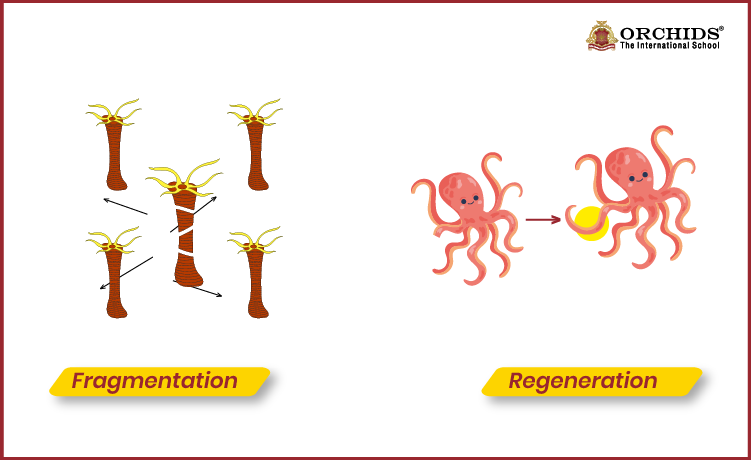
In this article, we learnt that fragmentation helps organisms multiply, while regeneration helps them heal or recover. Understanding the difference between regeneration and fragmentation not only highlights how living organisms reproduce and repair themselves but also helps us appreciate the adaptability and resilience of life itself.
Frequently Asked Questions on Difference Between Fragmentation and Regeneration
1. What is the difference between fragmentation and regeneration?
Fragmentation forms a new organism from each part, while regeneration only replaces a lost body part.
2. Is regeneration a type of asexual reproduction?
Yes, regeneration is a type of asexual reproduction where lost parts are replaced through cell division.
3. Can humans regenerate body parts?
Humans can regenerate certain tissues like skin or liver but cannot regrow whole organs or limbs.
4. Fragmentation vs regeneration: give one example of each?
For fragmentation, starfish is the best example, and the growing tail of a lizard is an apt instance of regeneration.
5. Which process helps in reproduction?
Fragmentation helps in reproduction since it forms new individuals, while regeneration mainly aids in repair.
6. Do all animals show fragmentation?
No, fragmentation mostly occurs in simple organisms like sponges and planaria.
7. Fragmentation vs regeneration: Why are both important?
Both help organisms survive; fragmentation ensures population growth, while regeneration helps recovery after injury.
Science isn't just a subject, it's the way of seeing the world. Curious how Orchids The International School teaches it that way? Talk to our admissions team.
Admissions Open for 2026-27
What type of concept pages would you prefer?
CBSE Schools In Popular Cities
- CBSE Schools in Bangalore
- CBSE Schools in Mumbai
- CBSE Schools in Pune
- CBSE Schools in Hyderabad
- CBSE Schools in Chennai
- CBSE Schools in Gurgaon
- CBSE Schools in Kolkata
- CBSE Schools in Indore
- CBSE Schools in Sonipat
- CBSE Schools in Delhi
- CBSE Schools in Rohtak
- CBSE Schools in Bhopal
- CBSE Schools in Aurangabad
- CBSE Schools in Jabalpur
- CBSE Schools in Jaipur
- CBSE Schools in Jodhpur
- CBSE Schools in Nagpur
- CBSE Schools in Ahmednagar
- CBSE School In Tumkur











Orchids The International School is one of India's leading chains of CBSE and ICSE schools, with 110+ schools across the country.