

Aloe Vera Botanical Name
When people search for Aloe vera botanical name, they usually want clear and accurate scientific information about this well-known medicinal plant. Aloe vera is widely used in skincare, herbal remedies, and traditional medicine across the world.
But what is its exact scientific identity? Why does it have a botanical name, and what does that name mean? In this article, you will learn the botanical name of Aloe vera, its meaning, plant classification, family details, common names, origin, uses, and why its scientific name is important.
Table of Contents
- What Is The Botanical Name Of Aloe Vera?
- Where Does Aloe Vera Grow Naturally?
- Importance of Knowing The Aloe Vera Botanical Name
- Common Uses of Aloe Vera
- Frequently Asked Questions on Aloe Vera Botanical Name

What Is The Botanical Name Of Aloe Vera?
The botanical name of Aloe vera is:
Aloe barbadensis Miller
This is the official scientific name recognised worldwide. While people commonly call the plant “Aloe vera,” its correct botanical classification is Aloe barbadensis Miller.
Botanical names are universal. They help scientists, doctors, researchers, and herbal experts identify the exact plant species without confusion.
Why does aloe vera have a botanical name? Let’s discuss.
Common names can vary by country and language. For example, Aloe vera may be called:
- Ghritkumari (in Hindi)
- Kumari (in Sanskrit)
- Medicinal aloe
However, the botanical name remains the same everywhere. Using Aloe barbadensis Miller ensures there is no confusion between different Aloe species.
And the meaning of the botanical name Aloe barbadensis Miller is as follows, and the scientific plant names usually have three parts:
- Aloe, the genus name (group of related plants)
- Barbadensis, the species name (refers to Barbados, where the plant was widely found)
- Miller, the name of the botanist who officially classified the plant
The genus Aloe includes more than 500 species, but Aloe barbadensis Miller is the most commonly used for medicinal purposes.
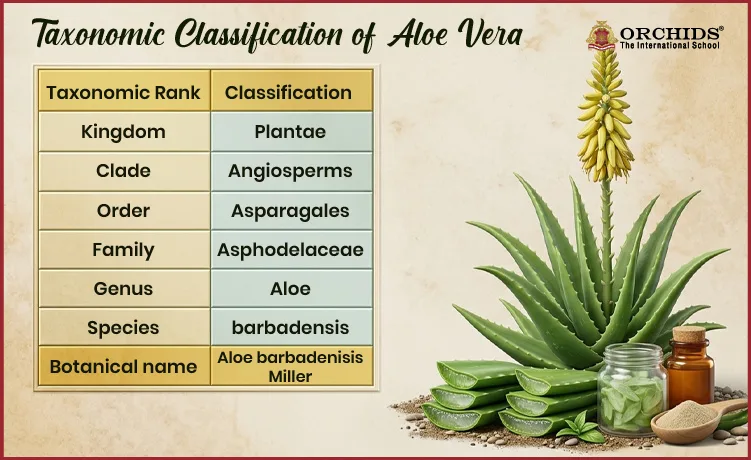
Here is the complete taxonomic classification of aloe vera:
|
Taxonomic Rank |
Classification |
|
Kingdom |
Plantae |
|
Clade |
Angiosperms |
|
Order |
Asparagales |
|
Family |
Asphodelaceae |
|
Genus |
Aloe |
|
Species |
barbadensis |
|
Botanical Name |
Aloe barbadensis Miller |
This classification helps researchers study the plant’s biological characteristics and medicinal properties.
Aloe vera belongs to the Asphodelaceae family. Plants in this family are mostly succulent plants, meaning they store water in their leaves.
This explains why Aloe vera has thick, fleshy leaves filled with gel.
Where Does Aloe Vera Grow Naturally?
Aloe vera is believed to have originated in the Arabian Peninsula. Today, it is widely grown in:
- India
- Africa
- Mediterranean regions
- Mexico
- United States
- Caribbean regions
The plant prefers warm climates, sandy soil, and good drainage. It grows well in dry areas because of its water-storing leaves.
Now you might think about how to identify Aloe Vera. Let’s look into it.
Aloe vera is easy to recognise due to its unique appearance:
- Thick, fleshy green leaves
- Spiky edges along the leaf margins
- Transparent gel inside the leaves
- Short stem or stemless growth pattern
The gel inside the leaves is the most valuable part and is widely used in skincare and health products.
Importance of Knowing The Aloe Vera Botanical Name
Understanding the Aloe vera botanical name is important for several reasons:
- Ensures accurate identification of the correct species
- Avoids confusion with other Aloe varieties
- Helps in scientific research and medical studies
- Important for herbal product labelling
- Useful for academic and exam purposes
Many Aloe species exist, but not all have the same medicinal value. That is why using the correct scientific name matters.
Common Uses Of Aloe Vera
Although this article focuses on the botanical name, it helps to understand why Aloe vera is so popular:
- Skin hydration and healing
- Soothing burns and sunburn
- Supporting digestion
- Used in cosmetics and herbal products
- Hair and scalp care
Its wide range of benefits is one reason why the plant has been studied extensively.
Till now, we have studied that the Aloe vera botanical name, Aloe barbadensis Miller, ensures accurate identification, reflects its classification, and highlights its importance in medicine, skincare, and herbal uses.
Frequently Asked Questions on Aloe Vera Botanical Name
1. What is the correct botanical name of Aloe vera?
The correct botanical name of Aloe vera is Aloe barbadensis Miller, which is the internationally accepted scientific name of the plant.
2. Why is Aloe vera scientifically known as Aloe barbadensis Miller?
The scientific name of aloe vera follows the binomial nomenclature system where Aloe indicates the genus, barbadensis identifies the species, and Miller credits the botanist Philip Miller.
3. Is Aloe barbadensis Miller the only scientific name of Aloe vera?
Aloe barbadensis Miller is the most widely accepted botanical name, though Aloe vera may sometimes be used informally in scientific texts.
4. What is the genus and species of Aloe vera?
The genus of Aloe vera is Aloe, and the species is barbadensis, forming the full botanical name Aloe barbadensis Miller.
5. Which family does Aloe vera belong to in plant classification?
Aloe vera belongs to the Asphodelaceae family, a group of flowering succulent plants.
6. How does the scientific name of aloe vera help identify Aloe vera?
The botanical name ensures accurate identification worldwide, especially in medicine, agriculture, and scientific research.
7. Are all Aloe species medicinal like Aloe vera?
No, while there are over 500 species in the Aloe genus, Aloe barbadensis Miller is the species most commonly used for medicinal and cosmetic purposes.
8. Who classified Aloe vera under its botanical name?
The botanical name Aloe barbadensis Miller was formally described and classified by the botanist Philip Miller.
Science isn't just a subject, it's the way of seeing the world. Curious how Orchids The International School teaches it that way? Talk to our admissions team.
Admissions Open for 2026-27
What type of concept pages would you prefer?
CBSE Schools In Popular Cities
- CBSE Schools in Bangalore
- CBSE Schools in Mumbai
- CBSE Schools in Pune
- CBSE Schools in Hyderabad
- CBSE Schools in Chennai
- CBSE Schools in Gurgaon
- CBSE Schools in Kolkata
- CBSE Schools in Indore
- CBSE Schools in Sonipat
- CBSE Schools in Delhi
- CBSE Schools in Rohtak
- CBSE Schools in Bhopal
- CBSE Schools in Aurangabad
- CBSE Schools in Jabalpur
- CBSE Schools in Jaipur
- CBSE Schools in Jodhpur
- CBSE Schools in Nagpur
- CBSE Schools in Ahmednagar
- CBSE School In Tumkur











Orchids The International School is one of India's leading chains of CBSE and ICSE schools, with 130+ schools across the country.