

What Is Life: Biological Definition and Characteristics
What is Life? Life is all around us. From tiny bacteria to huge trees and human beings, living things exist in many forms. But have you ever wondered what actually makes something “alive”?
In biology, life is not seen as a thing but as a process. Any organism is said to be alive when it shows certain basic features such as growth, metabolism, reproduction, response to the environment, and organisation. This article will help you understand this concept in a simple and clear way.
Table of Contents
- Biological Definition of Life
- What are the Main Characteristics of Life
- Frequently Asked Questions on What is Life

Biological Definition of Life
The definition of life goes beyond just existing or moving. Biologists define living organisms by a set of features that work together to sustain life. Non-living things may show one or two of these traits, but only living beings display all of them at the same time
These features are closely connected, as growth depends on metabolism, adaptation occurs through reproduction, and homeostasis supports the survival of the organism.
Interestingly! Scientists believe that life began nearly 4.1 billion years ago. Fossils found in ancient rocks suggest that living organisms existed long before complex life forms appeared.
What Are the Main Characteristics of Life?
Living organisms are complex, and understanding what makes something “alive” means looking closely at the features that set living beings apart from non-living things.
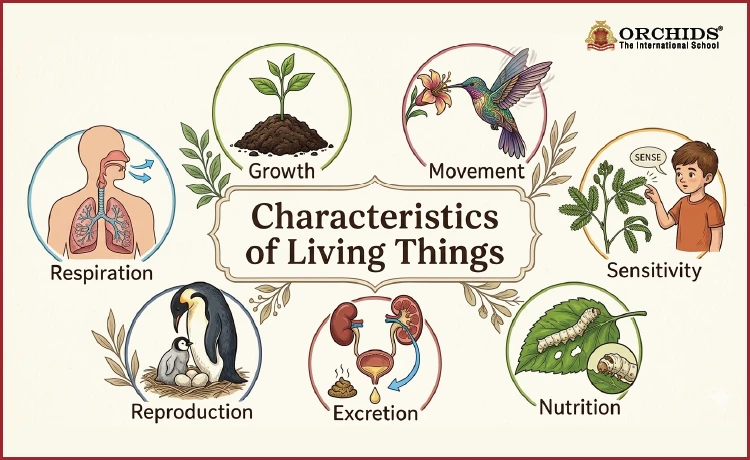
Let’s understand these characteristics one by one.
1. One of the most striking aspects of life is organisation. Living organisms are not random collections of matter; they are highly structured.
Every organism, whether as tiny as a single-celled bacterium or as complex as a human, is made up of cells, the basic units of life. Even a single cell is a marvel of organised processes.
In multicellular organisms, this organisation becomes even more remarkable. Cells join together to form tissues, which then form organs. These organs do not work in isolation; they form organ systems that function together to sustain life.
It’s like a perfectly coordinated system where every component has a clear role, working seamlessly to maintain the whole.
2. Closely tied to this is metabolism, the engine that keeps organisms alive. Metabolism includes all the chemical reactions that occur within an organism, providing energy for movement, growth, and repair.
It is a balance of building and breaking down; anabolism constructs complex molecules from simpler ones, while catabolism breaks molecules down to release energy.
This intricate balance ensures that living beings can grow, respond to their environment, and carry out all the activities necessary for survival.
3. Another vital feature of living organisms is homeostasis, the ability to maintain internal stability despite external changes.
Ever noticed how your body stays warm on a cold day or regulates sugar levels after a meal? That’s homeostasis at work.
By carefully controlling conditions like temperature, water balance, and chemical composition, organisms create a stable internal environment that allows their cells to function efficiently.
4. Of course, living things also exhibit growth, but not in the random way non-living things might expand. In single-celled organisms, growth often means the cell increases in size.
In more complex organisms, growth happens as cells divide and multiply in a highly controlled manner. Every new cell and tissue contributes to a larger, organised structure, reflecting the intricate planning inherent in life itself.
5. Reproduction is another defining trait. Life is self-perpetuating, and organisms reproduce to ensure the survival of their species.
This can happen through asexual reproduction, where a single organism creates offspring identical to itself, or sexual reproduction, where two organisms contribute genetic material through fertilisation to produce a new individual.
This process not only continues the lineage but also introduces variation, which is essential for adaptation and evolution.
6. Living organisms also can respond to stimuli, a feature that allows them to interact with and adapt to their environment.
This can be as simple as withdrawing your hand from a hot surface or as subtle as a plant bending toward sunlight.
Even microorganisms like bacteria move toward nutrients in their surroundings. These responses are vital for survival, helping organisms understand challenges and opportunities in their environment.
6. Finally, over longer timescales, living organisms exhibit evolution, the gradual change in species over generations. Evolution allows organisms to develop traits that enhance their survival and reproduction.
These advantageous traits are passed on, enabling populations to adapt to changing environments over time. This ongoing process of change and adaptation is one of the most remarkable aspects of life, shaping the diversity of organisms we see today.
Below is the simple overview of what life is!
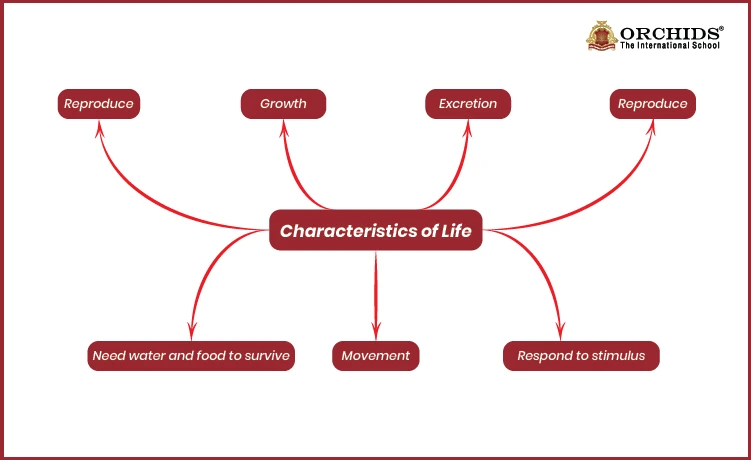
Together, these characteristics paint a comprehensive picture of what it means to be alive. They show life as a dynamic, intricate system, constantly maintaining balance, adapting, and evolving.
In this article, we learnt what is life and how life is not just about being alive. It is about how organisms function, grow, respond, and adapt. Understanding the concept of life in biology helps us see ourselves and other organisms in a meaningful way.
Frequently Asked Questions on What is Life
1. What is the biological definition of life?
Life is a process that includes growth, reproduction, metabolism, organisation, and response to stimuli. Anything that shows all these features is considered living.
2. What are the key characteristics of life?
The main characteristics include cellular structure, metabolism, growth, reproduction, response to stimuli, homeostasis, and evolution.
3. How is growth in living beings different from non-living things?
Living beings grow internally through cell division, while non-living things grow by external addition of material.
4. Can non-living things ever be alive?
No. Non-living things do not have cells, metabolism, reproduction, or the ability to respond to the environment.
5. What makes a single cell enough for life?
A single cell can perform all essential life processes, including metabolism, growth, reproduction, and response to stimuli.
6. Is energy use necessary for life?
Yes. All living organisms need energy to grow, reproduce, repair themselves, and respond to their surroundings.
7. Do all living things eventually die?
Yes. Every living organism has a life cycle, and death occurs when it can no longer maintain life processes.
8. Can a living thing stop being alive and then come back, like seeds or spores?
Some organisms can remain dormant, appearing inactive. They are still alive because they can resume growth, reproduction, and metabolism under favourable conditions.
Science isn't just a subject, it's the way of seeing the world. Curious how Orchids The International School teaches it that way? Talk to our admissions team.
Admissions Open for 2026-27
What type of concept pages would you prefer?
CBSE Schools In Popular Cities
- CBSE Schools in Bangalore
- CBSE Schools in Mumbai
- CBSE Schools in Pune
- CBSE Schools in Hyderabad
- CBSE Schools in Chennai
- CBSE Schools in Gurgaon
- CBSE Schools in Kolkata
- CBSE Schools in Indore
- CBSE Schools in Sonipat
- CBSE Schools in Delhi
- CBSE Schools in Rohtak
- CBSE Schools in Bhopal
- CBSE Schools in Aurangabad
- CBSE Schools in Jabalpur
- CBSE Schools in Jaipur
- CBSE Schools in Jodhpur
- CBSE Schools in Nagpur
- CBSE Schools in Ahmednagar
- CBSE School In Tumkur











Orchids The International School is one of India's leading chains of CBSE and ICSE schools, with 110+ schools across the country.