

What is Photosynthesis: How It Works, Steps and Interesting Facts
What is photosynthesis? It is something that happens around us every day, even though we often do not notice it. It is the natural process by which green plants make their own food using sunlight, water, and carbon dioxide from the air. While plants use this process to grow and stay healthy, it also plays a huge role in keeping life on Earth alive.
The oxygen we breathe and most of the food we eat exist because of photosynthesis. From tall trees to tiny algae in water, this process works silently to support all living beings. In this article, we explain what is photosynthesis, how it works inside plants, photorespiration and why it is so important for humans, animals, and the environment.
Table of Contents
- What Do You Mean By Photosynthesis
- The Overall Process of Photosynthesis
- Real Life Importance and Uses of Photosynthesis
- Frequently Asked Questions on What is Photosynthesis

What Do You Mean By Photosynthesis
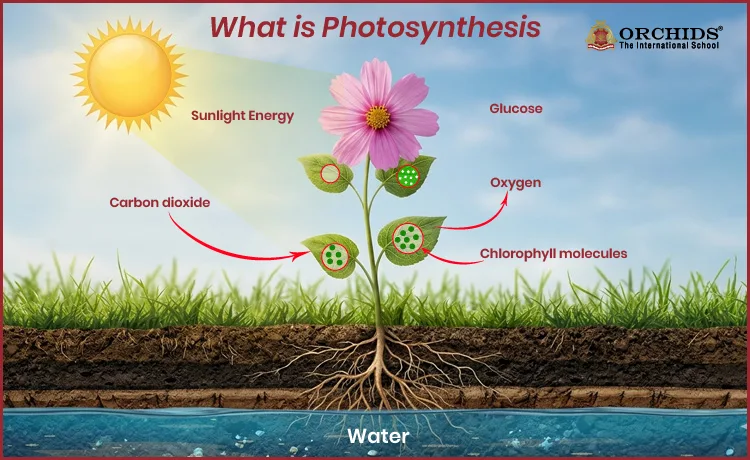
Photosynthesis is the way green plants, algae, and some bacteria make their own food using sunlight, carbon dioxide, and water.
During this process, light energy changes into chemical energy, glucose is prepared as food, and oxygen is released into the air. In simple terms, plants feed themselves through photosynthesis and at the same time provide oxygen for life on Earth.
This idea was not always known.
In the eighteenth century, scientist Joseph Priestley performed a small but meaningful experiment.
When he placed a burning candle or a mouse inside a closed glass jar, neither survived for long. However, when a green plant was added to the jar, both the flame and the mouse lasted much longer.
From this, he realised that plants improve the air by giving out oxygen. Later, Jan Ingenhousz added an important discovery by showing that this process works only in sunlight and mainly in the green parts of plants.
To see where this happens inside a plant, we look at the leaf cells. Photosynthesis occurs in tiny green structures called chloroplasts, found mostly in the mesophyll of leaves.
Inside each chloroplast, the grana absorb sunlight, the stroma helps make glucose, and thin connections between them allow energy to move easily. This setup helps the plant capture and use sunlight in the best possible way.
Even though photosynthesis works naturally, its speed is not always the same.
According to Blackman’s Law, when several factors affect a process, the slowest one controls the rate. In the same way, photosynthesis depends on light, carbon dioxide, water, and temperature. If any one of these is low, the whole process slows down.
Together, these ideas explains what is photosynthesis and how plants make food and why photosynthesis is essential for every living thing.
The Overall Process of Photosynthesis
Photosynthesis happens in two main stages that work together to help plants make food. Each stage has its own role, and both are equally important for the process to succeed.
1. First comes the light-dependent stage, which takes place in the thylakoid membranes of the chloroplast. In this stage, chlorophyll absorbs sunlight and uses that energy to break water into oxygen, protons, and electrons.
Oxygen is released into the air, while energy-rich molecules called ATP and NADPH are formed. These molecules carry energy forward to be used in the next step.
2. After this, the process moves into the Calvin cycle, which happens in the stroma of the chloroplast. This stage does not need light directly, but it depends on the energy made earlier. Carbon dioxide first joins with a molecule called RuBP using the enzyme RuBisCO.
Then ATP and NADPH help change this into glucose. Finally, RuBP is formed again so the cycle can continue. In this way, sugar is produced and stored as energy for the plant.
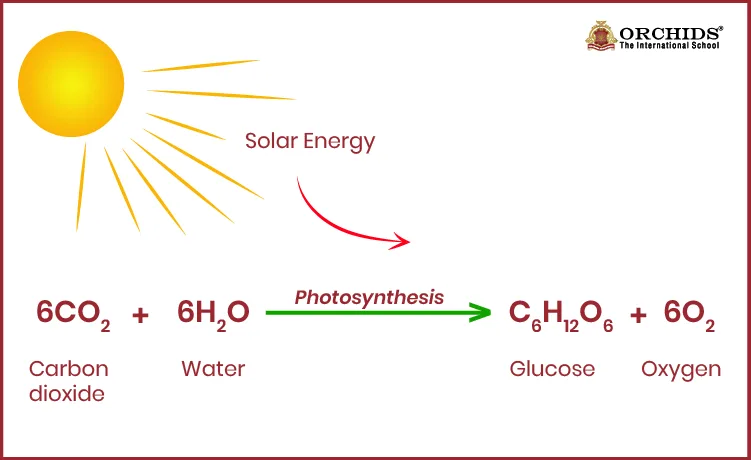
3. The entire process can be summed up in one chemical equation that shows how raw materials become food and oxygen:
6CO₂ + 6H₂O + sunlight → C₆H₁₂O₆ + 6O₂
This means carbon dioxide and water, in the presence of light, form glucose and oxygen.
4. Inside the light stage, energy moves in a smooth path through the electron transport chain. Electrons first get excited in Photosystem II, then pass through a chain of proteins before reaching Photosystem I.
From there, NADP is changed into NADPH. Because the movement looks like a zigzag pattern, it is often called the Z-pathway. This movement helps the plant store energy efficiently.
5. There are also two ways plants make ATP during this stage. In cyclic photophosphorylation, only Photosystem I is involved and electrons move in a circle, producing only ATP.
In contrast, non-cyclic photophosphorylation uses both Photosystem I and II, produces ATP and NADPH, and releases oxygen. Here, electrons flow in one direction and do not return.
6. Sometimes, plants perform a process called photorespiration. Unlike photosynthesis, it uses oxygen and releases carbon dioxide. It does not make energy and takes place only in light. Because of this, it lowers the plant’s efficiency instead of helping it grow.
Together, these steps show how sunlight is turned into food, air, and energy that support life on Earth.
Real-Life Importance and Uses of Photosynthesis
Photosynthesis may sound like a classroom topic, but in reality, it touches almost every part of our lives. Even when we are not aware of it, this process works continuously to keep the world alive.
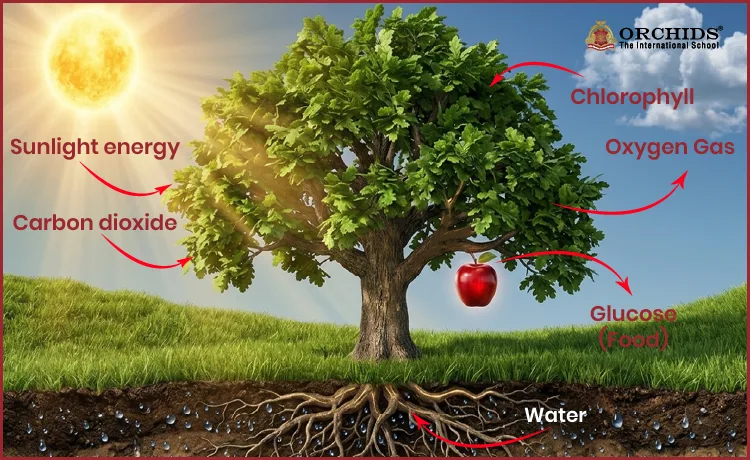
The air we breathe, the food we eat, and the green spaces we enjoy all exist because of photosynthesis.
1. To begin with, its presence can be seen in many everyday examples. Trees release oxygen that fills the air around us. Crops grow and provide food for families and communities.
2. In lakes, rivers, and seas, algae produce oxygen and support aquatic life. Along with this, oceans alone supply nearly half of the Earth’s oxygen. Not only in nature, but also in human-made places like greenhouses, people use this process to grow plants in a healthy and controlled way.
3. In addition to these visible effects, photosynthesis plays a deeper role in keeping the planet balanced. It helps plants make their own food, releases oxygen, and maintains the balance between carbon dioxide and oxygen in the atmosphere.
4. At the same time, it reduces the amount of harmful greenhouse gases, which helps control rising temperatures. Since all food chains begin with plants, entire ecosystems survive because of photosynthesis. Without this process, plants would disappear first, and slowly both animals and humans would struggle to survive.
5. Beyond the natural world, photosynthesis also supports scientific progress. Because of what we know about this process, farmers can produce more crops, scientists can work toward artificial photosynthesis, and researchers can develop cleaner energy solutions.
And it plays an important role in biotechnology and in the global effort to fight climate change.
Finally, we can say that photosynthesis connects nature, people, and technology into one system. It is the reason life continues today and hope grows for a healthier future.
Frequently Asked Questions on What is Photosynthesis
1. Why do plants need sunlight?
Sunlight provides the energy plants need to make food. Without sunlight, they cannot produce glucose or oxygen.
2. Can photosynthesis happen at night?
No, photosynthesis mainly occurs during the day because sunlight is required. However, some parts like the Calvin cycle can continue using stored energy.
3. Do all plants perform photosynthesis the same way?
Most plants use the same process, but some, like cacti, have adaptations to save water while performing photosynthesis efficiently.
4. How does water reach the leaves for photosynthesis?
Water is absorbed by the roots from the soil and transported to the leaves through xylem vessels.
5. What happens to the glucose produced in photosynthesis?
Glucose is used by the plant for energy, growth, and storage. Excess glucose can be stored as starch.
6. Why do leaves appear green?
Leaves look green because chlorophyll absorbs sunlight but reflects green light, which is why we see them as green.
7. How does photosynthesis help reduce carbon dioxide in the air?
During photosynthesis, plants take in carbon dioxide from the atmosphere to make glucose, helping reduce excess CO₂.
8. Can algae and bacteria perform photosynthesis like plants?
Yes! Algae and certain bacteria also perform photosynthesis, using sunlight to make food, though their structures are different from plants.
9. How does photosynthesis support life on Earth?
It produces oxygen for breathing and food for animals and humans, forming the base of the food chain.
10. What factors affect the rate of photosynthesis?
Light intensity, carbon dioxide levels, water availability, and temperature all affect how fast plants can produce glucose.
Science isn't just a subject, it's the way of seeing the world. Curious how Orchids The International School teaches it that way? Talk to our admissions team.
Admissions Open for 2026-27
What type of concept pages would you prefer?
CBSE Schools In Popular Cities
- CBSE Schools in Bangalore
- CBSE Schools in Mumbai
- CBSE Schools in Pune
- CBSE Schools in Hyderabad
- CBSE Schools in Chennai
- CBSE Schools in Gurgaon
- CBSE Schools in Kolkata
- CBSE Schools in Indore
- CBSE Schools in Sonipat
- CBSE Schools in Delhi
- CBSE Schools in Rohtak
- CBSE Schools in Bhopal
- CBSE Schools in Aurangabad
- CBSE Schools in Jabalpur
- CBSE Schools in Jaipur
- CBSE Schools in Jodhpur
- CBSE Schools in Nagpur
- CBSE Schools in Ahmednagar
- CBSE School In Tumkur











Orchids The International School is one of India's leading chains of CBSE and ICSE schools, with 110+ schools across the country.