

Diagram of Eye
A diagram of eye lets us see the whole set of parts in one picture and makes it easier to understand how we are able to see the world. The real eye works inside the skull, and most parts are hidden. We cannot see them in a mirror, but a labelled diagram of eye puts all of them in front of us in one shot.
What many people forget is that the eye does not only look. It catches light, bends it, builds an image and passes that image to the brain. It is the brain that finally turns that image into what we call “seeing”.
In this article, we will learn two things together. First, what each part of the eye diagram does in simple words. Second, how to draw a labelled diagram of human eye the way teachers expect in exams.
Table of Contents
- What do we mean by the structure of the eye diagram?
- How to draw a diagram of the human eye?
- Major Functions of Eye
- Frequently Asked Questions on Diagram of Eye
Before we even pick up a pencil to draw the diagram of eye, it is good to first know what the eye is made of and what each part is doing in real life.

What do we mean by the structure of the eye diagram?
In everyday words, the eye is a small, round organ that catches light from the world and passes that information to the brain so that we can see things around us.
So, how do eyes work?
Let’s discuss
Once you place these parts in order, you can literally trace the path of light: it enters through the cornea and is controlled by the iris and pupil.
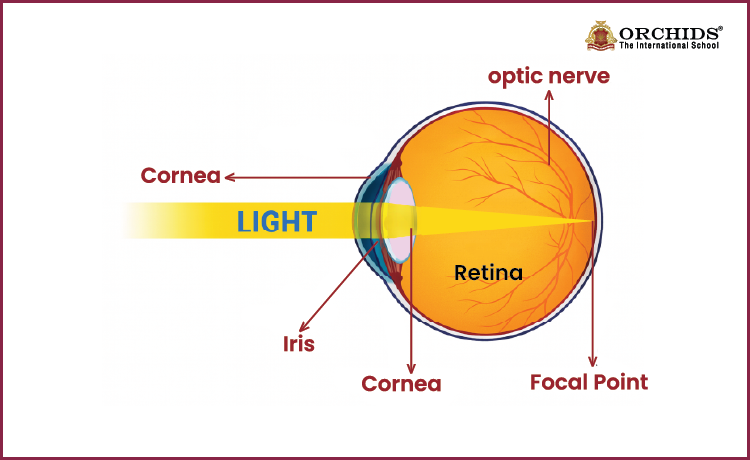
Later, it is bent by the lens, travels through fluid spaces, lands on the retina and finally exits as signals along the optic nerve to reach the brain.
If we put this whole process of the structure of eye diagram in one straight line, it goes like this:
Light comes in → Cornea bends it → Pupil controls it → Lens makes it sharp → Retina reads it → Optic nerve carries it → Brain makes the picture
Also Read: Diagram of Heart
Now there’s an obvious question: how to draw a labelled diagram of the human eye?
How to Draw a Diagram of Human Eye
The answer lies here:
When a question is asked about how to draw a diagram of the human eye, the simplest way is to think is how the eye is built layer by layer. The eyeball is not a perfect sphere. It is made of two fused segments of about 2.3 cm in width.
To understand these better, take a look at this diagram of the human eye with labelling, which shows how each part works together to support vision.
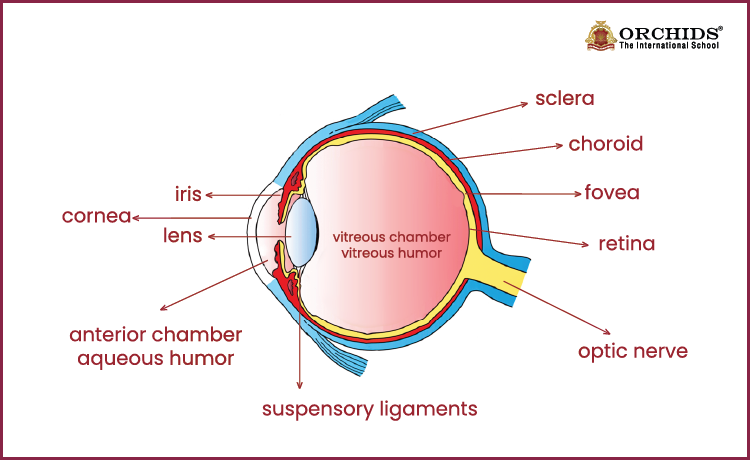
Now, let us walk through each part in the same order in which the eye is built:
First, let us look at the outside parts and why they are needed:
1) The white part is called the sclera. You can think of it like a strong outer shell. It keeps the shape of the eye and protects the soft parts inside.
On top of that white part, there is a thin, clear skin. This is the conjunctiva. It keeps the eye moist and stops dust and germs from harming the eye.
2) In the centre, the white shell becomes see-through. That clear window is the cornea. Light enters the eye through this window, and its bending starts here.
3) Now, if you notice the coloured ring, that is the iris. It can make the black opening in the centre, called the pupil, become big or small depending on how bright the light is.
In bright light, the pupil becomes small. In dim light, it becomes big so that more light can go in.
4) And then the choroid is a blood-rich middle layer that feeds the inner tissues.
Now, let us see the inside parts and how they help us see. After light passes through the pupil, it meets a few more parts that finish the work.
5) At the back wall of the eye, there is a thin living layer called the retina. It catches the light picture and turns it into tiny signals.
6) Right behind the pupil sits a clear biconvex lens. It hangs by ligaments from a muscular ciliary body. The lens changes shape to focus the image on the retina.
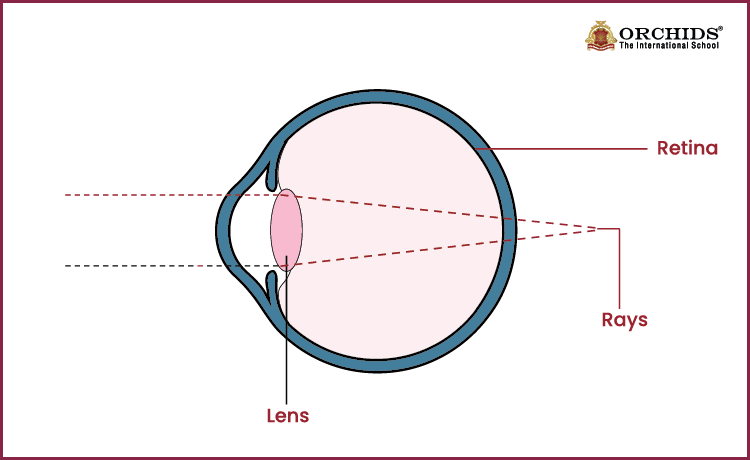
7) The fovea in the macula is a tiny depression on the retina that gives the most detailed central vision.
8) Optic nerve: These signals do not stay in the eye. They travel out through the optic nerve to the brain. The brain then reads these signals, and that is when we actually see.
9) Interestingly!! The spaces around the lens are not empty. The front space has a watery fluid called aqueous humour, and the big back space has a jelly called vitreous humour. These fluids keep the eye firm and also feed some parts
The diagram of the eye is not just a drawing exercise. It is a compressed picture of how seeing actually works.
Also Read: Diagram of Neuron
Next, let's look at the functions of the eye.
Major Functions of Eye
It is interesting to note that eye structure is not some chapter we study and forget. It quietly explains the things we feel in our eyes every single day.
Let’s break down each functions of eye in detail.
- If screens are used for long hours, the pupil stays open to bright light and the lens keeps refocusing, making the eyes feel heavy or strained.
- And in air-conditioned rooms, blinking slows down, reducing moisture on the cornea and conjunctiva, causing dryness, burning, or a sandy feeling.
- Even a little dust or smoke can irritate the eye’s outer layer, leading to redness and tears.
- Lastly, clarity issues often come from structure; hazy distance vision means the lens isn’t focusing properly, while double letters or dull colours point to retinal strain.
So the structure of eye diagram is not just a labelled picture for exams. It is a reminder that this organ is built like a tiny precision machine, and every part has its own function that shows up in real life whenever something goes off.
And what about the muscles around the eye? Let’s find out.
The fact is that even eye movement depends on structure. Six tiny muscles outside the eyeball keep the eye pointing where we want to see.
You can understand this better by looking at the diagram of human eye with labelling.
- The medial rectus pulls the eyeball towards the nose
- The lateral rectus pulls the eyeball outward
- Superior rectus lifts the eye upward
- Inferior rectus pulls the eye downward
- Superior oblique rotates and tilts the eye downward and inward
- The inferior oblique rotates and tilts the eye upward and outward
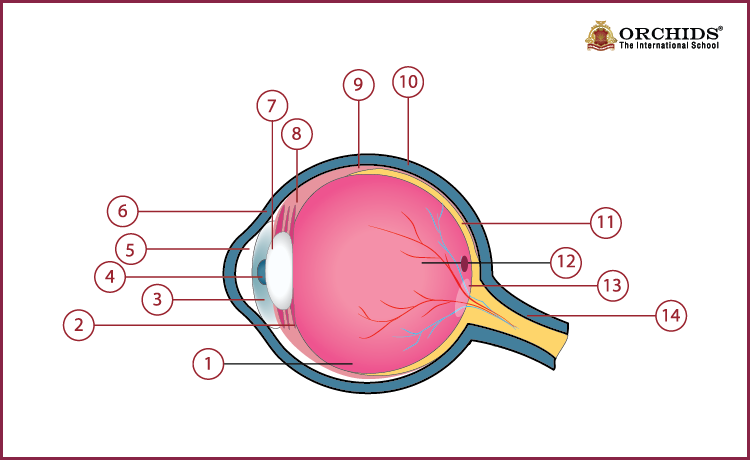
Practice Time:
Take a close look at the diagram of the human eye given above. Each part of the eye works together to help us see the world clearly. Can you identify and label them correctly?
Your task is simple: Label the main parts, such as the cornea, iris, pupil, lens, retina, optic nerve and more.
Tip: Think about the journey of light through the eye, where does it enter first, and how does it reach the retina? This will help you place each label correctly.
Now that you’ve understood the structure of human eye, test your understanding with these similar practice-based questions on the diagram of the eye:
- Structure of eye diagram and label the optioc nerve and iris
- Draw a diagram of human eye with labelling of pupil and cornea.
- Draw a labelled diagram of human eye
- How to draw a diagram of human eye
In this article, we discussed how to draw a diagram of human eye, the functions of eye and how to draw a diagram of the human eye, and we understood that if one of them goes weak or overworks, the eyes stop moving in sync, the picture splits into two, and the brain gets tired trying to merge the views.
This is why doctors test eye movements during check-ups; they are not “just moving a torch”. They are checking if the control system is still running smoothly.
Frequently Asked Questions on Diagram of Eye
1. What do we mean by a diagram of eye?
It is a simple labelled diagram of eye that shows how the eye is built from parts like the cornea, pupil, iris, lens, retina and the optic nerve.
2. Why do schools insist on drawing a well-labelled diagram of eye?
Because when we draw and tag each part with labels, the shape and the role of each part settle in the brain, and the chapter is remembered better.
3. Which labels are compulsory if we want a neat and correct eye diagram?
At minimum, you must put cornea, iris, pupil, lens, aqueous humour, vitreous humour, retina and optic nerve. Adding sclera or choroid gives extra marks.
4. Does the eye just act like a camera, or does it also start the brain's work?
It does both. The front parts bring light in and bend it, and the retina at the back starts turning that light into signals even before sending it to the brain.
5. Are all human eyes identical from the inside?
The blueprint is the same in all people, but there are small natural differences in the colour of the iris, lens flexibility with age and overall eye shape that affect vision.
6. Where exactly is the eye kept safe in the head?
Each eyeball rests inside a deep bony cup in the skull. Lids, lashes and tears add an extra safety layer against dust, dryness or sharp particles.
7. Can the eye repair itself if something inside gets damaged?
Only to a small extent. Surface tissues like the cornea layer or conjunctiva can heal but deeper parts rarely grow back fully without medical treatment.
Science isn't just a subject, it's the way of seeing the world. Curious how Orchids The International School teaches it that way? Talk to our admissions team.
Admissions Open for 2026-27
What type of concept pages would you prefer?
CBSE Schools In Popular Cities
- CBSE Schools in Bangalore
- CBSE Schools in Mumbai
- CBSE Schools in Pune
- CBSE Schools in Hyderabad
- CBSE Schools in Chennai
- CBSE Schools in Gurgaon
- CBSE Schools in Kolkata
- CBSE Schools in Indore
- CBSE Schools in Sonipat
- CBSE Schools in Delhi
- CBSE Schools in Rohtak
- CBSE Schools in Bhopal
- CBSE Schools in Aurangabad
- CBSE Schools in Jabalpur
- CBSE Schools in Jaipur
- CBSE Schools in Jodhpur
- CBSE Schools in Nagpur
- CBSE Schools in Ahmednagar
- CBSE School In Tumkur











Orchids The International School is one of India's leading chains of CBSE and ICSE schools, with 110+ schools across the country.