

Amoeba Diagram
An amoeba diagram helps us visually understand how this unicellular organism moves, feeds, and survives. Amoebae are microscopic organisms found mostly in freshwater habitats, such as ponds and streams, often hiding in decaying vegetation. Interestingly!! Despite being a single-celled organism, Amoebae can perform all essential life functions, including movement, feeding, excretion, and reproduction.
This article explains how to draw a diagram of Amoeba, its structure, and why it is important to understand it.
Table of Contents
- What do we mean by an Amoeba?
- How To Draw an Amoeba Diagram: Structure and Labels
- Key Characteristics and Adaptations of Amoeba
- Frequently Asked Questions on Amoeba Diagram

What do we mean by an Amoeba?
In simple terms, an amoeba is a unicellular eukaryotic organism belonging to the Kingdom Protista. It has no fixed shape and moves using pseudopodia, which are temporary extensions of its cytoplasm.
The amoeba was first observed by Antonie van Leeuwenhoek in the 17th century under a microscope, and its behaviour and structure were later studied in more detail by scientists like Fritz Schaudinn.
Before drawing a well-labelled diagram of Amoeba, shouldn’t we first understand what we are actually representing?
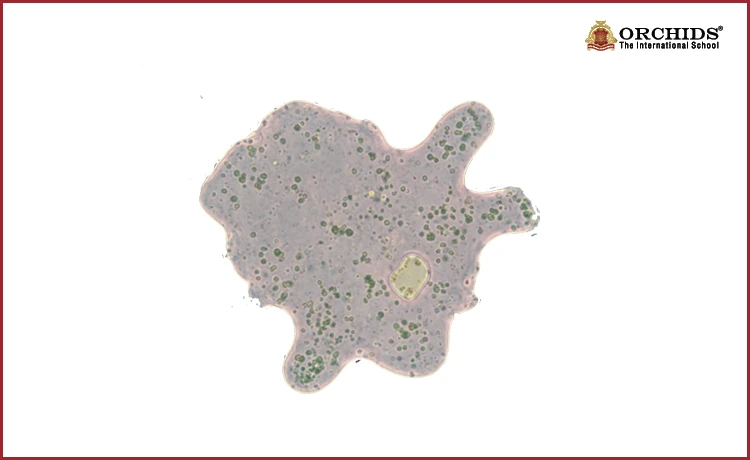
It is interesting to note that amoebae are unicellular eukaryotic organisms belonging to the Kingdom Protista. They are placed in the family Amoebidae and genus Amoeba.
The complete classification is as follows:
This classification helps us understand its evolutionary position and relation to other unicellular organisms.
Amoebae live in freshwater and feed on microscopic organisms and decaying matter. They reproduce asexually by binary fission and can survive harsh conditions through a process called encystation, where they form a protective cyst.
If we put its life processes in one simple flow, it reads like this:
Pseudopodia extend → Movement → Engulf food → Digestion in food vacuole → Water balance via contractile vacuole → Binary fission → Encystation in harsh conditions → Return to active form.
Also Read: Diagram of eye
Curious about how this tiny cell survives and reproduces in its freshwater habitat?
Let’s break down its classification and life processes so we can better understand the parts we need to draw.
How To Draw an Amoeba Diagram: Structure and Labels
When asked to draw a well-labelled diagram of an Amoeba, the easiest way is to think of the cell as a story of movement, feeding, and survival.
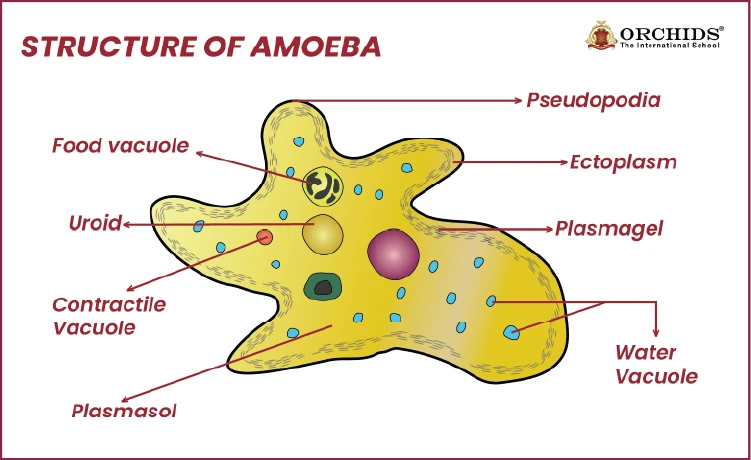
Let’s find out:
1. Pseudopodia are finger-like projections that extend from the cell and help the Amoeba in movement and capturing food. When drawing, extend them outward from the main body of the Amoeba.
2. Ectoplasm is a clear, firm layer located just beneath the plasma membrane. In a diagram, it should be represented as a thin outer layer surrounding the endoplasm.
3. Endoplasm is the granular inner layer of the cytoplasm that contains essential organelles, including the nucleus, food vacuoles, and the contractile vacuole.
4. The nucleus is a round structure situated inside the endoplasm that controls all the cellular activities of the Amoeba. It should be clearly drawn at the centre of the endoplasm in the diagram.
5. Food vacuoles are small circular structures within the endoplasm where the Amoeba stores and digests engulfed food particles.
6. The contractile vacuole is a larger vacuole that collects and expels excess water from the Amoeba, helping to maintain osmotic balance in freshwater habitats.
7. The plasma membrane is the thin boundary that encloses the cytoplasm, giving the Amoeba its flexible shape and allowing it to change form while moving or feeding.
Tip: Use light blue for ectoplasm, grey for endoplasm, purple for the nucleus, and transparent bubbles for vacuoles to make the diagram visually clear.
Practice Task:
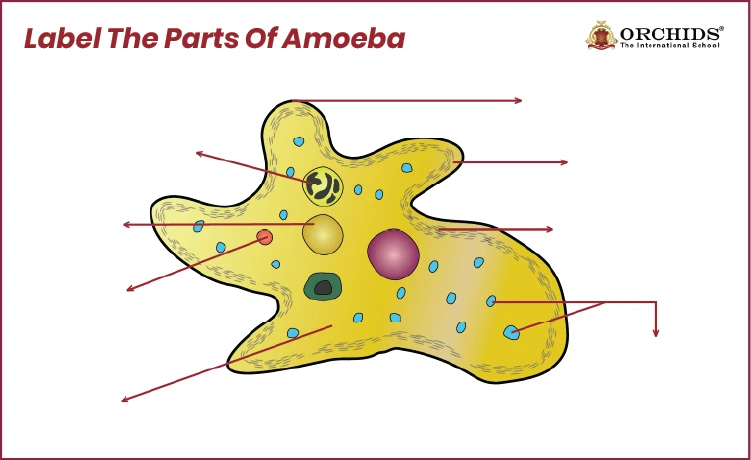
Now, using the diagram below, try to label all the parts of the Amoeba on your own to check your understanding.
Also Read: Diagram of Mitochondria
But why stop at just drawing it? And what makes an Amoeba’s structure so special?
To understand it, let's discuss its characteristics.
Key Characteristics and Adaptations of Amoeba
The Amoeba is not just a simple cell. Its structure supports multiple life processes that help it survive, feed, move, and reproduce:
1. Shape-shifting ability of amoebae constantly extends and retracts their pseudopodia, which allows them to move across surfaces and capture food efficiently.
2. Holozoic nutrition helps amoebae engulf food particles using pseudopodia and store them in food vacuoles, where enzymes digest the food for nourishment.
3. The contractile vacuole collects and expels excess water, helping the Amoeba maintain water balance in freshwater environments.
4 Amoebae reproduce asexually through binary fission, where the nucleus divides first, followed by the cytoplasm, producing two daughter cells.
5. Encystation, in unfavourable conditions, Amoebae form protective cysts that allow them to survive until the environment improves.
6. Environmental sensitivity, amoebae can detect chemical signals in their surroundings, helping them locate food and respond to changes in their habitat.
And here are some practice questions for exams:
-
Draw a diagram of an Amoeba
-
Draw a labelled diagram of an Amoeba
-
Draw a well-labelled diagram of Amoeba
In this article, we discussed that the amoeba diagram is more than just a drawing. It is a visual story of a unicellular organism performing all essential life processes. And when asked to draw a well-labelled diagram of an amoeba, it helps students understand its structure. feeding, movement, reproduction, and survival mechanisms, making it a crucial topic for biology exams.
Frequently Asked Questions on Amoeba Diagram
1. What is an amoeba diagram?
It is a labelled illustration showing all major structures of Amoeba, including pseudopodia, ectoplasm, endoplasm, nucleus, food vacuoles, and contractile vacuole.
2. Why study Amoeba?
Amoeba is a model unicellular organism that demonstrates essential cell functions like movement, nutrition, water regulation, and reproduction. Studying it helps to understand basic biology concepts for exams.
3. Which parts must be labelled in an Amoeba diagram?
Essential labels include Pseudopodia, Ectoplasm, Endoplasm, Nucleus, Food Vacuoles, Contractile Vacuole, and Plasma Membrane. These structures show how the cell performs key life processes.
4. How does an Amoeba move and feed?
Amoeba extends pseudopodia to move and surround food particles, forming food vacuoles. This process, called phagocytosis, allows it to ingest and digest food efficiently.
5. How does an Amoeba survive harsh conditions?
It undergoes encystation, forming a protective cyst that prevents dehydration and damage. Once conditions improve, it emerges from the cyst and resumes normal activity.
6. What is the function of the contractile vacuole?
The contractile vacuole collects and expels excess water from the cell. This maintains osmotic balance and prevents the Amoeba from bursting in freshwater habitats.
7. How does an Amoeba reproduce?
Amoeba reproduces asexually by binary fission, where the nucleus divides first, followed by the cytoplasm.
Science isn't just a subject, it's the way of seeing the world. Curious how Orchids The International School teaches it that way? Talk to our admissions team.
Admissions Open for 2026-27
What type of concept pages would you prefer?
CBSE Schools In Popular Cities
- CBSE Schools in Bangalore
- CBSE Schools in Mumbai
- CBSE Schools in Pune
- CBSE Schools in Hyderabad
- CBSE Schools in Chennai
- CBSE Schools in Gurgaon
- CBSE Schools in Kolkata
- CBSE Schools in Indore
- CBSE Schools in Sonipat
- CBSE Schools in Delhi
- CBSE Schools in Rohtak
- CBSE Schools in Bhopal
- CBSE Schools in Aurangabad
- CBSE Schools in Jabalpur
- CBSE Schools in Jaipur
- CBSE Schools in Jodhpur
- CBSE Schools in Nagpur
- CBSE Schools in Ahmednagar
- CBSE School In Tumkur











Orchids The International School is one of India's leading chains of CBSE and ICSE schools, with 110+ schools across the country.