

Angiosperms and Gymnosperms Difference
The angiosperms and gymnosperms difference is one of the key ideas in plant biology, especially when trying to understand how different plants reproduce and protect their seeds. Even though both belong to the group of seed plants, the way they form flowers, cones, fruits, and seed coverings varies greatly.
This article helps you clearly understand what is the difference between angiosperms and gymnosperms with simple explanations and examples.
Table of Contents
- What Are Angiosperms and Gymnosperms?
- Difference Between Angiosperms and Gymnosperms
- Frequently Asked Questions on Angiosperms and Gymnosperms Difference

What Are Angiosperms and Gymnosperms?
Both angiosperms and gymnosperms are seed plants, which means they reproduce using seeds instead of spores. But the way they produce, protect, and develop these seeds is completely different, and that’s what makes these two groups amazing.
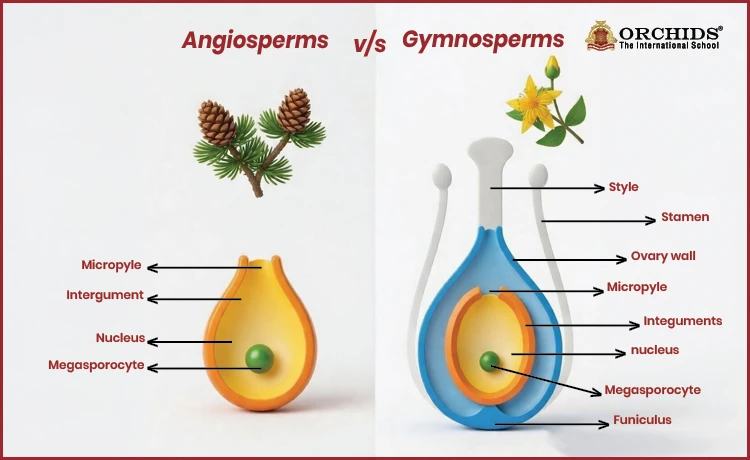
Think of seed plants as having two major paths of evolution.
Have you ever looked at a pine tree and a mango tree and wondered why they are so different, even though both grow from seeds?
That curiosity leads us to one of the most important concepts in plant biology: the angiosperms and gymnosperms difference.
To understand this difference clearly, let’s start with the basics.
One path led to angiosperms, the flowering plants we see around us every day.
Angiosperms are the plants that produce flowers and fruits, and their seeds are safely enclosed inside the fruit, giving them extra protection.
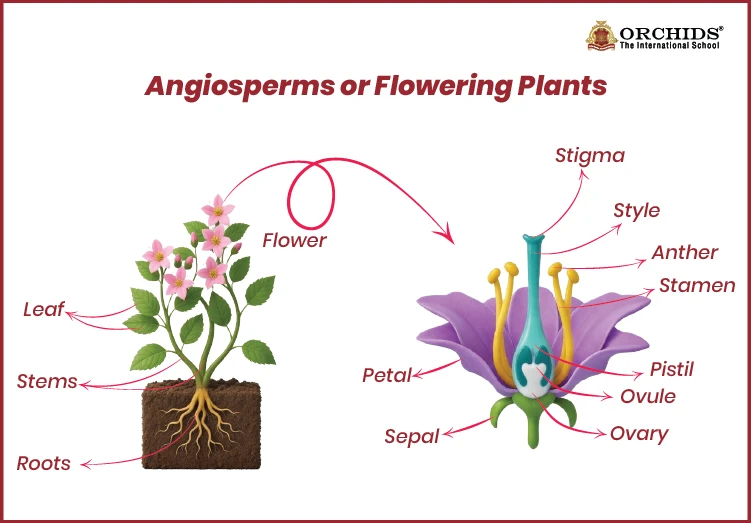
This group includes almost everything we commonly eat or see, such as mangoes, roses, wheat, sunflowers, apples, coconuts, and thousands more. They have broad leaves, undergo double fertilisation, and are the most diverse group of plants on Earth.
Interestingly!! The other path led to gymnosperms, ancient plants with “naked seeds” that existed even before dinosaurs.
Gymnosperms do not produce flowers at all. Their seeds remain exposed on the scales of cones, which is why they are called naked seeds. These plants usually have needle-like or scale-like leaves and are often evergreen.
Common examples include pine, cycas, cedar, fir, and spruce plants you’ll commonly notice in colder or mountainous regions.
If you merge both groups into a simple memory line, it becomes easy to recall:
Gymnosperms include pine, fir, spruce, and cycas, while angiosperms include mango, sunflower, apple, and rose.
Now, you might be thinking: what exactly makes angiosperms and gymnosperms difference?
Let’s break it down in the simplest way.
Difference Between Angiosperms and Gymnosperms
And here’s a clear comparison to understand the angiosperms and gymnosperms:
Till now, we have discussed that understanding the angiosperms and gymnosperms helps us see how plants evolved two distinct ways of producing and protecting seeds. Together, they form the foundation of Earth’s plant life, supporting ecosystems, providing food, and shaping the world around us.
Frequently Asked Questions on Angiosperms and Gymnosperms Difference
1. What is the difference between angiosperms and gymnosperms?
The simple angiosperms and gymnosperms difference is that angiosperms produce flowers and fruits, while gymnosperms produce naked seeds without fruits.
2. Why are angiosperms considered more advanced than gymnosperms?
Angiosperms are more advanced because they have flowers for reproduction, fruits for seed protection, and highly efficient vascular tissues, making them more adaptable than gymnosperms.
3. Which plants grow faster: angiosperms vs gymnosperms?
Angiosperms generally grow faster due to their efficient nutrient transport system and diverse reproductive strategies, unlike gymnosperms, which grow slower and live much longer.
4. Do both angiosperms and gymnosperms produce seeds?
Yes, both produce seeds. The difference is that angiosperms enclose seeds inside fruits, while gymnosperms have exposed or naked seeds.
5. What is an easy example of gymnosperms vs angiosperms
Gymnosperms include pine, fir, spruce and cycas, while angiosperms include mango, sunflower, apple and rose.
6. Which group is more diverse: angiosperms vs gymnosperms?
Angiosperms are far more diverse with over 2.5 lakh species, while gymnosperms have only about 1,000 species.
7. Do gymnosperms have flowers like angiosperms?
No. Gymnosperms do not have flowers; they have cones, while angiosperms reproduce through flowers.
8. Why are fruits found only in angiosperms?
Fruits develop from fertilised flowers, and since gymnosperms lack flowers, they cannot produce fruits.
Science isn't just a subject, it's the way of seeing the world. Curious how Orchids The International School teaches it that way? Talk to our admissions team.
Admissions Open for 2026-27
What type of concept pages would you prefer?
CBSE Schools In Popular Cities
- CBSE Schools in Bangalore
- CBSE Schools in Mumbai
- CBSE Schools in Pune
- CBSE Schools in Hyderabad
- CBSE Schools in Chennai
- CBSE Schools in Gurgaon
- CBSE Schools in Kolkata
- CBSE Schools in Indore
- CBSE Schools in Sonipat
- CBSE Schools in Delhi
- CBSE Schools in Rohtak
- CBSE Schools in Bhopal
- CBSE Schools in Aurangabad
- CBSE Schools in Jabalpur
- CBSE Schools in Jaipur
- CBSE Schools in Jodhpur
- CBSE Schools in Nagpur
- CBSE Schools in Ahmednagar
- CBSE School In Tumkur











Orchids The International School is one of India's leading chains of CBSE and ICSE schools, with 110+ schools across the country.