

Diagram of Mitochondria
A diagram of mitochondria helps us see how this tiny bean-shaped organelle quietly keeps every cell alive and active. From the beating of the heart to the blinking of the eyes, none of it is possible without the energy produced by mitochondria.
Every living organism, from a simple amoeba to humans, has cells. And inside those cells, there are smaller parts called cell organelles. One of the most important among them is the mitochondrion.
Often called the “powerhouse of the cell,” it produces energy in the form of ATP (adenosine triphosphate), which the cell uses to carry out all its functions.
This article focuses on what mitochondria are, how their structure looks in a labelled diagram, and why they play such a vital role in cell life.
Table of Contents
- What is the Structure of Mitochondria?
- How to Draw a Labelled Diagram of Mitochondria
- Main Functions of Mitochondria
- Why Are Mitochondria Not Shown in the Diagram of an Amoeba?
- Frequently Asked Questions On Diagram of Mitochondria

What is the Structure of Mitochondria?
If you look closely at a structure of mitochondria diagram, you’ll notice it’s built like a double-layered capsule.
The outer membrane forms the smooth outer cover, while the inner membrane folds inward to form ridges called cristae.
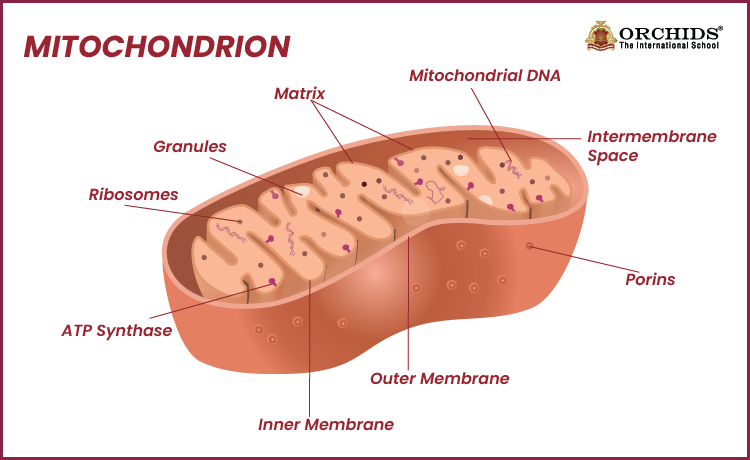
These folds are where most of the energy reactions happen. Between the two layers lies a thin space known as the intermembrane space.
Inside, the central region is filled with a thick, jelly-like fluid called the matrix. This matrix holds enzymes, mitochondrial DNA (mtDNA), and ribosomes, all of which help the mitochondrion produce energy.
In simple order, the structure goes like this:
Outer membrane → Intermembrane space → Inner membrane (with cristae) → Matrix
So, whenever you look at a labelled mitochondria diagram, these are the key parts you’ll see.
How To Draw a Labelled Diagram of Mitochondria
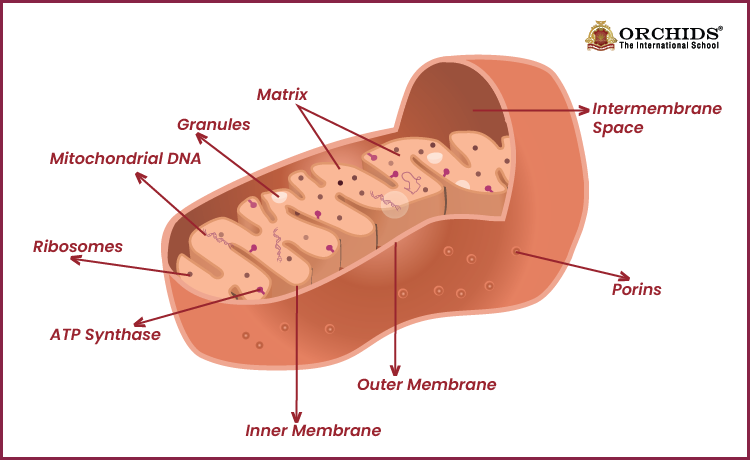
When you’re asked to draw a neat labelled diagram of mitochondria in class, think of it as drawing a bean with layers inside. Each layer has a job.
Let’s walk through the main labels one by one:
1. Outer Membrane, the smooth protective layer that forms the first boundary of the mitochondrion. It has tiny pores called porins that act like small gates, allowing essential molecules to move in and out while keeping the inner parts safe.
2. Inner Membrane, the next layer tucked inside. It folds inward to form finger-like ridges called cristae. These folds are not random; they exist to increase the surface area so the mitochondrion can perform more energy-producing reactions at the same time.
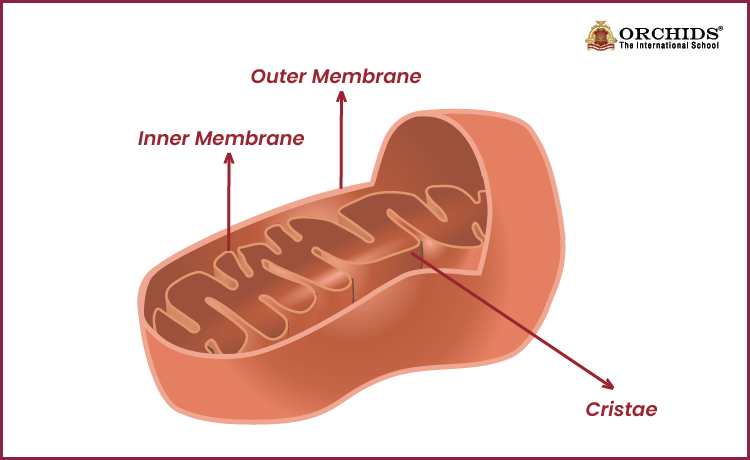
3. Cristae, the folded regions of the inner membrane. Think of them as the main energy spots. This is where the electron transport chain operates and where most of the ATP is generated during respiration.
4. Matrix, the central fluid-filled space. It holds enzymes, mitochondrial DNA, and ribosomes. The Krebs cycle happens here, breaking down nutrients and preparing the high-energy molecules needed for the next steps of ATP production
5. Intermembrane Space, the narrow gap between the outer and inner membranes. Even though it looks like a simple space, it plays a crucial role by holding protons during respiration. This buildup later drives ATP formation.
6. Ribosomes (Mitoribosomes), the tiny protein-making structures inside the matrix. They help the mitochondrion produce some of its own proteins, supporting its ability to function independently inside the cell.
When you label these six parts, your mitochondria diagram is complete and exam-ready.
Main Functions of Mitochondria
Now that you know the structure, let’s understand what this organelle actually does.
Here are its key functions:
-
ATP Production makes energy molecules (ATP) through oxidative phosphorylation.
-
Cellular Respiration breaks down food and oxygen to release energy.
-
Metabolic Regulation runs processes like the Krebs cycle.
-
Calcium Balance controls calcium levels inside the cell.
-
Apoptosis triggers programmed cell death when needed.
-
Detoxification helps in hormone production and waste removal, especially in liver cells.
No wonder mitochondria are called the powerhouse of the cell; every movement, thought, and heartbeat relies on their work.
Why Are Mitochondria Not Shown in the Diagram of an Amoeba?
Students often wonder: “If an amoeba is a living cell, why aren’t mitochondria shown in its diagram?”
The answer is simple: amoeba does have mitochondria, but textbook diagrams usually show only the main visible parts like the pseudopodia, nucleus, contractile vacuole, and food vacuole.
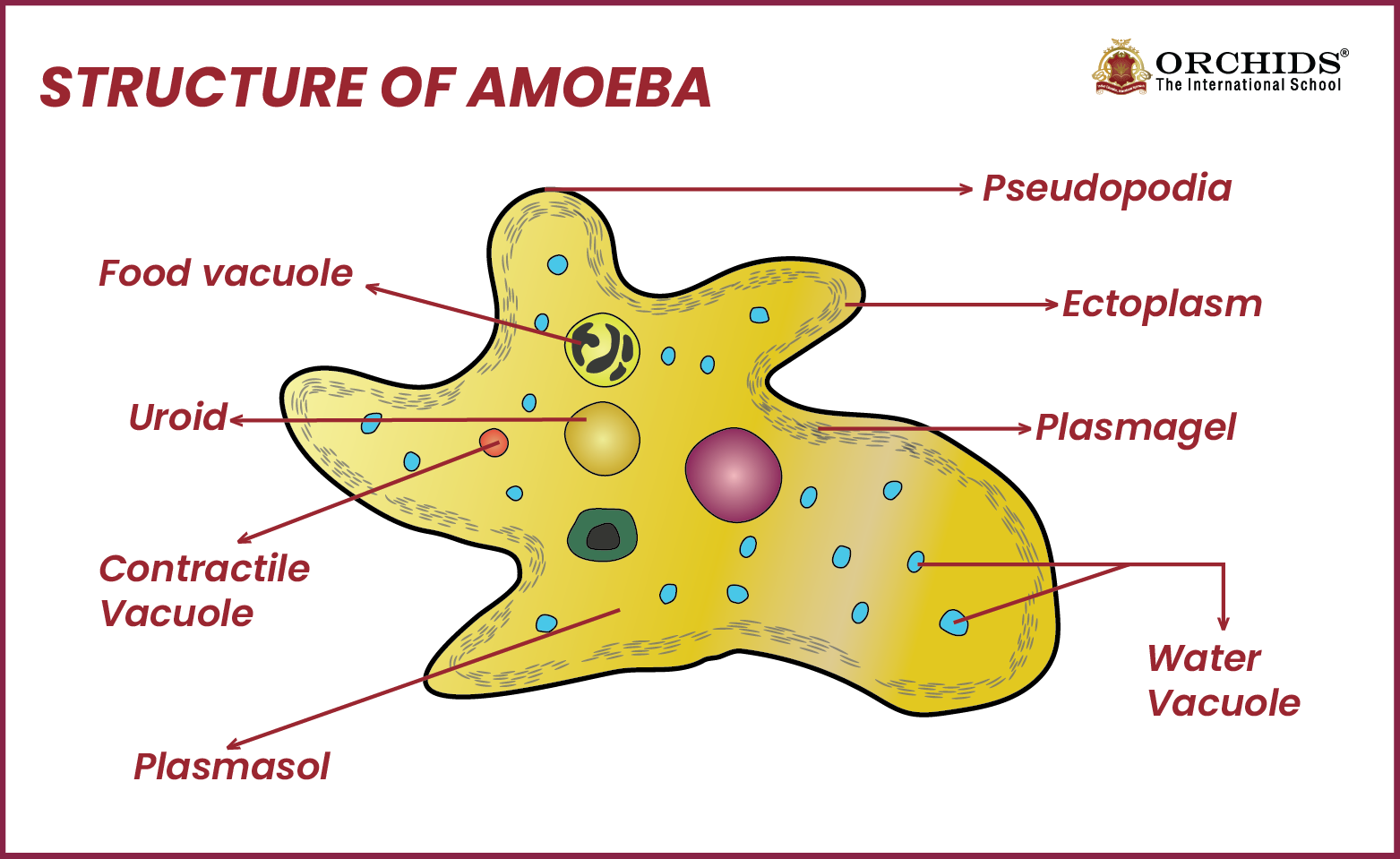
If every internal organelle were drawn, the picture would become overcrowded and confusing. So, for clarity, mitochondria are usually left out even though they are very much present.
Interestingly!! Scientists believe mitochondria were once free-living bacteria that entered larger cells and began living inside them. Over time, both started depending on each other.
This theory is called the Endosymbiotic Theory, supported by the fact that mitochondria have their own DNA and ribosomes, just like bacteria.
And why do examiners ask this diagram so often? Let’s understand.
Because it’s easy to label, visually clear, and conceptually important. You’ll often see questions like:
-
Draw a neat labelled diagram of mitochondria.
-
Explain the structure of the mitochondria diagram with parts.
-
Write two functions of mitochondria.
-
Draw a structure of mitochondria diagram and label the parts
-
Well-labelled diagram of mitochondria
Understanding it once makes it simple to recall during exams.
Practice Time
Take a look at the diagram of mitochondria below. Each part plays a role in energy production.
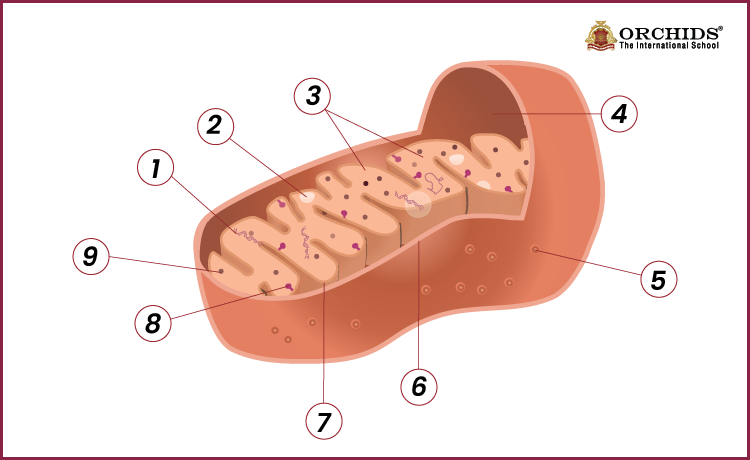
Your task: Label the following correctly: outer membrane, inner membrane, cristae, matrix, and ribosomes.
Tip: Imagine you’re tracing the flow of energy from the outermost layer to the inner core and label each step in that path.
In this article, we looked at how to draw a diagram of mitochondria, the structure of each part, and how they work together to produce energy for the cell. We also learnt that if mitochondria slow down or get damaged, the cell cannot function properly.
That’s why studying the mitochondria diagram helps us understand how every living cell stays active and alive by turning nutrients into usable energy.
Frequently Asked Questions On Diagram of Mitochondria
1. What is a mitochondria diagram?
A mitochondria diagram is a labelled illustration showing its key parts like the outer membrane, inner membrane, cristae, and matrix, all of which help in energy production.
2. Why are mitochondria called the “powerhouse of the cell”?
It’s called the powerhouse because it produces ATP (adenosine triphosphate), the main energy molecule that powers most cellular activities.
3. Which cells have a large number of mitochondria?
Cells that need a lot of energy, such as muscle cells, liver cells, and sperm cells, contain many mitochondria.
4. What is found inside the mitochondrial matrix?
The matrix contains enzymes, ribosomes, ions, and mitochondrial DNA, all essential for energy production and cell metabolism.
5. Do plants have mitochondria?
Yes. Both plant and animal cells have mitochondria, as they are required for cellular respiration and energy generation.
6. Do mitochondria have their own DNA?
Yes, mitochondria contain circular DNA, similar to bacterial DNA. This supports the endosymbiotic theory, which suggests mitochondria evolved from ancient bacteria.
Science isn't just a subject, it's the way of seeing the world. Curious how Orchids The International School teaches it that way? Talk to our admissions team.
Admissions Open for 2026-27
What type of concept pages would you prefer?
CBSE Schools In Popular Cities
- CBSE Schools in Bangalore
- CBSE Schools in Mumbai
- CBSE Schools in Pune
- CBSE Schools in Hyderabad
- CBSE Schools in Chennai
- CBSE Schools in Gurgaon
- CBSE Schools in Kolkata
- CBSE Schools in Indore
- CBSE Schools in Sonipat
- CBSE Schools in Delhi
- CBSE Schools in Rohtak
- CBSE Schools in Bhopal
- CBSE Schools in Aurangabad
- CBSE Schools in Jabalpur
- CBSE Schools in Jaipur
- CBSE Schools in Jodhpur
- CBSE Schools in Nagpur
- CBSE Schools in Ahmednagar
- CBSE School In Tumkur











Orchids The International School is one of India's leading chains of CBSE and ICSE schools, with 110+ schools across the country.