

Difference Between Food Chain and Food Web
The difference between food chain and food web helps us understand how energy moves through nature, from the sunlight that helps grass grow to the lion resting after a hunt . That’s exactly what food chains vs food webs show.
Initially, they might appear quite similar since both explain how living organisms rely on one another for food. But when you look a bit closer, you’ll notice that the difference between a food chain and a food web lies in how detailed and interconnected these feeding links actually are.
This article provides the details of what differences between a food chain and a food web, how they function, and how they differ from each other through simple explanations and examples.
Table of Contents

Learn About Food Chain and Food Web
Let’s start with a simple question: when a deer eats grass and a lion eats the deer, what’s really happening?
That’s explained by the food chain, which shows how energy moves from one organism to another in nature.
It all begins with producers like plants and algae that make their own food using sunlight.
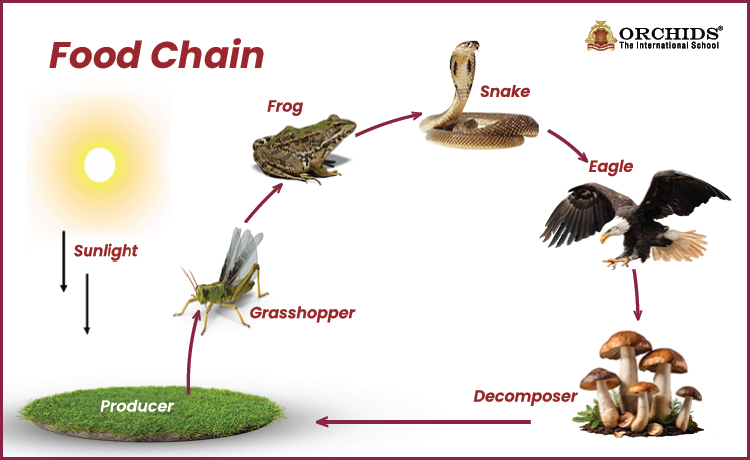
Then come the consumers, herbivores, carnivores, and omnivores followed by decomposers, which break down dead matter and return nutrients to the soil.
Curious how it works?
Example: Grass → Grasshopper → Frog → Snake → Eagle → Decomposers
Each step is called a trophic level, and energy decreases as we move up the chain because organisms use some of it to live and grow.
But what happens when many animals feed on the same plant or share a predator?
That’s when a food web forms!
A food web connects multiple food chains, showing how all living things are linked in one big network.
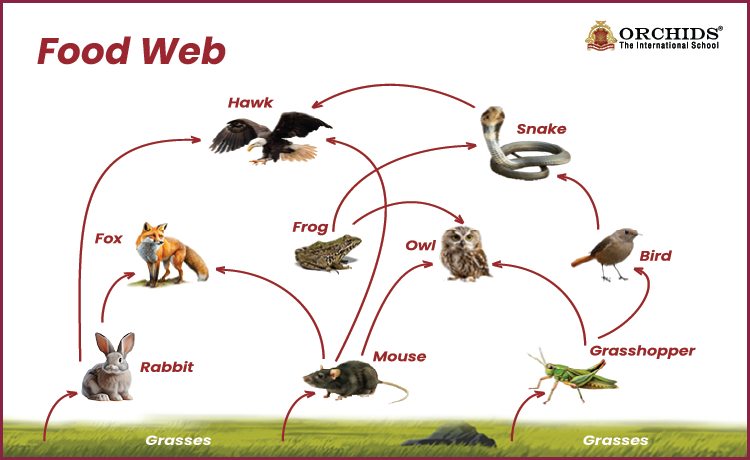
Example: Grass → Rabbit / Grasshopper / Mouse → Bird / Frog / Owl → Snake / Fox / Hawk
And to understand food chain vs food web more clearly, you can check out the image below:
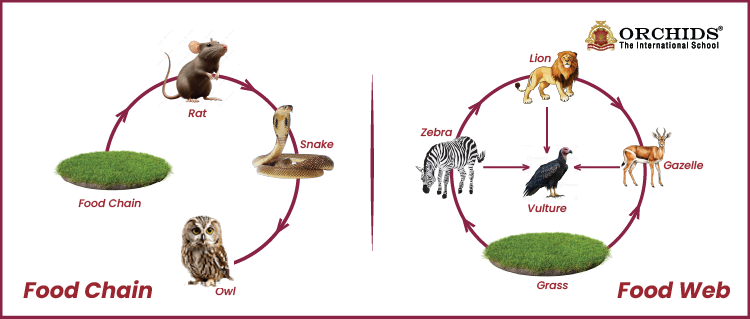
Difference Between Food Chain and Food Web
Here’s a simple comparison that clearly shows what the difference is between food chain and a food web:
|
Feature |
Food Chain |
Food Web |
|
Definition |
A straight line showing how energy flows from one organism to another. |
A network of many connected food chains shows how energy flows in an ecosystem. |
|
Structure |
Linear and simple. |
Complex and interconnected. |
|
Number of Paths |
Single path of energy flow. |
Multiple interconnected paths. |
|
Dependence |
Each organism depends on one source of food. |
Organisms have multiple food sources. |
|
Stability |
Less stable, as the removal of one species can break the chain. |
More stable, as the web remains even if one species disappears. |
|
Adaptability |
Does not show adaptability or competition. |
Shows adaptability and competition among species. |
|
Example |
Grass → Grasshopper → Frog → Snake → Hawk |
Grass → Rabbit / Deer / Grasshopper → Snake / Fox → Eagle / Lion |
Now that you have a clear idea of what the difference is between a food chain and a food web, next, let’s check out their key similarities.
Similarities Between Food Chain and Food Web
Even though they differ in structure, both food chains and food webs share the same purpose, showing how energy and nutrients move through living organisms.
Here are a few key similarities:
-
Both start with producers like plants or algae.
-
Both include consumers and decomposers.
-
Both explain how energy flows through trophic levels.
-
Both help us understand the balance and interdependence in nature.
In this article, we discussed that the difference between a food chain and a food web lies in their complexity and connections.
A food chain is a simple line showing “who eats whom”, while a food web is a detailed network of these chains combined. Both are essential to understanding how life on Earth stays balanced, one showing the path and the other showing the whole map.
By observing food chains vs food webs around us, from forests to oceans, we can see just how connected every living thing truly is.
Frequently Asked Questions on Difference Between Food Chain and Food Web
1. What is the difference between a food chain and a food web?
A food chain shows a single path of energy flow in an ecosystem, while a food web displays many interconnected food chains, showing how different organisms depend on one another.
2. Why is a food web more stable than a food chain?
A food web is more stable because if one species is removed, others can still survive by shifting to different food sources. In a food chain, losing one link can break the entire chain.
3. Can an organism be part of more than one food chain?
Yes, many organisms belong to multiple food chains. For example, a frog can eat both grasshoppers and mosquitoes, making it part of more than one chain within a food web.
4. What are the levels of a food chain called?
Each step in a food chain is called a trophic level. These levels include producers, primary consumers, secondary consumers, tertiary consumers, and decomposers.
5. Why is energy transfer in a food chain not 100% efficient?
At each trophic level, some energy is lost as heat or used for growth and movement. Only about 10% of energy moves from one level to the next.
6. How does a food web maintain balance in nature?
A food web maintains ecological balance by connecting multiple food chains. This ensures that energy keeps flowing even if one organism or chain is disrupted.
7. What is the role of decomposers in a food chain vs a food web?
Decomposers like fungi and bacteria break down dead plants and animals. They return nutrients to the soil, helping plants grow and restarting the energy cycle.
Science isn't just a subject, it's the way of seeing the world. Curious how Orchids The International School teaches it that way? Talk to our admissions team.
Admissions Open for 2026-27
What type of concept pages would you prefer?
CBSE Schools In Popular Cities
- CBSE Schools in Bangalore
- CBSE Schools in Mumbai
- CBSE Schools in Pune
- CBSE Schools in Hyderabad
- CBSE Schools in Chennai
- CBSE Schools in Gurgaon
- CBSE Schools in Kolkata
- CBSE Schools in Indore
- CBSE Schools in Sonipat
- CBSE Schools in Delhi
- CBSE Schools in Rohtak
- CBSE Schools in Bhopal
- CBSE Schools in Aurangabad
- CBSE Schools in Jabalpur
- CBSE Schools in Jaipur
- CBSE Schools in Jodhpur
- CBSE Schools in Nagpur
- CBSE Schools in Ahmednagar
- CBSE School In Tumkur











Orchids The International School is one of India's leading chains of CBSE and ICSE schools, with 110+ schools across the country.