

Table of 21
Table of 21 helps learners understand multiplication with larger numbers by showing how values increase in steps of 21. Each time you multiply 21 by a whole number, you are actually adding 21 repeatedly. For example, 21 × 1 = 21, 21 × 2 = 42, and 21 × 3 = 63, each result is 21 more than the previous one. Download the free chart below to see the full pattern - including a trick that makes memorising the 21 table 3× faster.
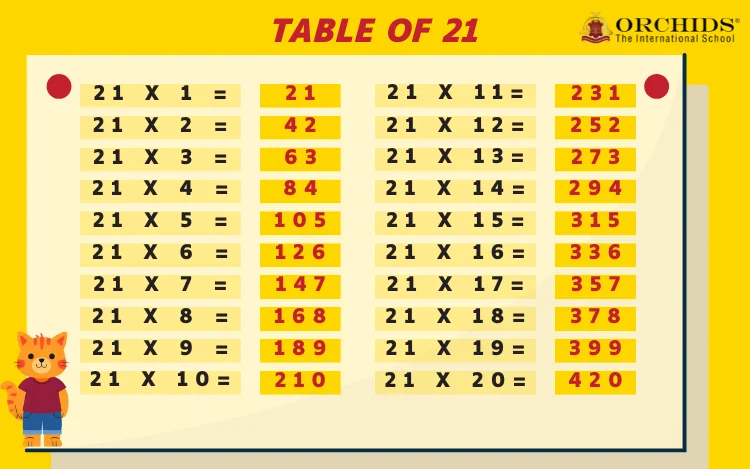
Table of 21 Chart
A Table of 21 chart presents the multiplication facts from 21 × 1 up to 21 × 20 in a clear, easy-to-read format. This chart helps students visualize how numbers grow as they are multiplied by 21, making it easier to memorize and recall quickly.
Read more:
- Assertion Reason Questions - Class 9 Maths
- Class 10 - Chapter 6 - Triangles - Free Downloadable PDF Worksheets

Multiplication Table of 21
The Table of 21 shows the results of multiplying 21 by numbers from 1 to 20. Here is the complete table:
| Multiplicand | Operation | Multiplier | Result | |
| 21 | x | 1 | = | 21 |
| 21 | x | 2 | = | 42 |
| 21 | x | 3 | = | 63 |
| 21 | x | 4 | = | 84 |
| 21 | x | 5 | = | 105 |
| 21 | x | 6 | = | 126 |
| 21 | x | 7 | = | 147 |
| 21 | x | 8 | = | 168 |
| 21 | x | 9 | = | 189 |
| 21 | x | 10 | = | 210 |
| 21 | x | 11 | = | 231 |
| 21 | x | 12 | = | 252 |
| 21 | x | 13 | = | 273 |
| 21 | x | 14 | = | 294 |
| 21 | x | 15 | = | 315 |
| 21 | x | 16 | = | 336 |
| 21 | x | 17 | = | 357 |
| 21 | x | 18 | = | 378 |
| 21 | x | 19 | = | 399 |
| 21 | x | 20 | = | 420 |
You can also download the Table of 21 as a free PDF to practice and revise anytime by clicking the link provided below.
Download PDF - Table of 21
How do you read the multiplication table of 21?
Reading the table of 21 is straightforward. Start with 21 and multiply it by each whole number in order: 1, 2, 3, and so on. Each step adds another set of 21 to the previous total. By following the table line by line, learners can see how the numbers grow and understand multiplication as repeated addition.
21 times 1 equals 21
21 times 2 equals 42
21 times 3 equals 63
21 times 4 equals 84
21 times 5 equals 105
21 times 6 equals 126
21 times 7 equals 147
21 times 8 equals 168
21 times 9 equals 189
21 times 10 equals 210
21 times 11 equals 231
21 times 12 equals 252
21 times 13 equals 273
21 times 14 equals 294
21 times 15 equals 315
21 times 16 equals 336
21 times 17 equals 357
21 times 18 equals 378
21 times 19 equals 399
21 times 20 equals 420
Table of 21 in Words
Reading the 21 times table in words helps students learn the numbers as sentences. This also improves speaking and listening skills:
Twenty-one times one equals twenty-one
Twenty-one times two equals forty-two
Twenty-one times three equals sixty-three
Twenty-one times four equals eighty-four
Twenty-one times five equals one hundred five
Twenty-one times six equals one hundred twenty-six
Twenty-one times seven equals one hundred forty-seven
Twenty-one times eight equals one hundred sixty-eight
Twenty-one times nine equals one hundred eighty-nine
Twenty-one times ten equals two hundred ten
Twenty-one times eleven equals two hundred thirty-one
Twenty-one times twelve equals two hundred fifty-two
Twenty-one times thirteen equals two hundred seventy-three
Twenty-one times fourteen equals two hundred ninety-four
Twenty-one times fifteen equals three hundred fifteen
Twenty-one times sixteen equals three hundred thirty-six
Twenty-one times seventeen equals three hundred fifty-seven
Twenty-one times eighteen equals three hundred seventy-eight
Twenty-one times nineteen equals three hundred ninety-nine
Twenty-one times twenty equals four hundred twenty
Quick Tricks to Remember the 21 Times Table
Most students already know the 20 times table. That makes learning the 21 table very easy using this simple trick:
The 20 + 1 Method: Split 21 into 20 and 1. Multiply the number by 20, then add the number itself.
Formula: 21 × N = (20 × N) + N
| Multiplication | Step 1: 20 × N | Step 2: + N | Answer |
| 21 × 3 | 20 × 3 = 60 | 60 + 3 | 63 |
| 21 × 6 | 20 × 6 = 120 | 120 + 6 | 126 |
| 21 × 7 | 20 × 7 = 140 | 140 + 7 | 147 |
| 21 × 9 | 20 × 9 = 180 | 180 + 9 | 189 |
| 21 × 12 | 20 × 12 = 240 | 240 + 12 | 252 |
| 21 × 15 | 20 × 15 = 300 | 300 + 15 | 315 |
Once you know this method, you can calculate any multiplication from the 21 table mentally - without memorising every answer separately.
Table of 21 Using Repeated Addition
Multiplication is a quicker way of adding the same number multiple times. The table of 21 can be understood by repeatedly adding 21:
|
Multiplication |
Repeated Addition |
Answer |
|
21 × 1 |
21 |
21 |
|
21 × 2 |
21 + 21 |
42 |
|
21 × 3 |
21 + 21 + 21 |
63 |
|
21 × 4 |
21 + 21 + 21 + 21 |
84 |
|
21 × 5 |
21 + 21 + 21 + 21 + 21 |
105 |
|
21 × 6 |
21 + 21 + 21 + 21 + 21 + 21 |
126 |
|
21 × 7 |
21 + 21 + 21 + 21 + 21 + 21 + 21 |
147 |
|
21 × 8 |
21 + 21 + 21 + 21 + 21 + 21 + 21 + 21 |
168 |
|
21 × 9 |
21 + 21 + 21 + 21 + 21 + 21 + 21 + 21 + 21 |
189 |
|
21 × 10 |
21 + 21 + 21 + 21 + 21 + 21 + 21 + 21 + 21 + 21 |
210 |
Solved Examples on Table of 21
1. There are 4 boxes, each containing 21 chocolates. How many chocolates are there in total?
Number of boxes = 4
Chocolates in each box = 21
Total chocolates = 4 × 21 = 84
Answer: 84
2. What is the 7th multiple of 21?
21 × 7 = 147
Answer: 147
3. If you have 21 pencils in one pack, how many pencils are in 5 packs?
21 × 5 = 105
Answer: 105
4. Add 21 eight times. What is the total?
21 + 21 + 21 + 21 + 21 + 21 + 21 + 21 = 168
Or 21 × 8 = 168
Answer: 168
5. Twice the 12th multiple of 21 is?
12th multiple = 21 × 12 = 252
Twice this = 252 × 2 = 504
Answer: 504
Learn More Multiplication Tables
Numbers make sense when they're taught right. To see how Orchids The International School turns Maths from intimidating to intuitive, reach out to our admissions team.
Frequently Asked Questions on Table of 21
1. What is the Table of 21?
The Table of 21 lists all the multiplication results of 21 with whole numbers. It shows how the number increases step by step when multiplied. For example, the first ten multiples of 21 are:
-
21 × 1 = 21
-
21 × 2 = 42
-
21 × 3 = 63
-
21 × 4 = 84
-
21 × 5 = 105
-
21 × 6 = 126
-
21 × 7 = 147
-
21 × 8 = 168
-
21 × 9 = 189
-
21 × 10 = 210
2. How are the numbers in the Table of 21 created?
Each number is formed by multiplying 21 by a whole number:
-
21 × 1 = 21
-
21 × 2 = 42
-
21 × 3 = 63
This method shows how repeated addition of the same number creates multiples.
3. What is the Table of 21 in Words?
The Table of 21 in Words presents each multiplication as a full sentence:
-
Twenty-one times one is twenty-one
-
Twenty-one times two is forty-two
-
Twenty-one times three is sixty-three
This format helps learners understand and remember the multiples more easily.
4. How can we use the Table of 21 in real life?
It helps solve everyday problems involving repeated quantities. For example, if there are 21 chairs in a row and 4 rows, the total number of chairs is:
21 × 4 = 84
This makes counting large numbers faster and more accurate.
5. What is a simple way to memorise the Table of 21?
You can memorise it by practising repeated addition (adding 21 each time), writing down multiples in order, or learning them in small groups. Regular practice helps you remember the table easily.
6. How do you learn the 21 times table easily?
The easiest trick to learn the 21 times table is to break it into two parts: 20 × the number, plus the number itself. For example, 21 × 6 = (20 × 6) + 6 = 120 + 6 = 126. Since most children already know the 20 times table, this method makes the 21 table very quick to calculate mentally.
7. 21 का पहाड़ा क्या है? (What is 21 ka table?)
21 का पहाड़ा इस प्रकार है: 21 × 1 = 21, 21 × 2 = 42, 21 × 3 = 63, 21 × 4 = 84, 21 × 5 = 105, 21 × 6 = 126, 21 × 7 = 147, 21 × 8 = 168, 21 × 9 = 189, 21 × 10 = 210. (The table of 21 starts at 21 and increases by 21 each step.)
8. What are the multiples of 21 up to 20 steps?
The multiples of 21 up to 20 steps are: 21, 42, 63, 84, 105, 126, 147, 168, 189, 210, 231, 252, 273, 294, 315, 336, 357, 378, 399, and 420. Each multiple is obtained by adding 21 to the previous result.
9. Is 21 a prime number?
10. Which tables does 21 appear in?
21 appears in the multiplication tables of 1, 3, 7, and 21. This is because 21 = 1 × 21 = 3 × 7. So if a student knows the 3 times table and the 7 times table, they can easily verify results in the 21 times table.
11. What is 21 times 12?
21 times 12 equals 252. You can calculate this as (20 × 12) + (1 × 12) = 240 + 12 = 252. This is a commonly searched multiplication fact from the table of 21.
12. What is 21 times 9?
21 times 9 equals 189. A quick way to calculate it: (20 × 9) + (1 × 9) = 180 + 9 = 189. Remembering this helps students quickly solve problems involving multiples of 21.
13. How is the table of 21 useful in real life?
The table of 21 is useful in situations involving groups of 21 items - such as calculating the cost of 21 identical items, working out distances in multiples of 21, or understanding patterns in data. It also builds mental arithmetic skills that are useful across all subjects in school.
14. What grade should know the table of 21?
Students in Class 4 and above are typically expected to know multiplication tables up to 20 or 25, which includes the table of 21. In the Indian curriculum (CBSE, ICSE, and state boards), larger multiplication tables are introduced around Class 3 - 4 to strengthen arithmetic foundations.
15. How can I easily memorize the 21 table?
You can memorise the table of 21 by learning the pattern of its multiples and practising them regularly. One simple method is to add 21 repeatedly to get the next multiple (21, 42, 63, 84, 105, and so on). Since 21 is the product of 3 and 7, you can also use your knowledge of the 3 and 7 times tables to calculate the multiples of 21. Regular practice, writing the table several times, and reciting it aloud can help you remember it more easily.
Related Links


Admissions Open for 2026-27
What type of concept pages would you prefer?
CBSE Schools In Popular Cities
- CBSE Schools in Bangalore
- CBSE Schools in Mumbai
- CBSE Schools in Pune
- CBSE Schools in Hyderabad
- CBSE Schools in Chennai
- CBSE Schools in Gurgaon
- CBSE Schools in Kolkata
- CBSE Schools in Indore
- CBSE Schools in Sonipat
- CBSE Schools in Delhi
- CBSE Schools in Rohtak
- CBSE Schools in Bhopal
- CBSE Schools in Aurangabad
- CBSE Schools in Jabalpur
- CBSE Schools in Jaipur
- CBSE Schools in Jodhpur
- CBSE Schools in Nagpur
- CBSE Schools in Ahmednagar
- CBSE School In Tumkur











Orchids The International School is one of India's leading chains of CBSE and ICSE schools, with 110+ schools across the country.