

Table of 27
Table of 27 helps students recognise multiplication patterns and understand how numbers grow through repeated addition. Each line in the 27 times table shows how multiplying by 27 builds larger values step by step, making complex calculations easier to manage. This table is useful for exams, daily practice, and solving real-life maths situations. With regular revision, learners can quickly remember all multiples. For easy access and revision, the Table of 27 PDF is available for free download.
Table of 27 chart
The Table of 27 chart shows the multiples of 27 in an organised way, making it easier for students to follow how the value increases with each step. By looking at the chart from 27 × 1 up to 27 × 20, learners can quickly recognise number patterns and practise multiplication more effectively.
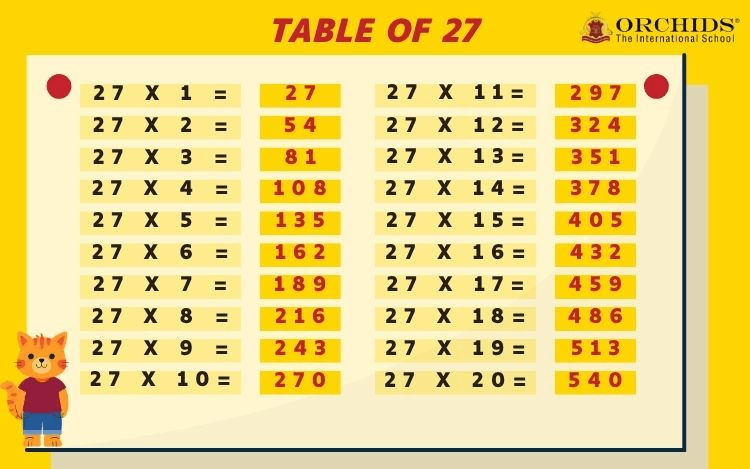

Multiplication Table of 27
The table of 27 shows what happens when the number 27 is multiplied by different whole numbers. It helps learners understand how multiplication works and supports quick problem-solving. Practising this table regularly makes it easier for students to remember the multiples and apply them in maths questions.
| Multiplicand | Operation | Multiplier | Result | |
| 27 | x | 1 | = | 27 |
| 27 | x | 2 | = | 54 |
| 27 | x | 3 | = | 81 |
| 27 | x | 4 | = | 108 |
| 27 | x | 5 | = | 135 |
| 27 | x | 6 | = | 162 |
| 27 | x | 7 | = | 189 |
| 27 | x | 8 | = | 216 |
| 27 | x | 9 | = | 243 |
| 27 | x | 10 | = | 270 |
| 27 | x | 11 | = | 297 |
| 27 | x | 12 | = | 324 |
| 27 | x | 13 | = | 351 |
| 27 | x | 14 | = | 378 |
| 27 | x | 15 | = | 405 |
| 27 | x | 16 | = | 432 |
| 27 | x | 17 | = | 459 |
| 27 | x | 18 | = | 486 |
| 27 | x | 19 | = | 513 |
| 27 | x | 20 | = | 540 |
Make learning the 27 times table simpler! Get your free PDF of the Table of 27 and use it to revise or practise whenever you like.
Know more about related topics:
Download PDF - Table of 27
How do you read the multiplication table of 27?
The 27 times table lists the multiples of 27 from 1 to 20. Reading it helps students see the pattern in multiplication and understand how each number increases steadily. Practising these multiples improves speed and confidence in calculations.
27 times 1 equals 27
27 times 2 equals 54
27 times 3 equals 81
27 times 4 equals 108
27 times 5 equals 135
27 times 6 equals 162
27 times 7 equals 189
27 times 8 equals 216
27 times 9 equals 243
27 times 10 equals 270
27 times 11 equals 297
27 times 12 equals 324
27 times 13 equals 351
27 times 14 equals 378
27 times 15 equals 405
27 times 16 equals 432
27 times 17 equals 459
27 times 18 equals 486
27 times 19 equals 513
27 times 20 equals 540
Table of 27 in words
Using the Table of 27 in words, students can say and read each multiple aloud. This approach strengthens memory, helps them recognise patterns, and understand how the numbers increase when multiplied by 27.
Twenty-seven times one equals twenty-seven
Twenty-seven times two equals fifty-four
Twenty-seven times three equals eighty-one
Twenty-seven times four equals one hundred eight
Twenty-seven times five equals one hundred thirty-five
Twenty-seven times six equals one hundred sixty-two
Twenty-seven times seven equals one hundred eighty-nine
Twenty-seven times eight equals two hundred sixteen
Twenty-seven times nine equals two hundred forty-three
Twenty-seven times ten equals two hundred seventy
Twenty-seven times eleven equals two hundred ninety-seven
Twenty-seven times twelve equals three hundred twenty-four
Twenty-seven times thirteen equals three hundred fifty-one
Twenty-seven times fourteen equals three hundred seventy-eight
Twenty-seven times fifteen equals four hundred five
Twenty-seven times sixteen equals four hundred thirty-two
Twenty-seven times seventeen equals four hundred fifty-nine
Twenty-seven times eighteen equals four hundred eighty-six
Twenty-seven times nineteen equals five hundred thirteen
Twenty-seven times twenty equals five hundred forty
Table of 27 Using Repeated Addition
Multiplication can be thought of as adding the same number repeatedly. The table of 27 shows how each multiple is formed by repeatedly adding 27. This helps students understand the concept behind multiplication and makes learning the table easier.
|
Multiplication |
Repeated Addition |
Result |
|
27 × 1 |
27 |
27 |
|
27 × 2 |
27 + 27 |
54 |
|
27 × 3 |
27 + 27 + 27 |
81 |
|
27 × 4 |
27 + 27 + 27 + 27 |
108 |
|
27 × 5 |
27 + 27 + 27 + 27 + 27 |
135 |
|
27 × 6 |
27 + 27 + 27 + 27 + 27 + 27 |
162 |
|
27 × 7 |
27 + 27 + 27 + 27 + 27 + 27 + 27 |
189 |
|
27 × 8 |
27 + 27 + 27 + 27 + 27 + 27 + 27 + 27 |
216 |
|
27 × 9 |
27 + 27 + 27 + 27 + 27 + 27 + 27 + 27 + 27 |
243 |
|
27 × 10 |
27 + 27 + 27 + 27 + 27 + 27 + 27 + 27 + 27 + 27 |
270 |
Solved Examples on Table of 27
1. A notebook costs Rs. 27. What will be the cost of 4 notebooks?
27 × 4 = 108
Rs. 108
2. There are 27 students in a class. How many students are there in 5 such classes?
27 × 5 = 135
135 students
3. A packet contains 27 candies. How many candies are there in 8 packets?
27 × 8 = 216
216 candies
4. Each worker earns Rs. 27 per hour. How much will 7 workers earn in one hour?
27 × 7 = 189
Rs. 189
5. A book has 27 pages. How many pages are there in 12 such books?
27 × 12 = 324
324 pages
Learn More Multiplication Tables
Numbers make sense when they're taught right. To see how Orchids The International School turns Maths from intimidating to intuitive, reach out to our admissions team.
Frequently Asked Questions on Table of 27
1. How can I quickly check if a number is a multiple of 27?
If the number can be divided by 27 without a remainder, then it is a multiple of 27. For example, 270 ÷ 27 = 10, so 270 is a multiple of 27.
2. What is an easy trick to remember the table of 27?
Think of 27 as 30 - 3. First multiply by 30 and then subtract three times the number. This makes calculations faster and easier.
3. Where do students use the table of 27 in maths problems?
The table of 27 is often used in word problems, division checks, and while solving larger multiplication sums in upper primary classes.
4. Can the table of 27 help in learning other tables faster?
Yes, once students understand the table of 27, it becomes easier to learn nearby tables like 26 and 28 by adding or subtracting 27.
5. Why does the table of 27 increase in a steady pattern?
Each step in the table adds 27 to the previous answer, which creates a regular and predictable number pattern.
Related Links


Admissions Open for 2026-27
What type of concept pages would you prefer?
CBSE Schools In Popular Cities
- CBSE Schools in Bangalore
- CBSE Schools in Mumbai
- CBSE Schools in Pune
- CBSE Schools in Hyderabad
- CBSE Schools in Chennai
- CBSE Schools in Gurgaon
- CBSE Schools in Kolkata
- CBSE Schools in Indore
- CBSE Schools in Sonipat
- CBSE Schools in Delhi
- CBSE Schools in Rohtak
- CBSE Schools in Bhopal
- CBSE Schools in Aurangabad
- CBSE Schools in Jabalpur
- CBSE Schools in Jaipur
- CBSE Schools in Jodhpur
- CBSE Schools in Nagpur
- CBSE Schools in Ahmednagar
- CBSE School In Tumkur











Orchids The International School is one of India's leading chains of CBSE and ICSE schools, with 110+ schools across the country.