

Table of 30
Table of 30 shows the results of multiplying 30 by numbers 1 to 20. Each multiple can be calculated by adding 30 repeatedly, such as 3 × 30 = 30 + 30 + 30 = 90. Practising this table helps students understand multiplication patterns and perform calculations quickly. A Table of 30 PDF is also available for revision.
Table of 30 chart
Table of 30 chart shows the multiplication pattern of 30 in a neatly arranged table, making it easy for students to follow the jump of 30 in every step. From 30 × 1 up to 30 × 20, the chart helps learners memorise the multiples and strengthens their understanding of repeated addition. It is a useful tool for homework, practice, and quick reference during revision.
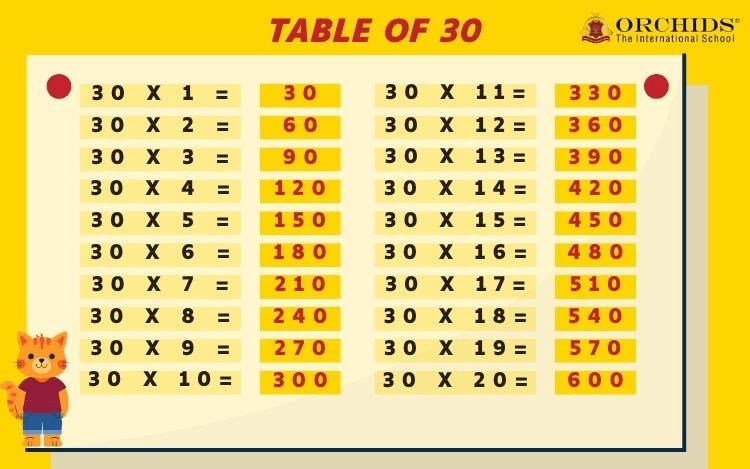

Multiplication Table of 30
Multiplication Table of 30 presents the results of multiplying 30 by numbers from 1 to 20. This table is useful for understanding how multiplication works with round numbers and how values jump by 30 in every step. Learning this table strengthens numerical fluency and helps students perform calculations faster in classwork, exams, and real-life situations.
| Multiplicand | Operation | Multiplier | Result | |
| 30 | x | 1 | = | 30 |
| 30 | x | 2 | = | 60 |
| 30 | x | 3 | = | 90 |
| 30 | x | 4 | = | 120 |
| 30 | x | 5 | = | 150 |
| 30 | x | 6 | = | 180 |
| 30 | x | 7 | = | 210 |
| 30 | x | 8 | = | 240 |
| 30 | x | 9 | = | 270 |
| 30 | x | 10 | = | 300 |
| 30 | x | 11 | = | 330 |
| 30 | x | 12 | = | 360 |
| 30 | x | 13 | = | 390 |
| 30 | x | 14 | = | 420 |
| 30 | x | 15 | = | 450 |
| 30 | x | 16 | = | 480 |
| 30 | x | 17 | = | 510 |
| 30 | x | 18 | = | 540 |
| 30 | x | 19 | = | 570 |
| 30 | x | 20 | = | 600 |
Learning the 30 times table becomes faster with regular practice. Access the free Table of 30 PDF and keep it handy for daily revision.
Know more about related topics:
Download PDF - Table of 30
How do you read the multiplication table of 30?
Reading the 30 times table is simple because each result increases by 30. Start with 30 × 1 = 30, then move to 30 × 2 = 60, 30 × 3 = 90, and continue up to 20. Since 30 is a round number, students can quickly spot the pattern and confidently apply these multiples in calculations, mental maths, and everyday situations.
30 times 1 equals 30
30 times 2 equals 60
30 times 3 equals 90
30 times 4 equals 120
30 times 5 equals 150
30 times 6 equals 180
30 times 7 equals 210
30 times 8 equals 240
30 times 9 equals 270
30 times 10 equals 300
30 times 11 equals 330
30 times 12 equals 360
30 times 13 equals 390
30 times 14 equals 420
30 times 15 equals 450
30 times 16 equals 480
30 times 17 equals 510
30 times 18 equals 540
30 times 19 equals 570
30 times 20 equals 600
Table of 30 in words
The table of 30 shows how 30 multiplies by natural numbers to form its multiples. Each value goes up by 30, making the pattern easy to follow. This table helps students quickly learn and remember the 30 times table.
Thirty times one equals thirty
Thirty times two equals sixty
Thirty times three equals ninety
Thirty times four equals one hundred twenty
Thirty times five equals one hundred fifty
Thirty times six equals one hundred eighty
Thirty times seven equals two hundred ten
Thirty times eight equals two hundred forty
Thirty times nine equals two hundred seventy
Thirty times ten equals three hundred
Thirty times eleven equals three hundred thirty
Thirty times twelve equals three hundred sixty
Thirty times thirteen equals three hundred ninety
Thirty times fourteen equals four hundred twenty
Thirty times fifteen equals four hundred fifty
Thirty times sixteen equals four hundred eighty
Thirty times seventeen equals five hundred ten
Thirty times eighteen equals five hundred forty
Thirty times nineteen equals five hundred seventy
Thirty times twenty equals six hundred
Table of 30 Using Repeated Addition
The table of 30 shows multiplication in its simplest form, adding 30 repeatedly. This approach helps students notice the regular jump of 30 each time and understand how larger numbers are multiplied.
|
Multiplication |
Repeated Addition |
Result |
|
30 × 1 |
30 |
30 |
|
30 × 2 |
30 + 30 |
60 |
|
30 × 3 |
30 + 30 + 30 |
90 |
|
30 × 4 |
30 + 30 + 30 + 30 |
120 |
|
30 × 5 |
30 + 30 + 30 + 30 + 30 |
150 |
|
30 × 6 |
30 + 30 + 30 + 30 + 30 + 30 |
180 |
|
30 × 7 |
30 + 30 + 30 + 30 + 30 + 30 + 30 |
210 |
|
30 × 8 |
30 + 30 + 30 + 30 + 30 + 30 + 30 + 30 |
240 |
|
30 × 9 |
30 + 30 + 30 + 30 + 30 + 30 + 30 + 30 + 30 |
270 |
|
30 × 10 |
30 + 30 + 30 + 30 + 30 + 30 + 30 + 30 + 30 + 30 |
300 |
Solved Examples on Table of 30
1. Julia jogs 4 miles per day. How many miles does she jog in 30 days?
Multiply the daily distance (4 miles) by the number of days (30).
4 × 30 = 120
Julia jogs 120 miles in 30 days.
2. There are 5 pencils in a pencil box. How many pencils are there in 30 pencil boxes?
Multiply the number of pencils per box (5) by the total number of boxes (30).
5 × 30 = 150
There are 150 pencils in 30 pencil boxes.
3. Noah earns $19 per hour. How much money will he earn if he works for 30 hours?
Multiply his hourly wage (19) by the total hours worked (30).
19 × 30 = 570
Noah will earn $570.
Learn More Multiplication Tables
Numbers make sense when they're taught right. To see how Orchids The International School turns Maths from intimidating to intuitive, reach out to our admissions team.
Frequently Asked Questions on Table of 30
1. What is the Table of 30?
The Table of 30 is the multiplication table of the number 30. It shows the products of 30 multiplied by natural numbers like 1, 2, 3, and so on. Learning this table helps students calculate quickly and solve math problems efficiently.
2. How do you write the Table of 30 up to 10?
The first ten multiples of 30 are.
- 30 × 1 = 30
- 30 × 2 = 60
- 30 × 3 = 90
- 30 × 4 = 120
- 30 × 5 = 150
- 30 × 6 = 180
- 30 × 7 = 210
- 30 × 8 = 240
- 30 × 9 = 270
- 30 × 10 = 300
3. What is the trick to remembering the Table of 30?
A simple trick is to multiply the number by 3 first and then add a zero at the end.
Example:
30 × 4 = 3 × 4 = 12 = add a zero = 120
This makes it easier to memorize and calculate the multiples quickly.
4. What pattern is observed in the Table of 30?
In the Table of 30.
- All multiples end with a zero.
- Each next multiple increases by 30.
- This consistent pattern helps students predict and verify results easily.
5. What are some real-life applications of the Table of 30?
The Table of 30 is useful in daily life, such as
- Calculating the total money when an item costs $30.
- Determining the total distance if someone walks 30 km each day.
- Planning total quantities in groups of 30, like 30 pencils per box.
Related Links


Admissions Open for 2026-27
What type of concept pages would you prefer?
CBSE Schools In Popular Cities
- CBSE Schools in Bangalore
- CBSE Schools in Mumbai
- CBSE Schools in Pune
- CBSE Schools in Hyderabad
- CBSE Schools in Chennai
- CBSE Schools in Gurgaon
- CBSE Schools in Kolkata
- CBSE Schools in Indore
- CBSE Schools in Sonipat
- CBSE Schools in Delhi
- CBSE Schools in Rohtak
- CBSE Schools in Bhopal
- CBSE Schools in Aurangabad
- CBSE Schools in Jabalpur
- CBSE Schools in Jaipur
- CBSE Schools in Jodhpur
- CBSE Schools in Nagpur
- CBSE Schools in Ahmednagar
- CBSE School In Tumkur











Orchids The International School is one of India's leading chains of CBSE and ICSE schools, with 110+ schools across the country.