

Table of 42
Table of 42 contains the multiplication results of 42 with the first 20 natural numbers. Because 42 is formed by 6 × 7, its multiples connect well with both tables, making patterns easier to understand. To make learning smoother, a Table of 42 printable PDF is available on this page for students who prefer offline practice.
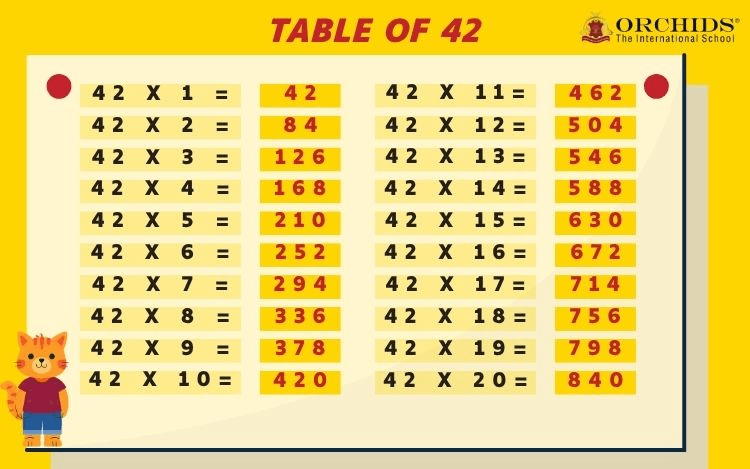
Table of 42 Chart
The Table of 42 chart displays every multiplication fact from 42 × 1 to 42 × 20 in an organised format. Students can easily observe the steady jump of 42 in each line. It serves as a helpful tool for homework, learning, and fast recall.

Know more about related topics:
Multiplication Table of 42
The Multiplication Table of 42 lists all the products formed when 42 is multiplied by numbers 1 to 20. Since 42 is an even composite number, students can easily observe how its multiples grow in a smooth pattern. Learning this table boosts calculation speed and helps in solving questions involving large values
| Multiplicand | Operation | Multiplier | Result | |
| 42 | x | 1 | = | 42 |
| 42 | x | 2 | = | 84 |
| 42 | x | 3 | = | 126 |
| 42 | x | 4 | = | 168 |
| 42 | x | 5 | = | 210 |
| 42 | x | 6 | = | 252 |
| 42 | x | 7 | = | 294 |
| 42 | x | 8 | = | 336 |
| 42 | x | 9 | = | 378 |
| 42 | x | 10 | = | 420 |
| 42 | x | 11 | = | 462 |
| 42 | x | 12 | = | 504 |
| 42 | x | 13 | = | 546 |
| 42 | x | 14 | = | 588 |
| 42 | x | 15 | = | 630 |
| 42 | x | 16 | = | 672 |
| 42 | x | 17 | = | 714 |
| 42 | x | 18 | = | 756 |
| 42 | x | 19 | = | 798 |
| 42 | x | 20 | = | 840 |
The Table of 42 PDF offers a simple way to review the multiplication facts daily. Save it for quick access during study time or homework. Frequent revision helps strengthen understanding of the 42 times table.
Download PDF - Table of 42
How do you read the multiplication table of 42?
Reading the 42 times table means going through each multiplication fact one by one, starting from 42 × 1 = 42. Every next product is simply 42 more than the previous one, forming a smooth number pattern. This regular increase helps students recognise how multiplication works through repeated addition.
42 times 1 equals 42
42 times 2 equals 84
42 times 3 equals 126
42 times 4 equals 168
42 times 5 equals 210
42 times 6 equals 252
42 times 7 equals 294
42 times 8 equals 336
42 times 9 equals 378
42 times 10 equals 420
42 times 11 equals 462
42 times 12 equals 504
42 times 13 equals 546
42 times 14 equals 588
42 times 15 equals 630
42 times 16 equals 672
42 times 17 equals 714
42 times 18 equals 756
42 times 19 equals 798
42 times 20 equals 840
Table of 42 in words
The table of 42 written in words helps students connect the spoken form of numbers with their multiplication results. Since each line adds 42 to the previous value, the pattern becomes easy to recognise and read aloud, supporting better memorisation.
Forty-two times one equals forty-two
Forty-two times two equals eighty-four
Forty-two times three equals one hundred twenty-six
Forty-two times four equals one hundred sixty-eight
Forty-two times five equals two hundred ten
Forty-two times six equals two hundred fifty-two
Forty-two times seven equals two hundred ninety-four
Forty-two times eight equals three hundred thirty-six
Forty-two times nine equals three hundred seventy-eight
Forty-two times ten equals four hundred twenty
Forty-two times eleven equals four hundred sixty-two
Forty-two times twelve equals four hundred four
Forty-two times thirteen equals five hundred forty-six
Forty-two times fourteen equals five hundred eighty-eight
Forty-two times fifteen equals six hundred thirty
Forty-two times sixteen equals six hundred seventy-two
Forty-two times seventeen equals seven hundred fourteen
Forty-two times eighteen equals seven hundred fifty-six
Forty-two times nineteen equals seven hundred ninety-eight
Forty-two times twenty equals eight hundred forty
Table of 42 Using Repeated Addition
The table of 42 can be explored by beginning with 42 and adding another 42 each time. Watching the values rise in this steady pattern helps learners see the link between addition and multiplication clearly.
|
Multiplication |
Repeated Addition |
Result |
|
42 × 1 |
42 |
42 |
|
42 × 2 |
42 + 42 |
84 |
|
42 × 3 |
42 + 42 + 42 |
126 |
|
42 × 4 |
42 + 42 + 42 + 42 |
168 |
|
42 × 5 |
42 + 42 + 42 + 42 + 42 |
210 |
|
42 × 6 |
42 + 42 + 42 + 42 + 42 + 42 |
252 |
|
42 × 7 |
42 + 42 + 42 + 42 + 42 + 42 + 42 |
294 |
|
42 × 8 |
42 + 42 + 42 + 42 + 42 + 42 + 42 + 42 |
336 |
|
42 × 9 |
42 + 42 + 42 + 42 + 42 + 42 + 42 + 42 + 42 |
378 |
|
42 × 10 |
42 + 42 + 42 + 42 + 42 + 42 + 42 + 42 + 42 + 42 |
420 |
Solved Examples on Table of 42
1. A case of juice contains 42 bottles. If a store orders 6 cases, how many bottles do they receive?
Answer: 42×6=252 bottles
2. A farmer harvests 42 kilograms of potatoes from each row. If he has 8 rows, how many kilograms of potatoes does he harvest?
Answer: 42×8=336 kg
3. A baker uses 42 grams of sugar for one cake. How much sugar does she use for 10 cakes?
Answer: 42×10=420 grams
4. A factory worker assembles 42 toys per hour. If he works for 15 hours, how many toys does he assemble?
Answer: 42×15=630 toys
5. A theatre has 42 seats in each section. If there are 13 sections, what is the total seating capacity?
Answer: 42×13=546 seats
Learn More Multiplication Tables
Numbers make sense when they're taught right. To see how Orchids The International School turns Maths from intimidating to intuitive, reach out to our admissions team.
Frequently Asked Questions on Table of 42
1. What is a simple way to learn the table of 42?
A simple way to learn the table of 42 is to break 42 into 40 + 2. First multiply by 40 and then add twice the number to get the answer.
2. How does the table of 42 help in understanding number patterns?
The multiples of 42 increase by a fixed gap of 42, which helps students identify and continue number patterns easily.
3. Where is the table of 42 commonly used in word problems?
The table of 42 is often used in problems involving equal groups, repeated quantities, and total calculations in daily situations.
4. How can students practise the table of 42 without memorising?
Students can practise the table of 42 by using repeated addition or by relating it to nearby tables like 40 and 45.
5. Why is the table of 42 important for higher maths topics?
Learning the table of 42 builds a strong foundation for division, fractions, and algebra-related problems in higher classes.
Related Links


Admissions Open for 2026-27
What type of concept pages would you prefer?
CBSE Schools In Popular Cities
- CBSE Schools in Bangalore
- CBSE Schools in Mumbai
- CBSE Schools in Pune
- CBSE Schools in Hyderabad
- CBSE Schools in Chennai
- CBSE Schools in Gurgaon
- CBSE Schools in Kolkata
- CBSE Schools in Indore
- CBSE Schools in Sonipat
- CBSE Schools in Delhi
- CBSE Schools in Rohtak
- CBSE Schools in Bhopal
- CBSE Schools in Aurangabad
- CBSE Schools in Jabalpur
- CBSE Schools in Jaipur
- CBSE Schools in Jodhpur
- CBSE Schools in Nagpur
- CBSE Schools in Ahmednagar
- CBSE School In Tumkur











Orchids The International School is one of India's leading chains of CBSE and ICSE schools, with 110+ schools across the country.