

Sea Turtles: Physical Characteristics, Types, Ecological Importance, Habitat and Conservation
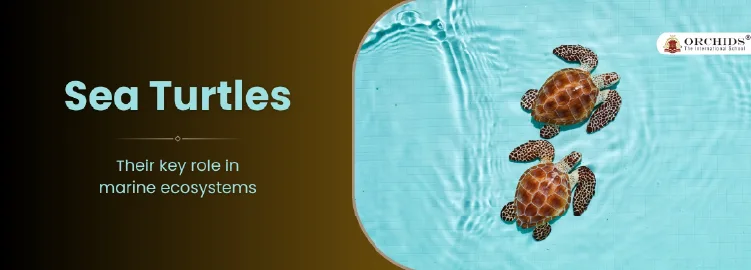
Have you ever watched a documentary or seen an image of a sea turtle? These creatures are really unique. For more than 100 million years, sea turtles have inhabited the planet. That means they were here even before the dinosaurs disappeared. They live in the ocean, travel thousands of kilometres and come to the shore only to lay eggs. Even today, people around the world work hard to protect them. Continue reading to find out why sea turtles are so fascinating.
Table of Contents:
- What is a Sea Turtle
- Physical Characteristics of Sea Turtles
- Interesting Facts about Sea Turtles
- Why Are Sea Turtles Important
- Are Sea Turtles in Danger
- Frequently Asked Questions about Sea Turtles

What is a Sea Turtle
A sea turtle is an aquatic animal. Sea turtles breathe air and have cold blood, just as reptiles and snakes. However, they live nearly their whole lives in the sea, in contrast to most other reptiles. They are protected by a hard shell on their back and they can swim with flat flippers in place of legs. Sea turtles move incredibly smoothly in the water, but they are slow on land.
There are seven types of sea turtles in the world:
- Green Sea Turtle
- Leatherback Sea Turtle
- Loggerhead Sea Turtle
- Hawksbill Sea Turtle
- Kemp’s Ridley Sea Turtle
- Olive Ridley Sea Turtle
- Flatback Sea Turtle
Each type is a little different in size, diet and where it lives.
Physical Characteristics of Sea Turtles
Shell
The carapace is the hard outer shell of sea turtles. It shields them from potential animal attacks. Sea turtles vary from land turtles in that they are unable to pull their heads or flippers within their shells.
Flippers
Sea turtles have broad, flat flippers in place of hands and feet. They can advance in the water because of their front flippers. They can shift direction with the aid of their back flippers. They are excellent swimmers because of these flippers.
Size
The sizes of sea turtles vary. The Kemp's Ridley is the smallest, weighing between 35 and 45 kg. The Leatherback is the largest, reaching a maximum weight of 900 kg and a maximum length of two meters.
How Long do Sea Turtles Live
Sea turtles have a very long lifespan. The majority of them have a 50–100 year lifespan. Some people might live even longer.
What they Eat
Sea turtles consume a variety of foods. Green turtles consume algae and seagrass. Coral reef sponges are consumed by hawksbill turtles. Jellyfish are a favourite of leatherback turtles. Crabs and other hard-shelled creatures are consumed by loggerhead turtles.
Finding their Way
Sea turtles are amazing travellers. They are able to return to the same beach after swimming across whole oceans. Scientists believe they do this by using the Earth's magnetic field, which functions as a natural internal compass.
Interesting Facts about Sea Turtles
- Sea turtles have been on Earth since the time of the dinosaurs.
- A female sea turtle always comes back to the same beach where she was born, just to lay her eggs.
- She can lay around 100 to 150 eggs in one nest.
- The sand temperature decides whether the babies will be male or female. Warmer sand makes more females. Cooler sand makes more males.
- Baby turtles are called hatchlings. They break out of their eggs at night and crawl straight to the ocean on their own.
- A sea turtle can hold its breath for up to 7 hours when it is resting or sleeping.
- The Leatherback turtle does not have a hard shell like other sea turtles. Its back is covered with thick, leathery skin.
Why are Sea Turtles Important
Sea turtles do more for the ocean than most people realise.
- Green turtles graze on seagrass, which keeps the grass healthy and short. This is good for many other sea animals.
- The consumption of sponges by hawksbill turtles promotes the growth of coral reefs.
- The shells and unhatched eggs that sea turtles deposit on beaches enrich the soil with nutrients. This promotes the growth of vegetation near the coast.
The balance of marine life would be impacted in the absence of sea turtles.
Are Sea Turtles in Danger
Yes, sadly, sea turtles are in danger. All seven kinds of sea turtles around the world need protection today.
There are many reasons for this.
- Plastic waste in the ocean is a big problem. Sea turtles sometimes mistake plastic bags for jellyfish and eat them, which can make them very sick.
- Many turtles also get trapped in fishing nets by accident and are unable to escape.
- Beaches where turtles lay their eggs are becoming crowded because of buildings, bright lights and too many visitors. This makes it difficult for turtles to nest safely.
- In some places, people still steal turtle eggs and shells.
The good news is that many people are trying to help sea turtles. Several countries have made laws to protect them. During the nesting season, volunteers visit beaches and protect turtle eggs until they hatch. In India, many people work to protect Olive Ridley turtles along the beaches of Odisha, Goa and Tamil Nadu.
Frequently Asked Questions about Sea Turtles
1. Do sea turtles drink seawater?
Yes, sea turtles can drink seawater. Their bodies have a special way to remove extra salt. Sometimes it looks like they are crying, but they are actually getting rid of the salt from their bodies.
2. How long does it take for sea turtle eggs to hatch?
Sea turtle eggs usually hatch in about 45 to 70 days. The time depends on the type of turtle and how warm the sand is.
3. Can sea turtles breathe underwater?
No, sea turtles cannot breathe underwater. They need to come up to the surface to breathe air, just like humans. But they can stay underwater for many hours while resting.
4. Where are sea turtles found in India?
Olive Ridley sea turtles are commonly found in India. They come to the beaches of Odisha, Goa and Tamil Nadu to lay their eggs. In some places, thousands of turtles come together at the same time to nest, which is a very amazing sight.
Understanding the world starts with the environment around us. To see how Orchids The International School brings EVS to life, reach out to our admissions team.


Admissions Open for 2026-27
What type of concept pages would you prefer?
CBSE Schools In Popular Cities
- CBSE Schools in Bangalore
- CBSE Schools in Mumbai
- CBSE Schools in Pune
- CBSE Schools in Hyderabad
- CBSE Schools in Chennai
- CBSE Schools in Gurgaon
- CBSE Schools in Kolkata
- CBSE Schools in Indore
- CBSE Schools in Sonipat
- CBSE Schools in Delhi
- CBSE Schools in Rohtak
- CBSE Schools in Bhopal
- CBSE Schools in Aurangabad
- CBSE Schools in Jabalpur
- CBSE Schools in Jaipur
- CBSE Schools in Jodhpur
- CBSE Schools in Nagpur
- CBSE Schools in Ahmednagar
- CBSE School In Tumkur











Orchids The International School is one of India's leading chains of CBSE and ICSE schools, with 110+ schools across the country.