

Tsunamis: Speed, Deep Ocean Behaviour and List of 10 Most Destructive Tsunamis in History
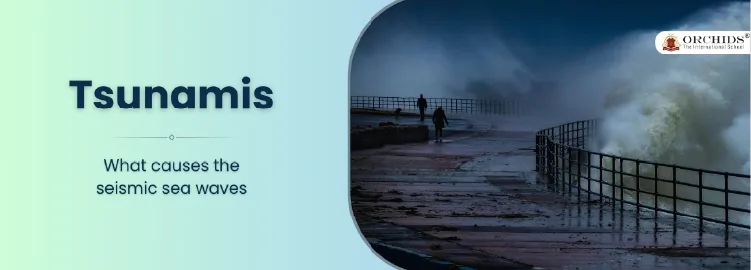
On 26 December 2004, people on beaches across South Asia noticed something strange: the sea was pulling back. Within minutes, massive walls of water came crashing onto the shore. That was the Indian Ocean tsunami, one of the deadliest in recorded history. But what exactly is a tsunami? A tsunami is a series of powerful ocean waves triggered by a sudden event under the sea, most often an earthquake. It can also be caused by a volcanic eruption or an underwater landslide. The word “tsunami” is Japanese and means “harbour wave.”
Table of Contents:
- How Fast does a Tsunami Travel
- How does a Tsunami Behave in the Deep Ocean
- 10 Most Destructive Tsunamis in History
- How are Tsunamis Detected
- Frequently Asked Questions about Tsunamis

How Fast does a Tsunami Travel
Tsunamis move very fast, much faster than you might expect. In deep ocean water, they can travel at speeds of up to 800 kilometres per hour. That is about as fast as a passenger airplane. The deeper the ocean, the faster the tsunami moves. Scientists use this simple relationship to understand tsunami speed:
Speed = √(g × d)
In this formula, g stands for gravitational acceleration (9.8 m/s²) and d is the depth of the water. So in an ocean that is 4,000 metres deep, a tsunami can travel at nearly 700 km/h. Because of this speed, a tsunami that starts near Indonesia can reach the coast of Africa in just 7 to 8 hours. This is why international warning systems are so important.
How does a Tsunami Behave in the Deep Ocean
Here is something surprising: in the deep ocean, a tsunami is almost invisible. The wave height is usually less than one metre, and the gap between two waves can stretch over hundreds of kilometres. A ship in the middle of the ocean would barely feel it passing. But the wave carries an enormous amount of energy beneath the surface. As it moves toward the shore and the water becomes shallower, the wave slows down.
When it slows, all that energy has to go somewhere, so the wave grows taller. This process is called wave shoaling. By the time the tsunami reaches the coast, it can be anywhere from 10 to 30 metres high. In some cases, it has been even higher. One natural warning sign to watch out for: before a tsunami hits, the sea near the shore often pulls back sharply, exposing rocks and the sea floor. If you ever see this, do not stop to look. Move to higher ground right away.
10 Most Destructive Tsunamis in History
|
Year |
Location |
Cause |
Approximate Deaths |
|
2004 |
Indian Ocean (Indonesia, India, Sri Lanka, Thailand) |
Earthquake – 9.1 magnitude |
~2,27,000 |
|
2011 |
Tōhoku, Japan |
Earthquake – 9.0 magnitude |
~19,000 |
|
1908 |
Messina, Italy |
Earthquake |
~75,000 |
|
1755 |
Lisbon, Portugal |
Earthquake |
~60,000 |
|
1883 |
Krakatoa, Indonesia |
Volcanic eruption |
~36,000 |
|
1896 |
Sanriku, Japan |
Earthquake |
~22,000 |
|
1976 |
Moro Gulf, Philippines |
Earthquake |
~8,000 |
|
1960 |
Chile and the Pacific coasts |
Earthquake – 9.5 magnitude |
~2,000 |
|
1998 |
Papua New Guinea |
Underwater landslide |
~2,200 |
|
1946 |
Hawaii, USA |
Aleutian Islands earthquake |
~165 |
How are Tsunamis Detected
Scientists track tsunamis using a system of underwater sensors called DART buoys, short for Deep-ocean Assessment and Reporting of Tsunamis. These buoys sit on the ocean floor and detect changes in water pressure when a tsunami passes over them. The data is sent to warning centres, which can then alert coastal communities.
Countries that lie in high-risk zones also use seismographs to detect underwater earthquakes and tide gauges to track unusual changes in sea level. When a warning is issued, people are told to move away from the coast and head to higher ground as quickly as possible.
Frequently Asked Questions about Tsunamis
1. Can a tsunami happen in India?
Yes, it can. Parts of India - especially the Andaman and Nicobar Islands, Tamil Nadu, Kerala and Andhra Pradesh - face tsunami risk. The 2004 Indian Ocean tsunami hit India’s eastern coastline hard, particularly the districts of Tamil Nadu and Andhra Pradesh, causing thousands of deaths and large-scale destruction.
2. Is a tsunami the same as a tidal wave?
No, they are not the same. A tidal wave is caused by the gravitational pull of the Moon and Sun on ocean water. A tsunami has nothing to do with tides; it is caused by geological events like earthquakes or volcanic eruptions. The two terms are sometimes used interchangeably, but that is not accurate.
3. How much warning time do people usually get?
It depends on where the tsunami starts. If it begins far away, warning systems can give people several hours to evacuate. But if the earthquake happens close to the shore, the tsunami can arrive in just a few minutes. That is why it is important to know the natural warning signs and act immediately without waiting for an official alert.
4. Did animals behave differently before the 2004 tsunami?
Yes, there were many reports of animals moving to higher ground before the waves arrived. Elephants in Sri Lanka and Thailand reportedly moved inland well before the tsunami hit. Scientists believe some animals can sense vibrations or changes in pressure that humans cannot. However, research on this is still ongoing, and no animal-based warning system exists yet.
Understanding the world starts with the environment around us. To see how Orchids The International School brings EVS to life, reach out to our admissions team.


Admissions Open for 2026-27
What type of concept pages would you prefer?
CBSE Schools In Popular Cities
- CBSE Schools in Bangalore
- CBSE Schools in Mumbai
- CBSE Schools in Pune
- CBSE Schools in Hyderabad
- CBSE Schools in Chennai
- CBSE Schools in Gurgaon
- CBSE Schools in Kolkata
- CBSE Schools in Indore
- CBSE Schools in Sonipat
- CBSE Schools in Delhi
- CBSE Schools in Rohtak
- CBSE Schools in Bhopal
- CBSE Schools in Aurangabad
- CBSE Schools in Jabalpur
- CBSE Schools in Jaipur
- CBSE Schools in Jodhpur
- CBSE Schools in Nagpur
- CBSE Schools in Ahmednagar
- CBSE School In Tumkur











Orchids The International School is one of India's leading chains of CBSE and ICSE schools, with 110+ schools across the country.