

1002 in Roman Numerals
1002 in Roman numerals is MII. It is formed by combining Roman numerals M (1000) and I (1) using the addition rule of the Roman numeral system. To convert 1002 into Roman numerals, we will write 1002 in its expanded form, i.e., 1002 = 1000 + 1 + 1. By replacing each number with its respective Roman numeral, we get 1002 = M + I + I = MII. Learning to write 1002 in Roman numerals builds number sense, problem-solving skills, and the ability to read and write Roman numerals. This page explains how to write the number 1002 in Roman numerals using Roman numeral rules and examples.
Table of Contents
- How to Write 1002 in Roman Numerals?
- Roman Numerals Related to 1002
- Basic Rules for Writing Roman Numerals
- Solved Examples on 1002 in Roman Numerals
- Facts About 1002 in Roman Numerals
- Practice Question on 1002 in Roman Numerals
- Conclusion
- Frequently Asked Questions on 1002 in Roman Numerals

How to Write 1002 in Roman Numerals?
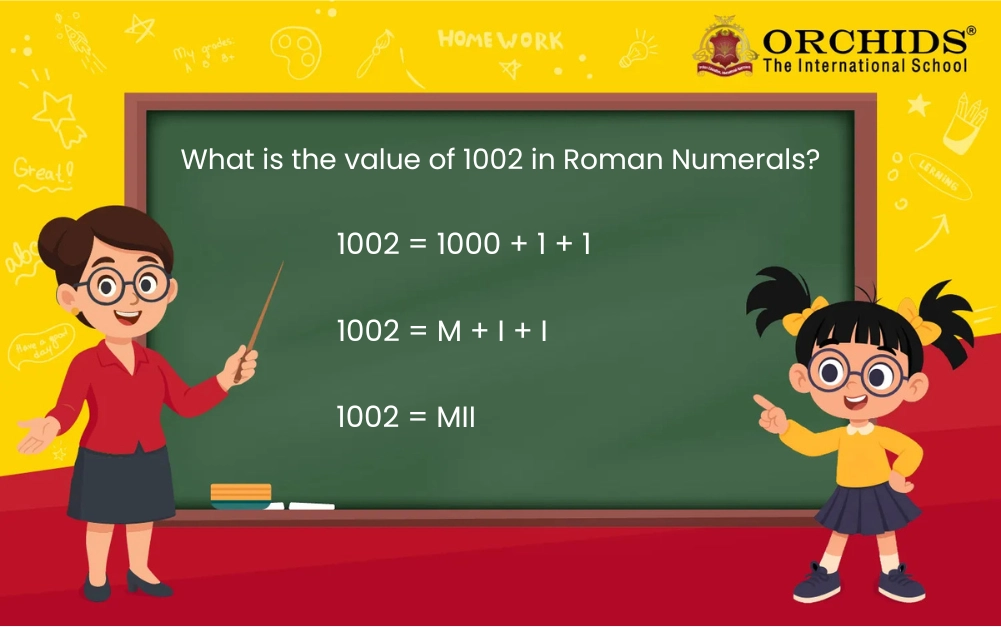
To convert 1002 into Roman numerals, follow these easy steps for a simple and accurate conversion.
Step 1: Break it down into components:
1002 = 1000 + 1 + 1
Step 2: Convert each component into Roman numerals
-
1000 = M
-
1 = I
Step 3: Combine them to write the final Roman numeral:
M + I + I = MII
So, 1002 in Roman numerals is MII.
Know more about related topics:
Roman Numerals Related to 1002
Basic Rules for Writing Roman Numerals
-
Roman numerals use seven symbols: I, V, X, L, C, D, and M.
-
Addition rule: When a smaller numeral is placed after a larger one, the values are added (VI = 5 + 1 = 6).
-
Subtraction rule: When a smaller numeral is placed before a larger one, it is subtracted (IV = 5 - 1 = 4).
-
Repetition rule: I, X, C, and M can be repeated up to three times in a row; however, V, L, and D are never repeated.
-
Order rule: Roman numerals are generally written from left to right in descending order of value.
Solved Examples on 1002 in Roman Numerals
Example 1: How to convert 1002 to Roman numerals
Solution: To convert 1002 to Roman numerals, use the Expansion method
1002 = 1000 + 1 + 1
Assign Roman Numeral symbols to the values
1000 = M and 1 = I
Combine the values: 1000 + 1 + 11 = M + I + I = MII
1002 in Roman numerals is MII.
Example 2: What numbers come before and after 1002 in Roman numerals?
Solution: MII in Roman numerals is 1002
Before: 1001 = MI
After: 1003 = MIII
Example 3: Convert MII into numbers.
Solution: M = 1000, I = 1
MII = M + I + I = 1000 + 1 + 1 = 1002
1002 in Roman numerals is MII.
Example 4: Subtract 60 from 1002 in Roman numerals.
Solution: 1002 in Roman Numerals is MII, and 60 is LX
1002 - 60 = 942
942 in Roman numerals is CMXLII
CCCLX - LX = CCC
Example 5: Simplify: (MII − XC) + XL
Solution: MII = 1002
XC = 100 - 10 = 90
XL = 50 - 10 = 40
(MII − XC) + XL = (1002 - 90) + 40 = 952
(MII − XC) + XL = CMLII
Facts About 1002 in Roman Numerals
Here is a simple and easy explanation of the key facts about 1002 in Roman numerals:
-
1002 in Roman numerals, MII, is written using three distinct Roman symbols: 'M' (1000) and 'I' (1).
-
1002 is an even composite number.
-
1002 in Roman numerals, MII, only uses additive notation and does not use subtractive notation.
-
1002 in Roman numerals is MII and follows the repetition rule. Symbol I(1) is repeated two times, giving a total value of 1 + 1 = 2.
-
1002 in Roman numerals is still widely used today in copyright dates for films and books, on building cornerstones, in movie sequels, in formal documents, etc.
Practice Question on 1002 in Roman Numerals
-
Write 1002 in Roman numerals.
-
What number does MII represent?
-
What is 1002 ÷ 2 in Roman numerals?
-
What is 1002 + 8 in Roman numerals?
-
Convert and simplify: (MII + XX) − XII = ?
-
A wheel makes 334 rotations per hour. How many rotations does it make in III hours? Express your answer in Roman numerals.
-
Compute: MII + CXL
Conclusion
1002 in Roman numerals is MII. Learning to write 1002 in Roman numerals helps develop skills like number sense, logical thinking, and problem-solving, while improving the ability to convert between Roman numerals and Hindu-Arabic numbers.
Learn 1002 in Roman numerals in a simple and student-friendly way at Orchids International School.
Numbers make sense when they're taught right. To see how Orchids The International School turns Maths from intimidating to intuitive, reach out to our admissions team.
Frequently Asked Questions on 1002 in Roman Numerals
1. How do you convert 1002 in Roman numerals?
1002 = 1000 + 1 + 1 = M + I + I = MII.
2. Why is 1002 written as MII and not another combination?
Roman numerals follow the addition rule, where smaller numbers placed after larger ones are added together. Since M (1000) > I (1), M (1000) + I (1) + I (1) = MII. This is why no other combination is used.
3. Is MII a prime number?
No. MII in Roman numerals is equal to 1002, which is an even composite number.
4. Does 1002 in Roman numerals use subtractive notation?
No. 1002 in Roman numerals, MII, is written entirely using additive notation.
1002 = 1000 + 1 + 1 = M + I + I = MII.
No subtractive notation is used.
5. Is MII used in modern times?
1002 in Roman numerals is MII. In modern times, MII is used in royal titles, in copyright dates for films and books, on building cornerstones, in movie sequels, and in formal documents, or to denote the 360th volume or chapter in a series or books, etc.
Related Links


Admissions Open for 2026-27
What type of concept pages would you prefer?
CBSE Schools In Popular Cities
- CBSE Schools in Bangalore
- CBSE Schools in Mumbai
- CBSE Schools in Pune
- CBSE Schools in Hyderabad
- CBSE Schools in Chennai
- CBSE Schools in Gurgaon
- CBSE Schools in Kolkata
- CBSE Schools in Indore
- CBSE Schools in Sonipat
- CBSE Schools in Delhi
- CBSE Schools in Rohtak
- CBSE Schools in Bhopal
- CBSE Schools in Aurangabad
- CBSE Schools in Jabalpur
- CBSE Schools in Jaipur
- CBSE Schools in Jodhpur
- CBSE Schools in Nagpur
- CBSE Schools in Ahmednagar
- CBSE School In Tumkur











Orchids The International School is one of India's leading chains of CBSE and ICSE schools, with 130+ schools across the country.