

1500 in Roman Numerals
1500 in Roman numerals is written as MD, a traditional number system used by the Romans. To convert 1500, we express it in expanded form: 1500 = 1000 + 500. Replacing these values with Roman symbols gives M + D = MD. Understanding how to read and write numbers like 1500 in Roman numerals helps students connect numerical concepts with logical thinking. It also improves problem-solving skills by showing how the addition of Roman symbols forms larger numbers. Learning MD is not only a mathematical skill but also a way to connect with ancient history, making number learning engaging and meaningful for students and parents.
Table of Contents
- How to Write 1500 in Roman Numerals?
- Roman Numerals for Numbers Related to 1500
- Basic Rules for Writing Roman Numerals
- Solved Examples on 1500 in Roman Numerals
- Fun Facts on 1500 in Roman Numerals
- Practice Questions on 1500 in Roman Numerals
- Conclusion
- Frequently Asked Questions on 1500 in Roman Numerals
How to Write 1500 in Roman Numerals?
1500 in Roman numerals can be written by identifying the Roman symbols that add up to the number. Follow these simple steps to understand the conversion clearly.
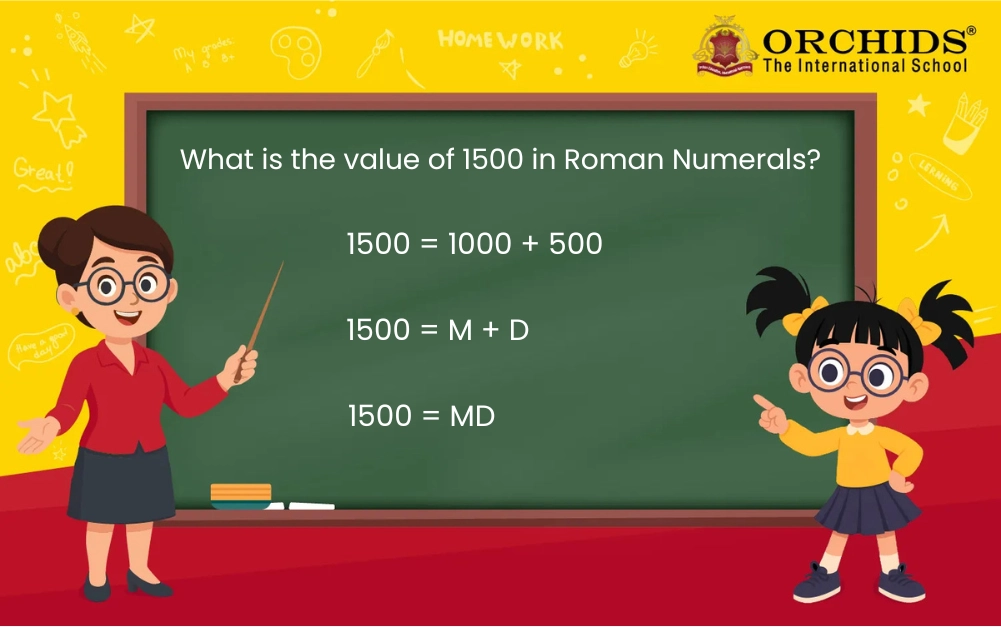
Step 1: Break the number into parts
1500 can be split into two basic values:
-
1500 = 1000 + 500
Step 2: Write the Roman numeral symbols
-
1000 is written as M
-
500 is written as D
Step 3: Combine the symbols
-
1500 = M + D
-
1500 = MD
-
Therefore, 1500 in Roman numerals is MD.

Roman Numerals for Numbers Related to 1500
|
Number |
Roman Numeral |
|
1500 |
MD |
|
1501 |
MDI |
|
1502 |
MDII |
|
1503 |
MDIII |
|
1504 |
MDIV |
|
1505 |
MDV |
|
1506 |
MDVI |
|
1507 |
MDVII |
|
1508 |
MDVIII |
|
1509 |
MDIX |
|
1510 |
MDX |
Know more about related topics:
Basic Rules for Writing Roman Numerals
-
Addition Rule: When symbols are written from left to right in decreasing value, their values are added. Example: MD = 1000 + 500 = 1500
-
Subtraction Rule: If a smaller numeral comes before a larger one, the smaller value is subtracted. Example: IV = 5 - 1 = 4
-
Repetition Rule: A numeral can be repeated up to three times to add value. Example: III = 3
-
No Zero Symbol: Roman numerals do not include zero; all numbers use letter combinations.
-
Limited Repetition: V, L, and D are never repeated. Example: MD uses each symbol only once.
Solved Examples on 1500 in Roman Numerals
Example 1: Write the sum of M (1000) and D (500) in Roman numerals.
Solution:
-
M = 1000, D = 500
-
1000 + 500 = 1500
-
Roman numerals = MD
Example 2: Subtract CM (900) from MMCD (2400).
Solution:
-
2400 - 900 = 1500
-
Roman numerals = MD
Example 3: Multiply D (500) by III (3).
Solution:
-
500 × 3 = 1500
-
Roman numerals = MD
Example 4: A museum has 1000 ancient coins in one section and 500 in another. How many coins are there in total?
Solution:
-
1000 + 500 = 1500
-
Roman numerals = MD
Example 5: Divide MMM (3000) by II (2).
Solution:
-
3000 ÷ 2 = 1500
-
Roman numerals = MD
Fun Facts on 1500 in Roman Numerals
-
Roman numerals such as MD are still used on building plaques, monuments, and film credits.
-
The symbol D stands for 500 and comes from half of the symbol for 1000 (M).
-
1500 is one of the simplest large Roman numerals because it only uses two symbols.
-
The ancient Romans never used zero, so all values were expressed through combinations of letters.
Practice Questions on 1500 in Roman Numerals
1. Write 1500 in Roman numerals.
2. What is the sum of D (500) and M (1000) in Roman numerals?
3. Write 1550 in Roman numerals.
4. Subtract CD (400) from MD (1500).
5. What comes after MD in Roman numerals?
Conclusion
1500 in Roman numerals is written as MD, formed by adding M (1000) and D (500). Since Roman numerals follow clear addition rules, writing MD becomes easy once symbol values are understood. Practicing nearby numbers such as 1501 (MDI), 1505 (MDV), and 1510 (MDX) helps students identify patterns in Roman numerals. Learning 1500 in Roman numerals improves number sense and helps learners read numerals used in clocks, books, and historical dates.
Learn 1500 in Roman numerals with simple explanations and guided practice at Orchids International School.
Numbers make sense when they're taught right. To see how Orchids The International School turns Maths from intimidating to intuitive, reach out to our admissions team.
Frequently Asked Questions on 1500 in Roman Numerals
1. How do you write 1500 in Roman numerals?
Answer: 1500 is written as MD with Roman numerals.
2. What does MD stand for in Roman numerals?
Answer: MD stands for 1500, where M = 1000 and D = 500.
3. How do you write 1600 in Roman numerals?
Answer: 1600 is written as MDC (1000 + 500 + 100).
4. Is there a Roman numeral for zero?
Answer: No, zero is not included in the Roman numeral system.
5. How is 1500 represented with Roman numerals on monuments or clocks?
Answer: The year 1500 is represented as MD in Roman numerals on clocks, buildings, and historical markers.
Related Links


Admissions Open for 2026-27
What type of concept pages would you prefer?
CBSE Schools In Popular Cities
- CBSE Schools in Bangalore
- CBSE Schools in Mumbai
- CBSE Schools in Pune
- CBSE Schools in Hyderabad
- CBSE Schools in Chennai
- CBSE Schools in Gurgaon
- CBSE Schools in Kolkata
- CBSE Schools in Indore
- CBSE Schools in Sonipat
- CBSE Schools in Delhi
- CBSE Schools in Rohtak
- CBSE Schools in Bhopal
- CBSE Schools in Aurangabad
- CBSE Schools in Jabalpur
- CBSE Schools in Jaipur
- CBSE Schools in Jodhpur
- CBSE Schools in Nagpur
- CBSE Schools in Ahmednagar
- CBSE School In Tumkur











Orchids The International School is one of India's leading chains of CBSE and ICSE schools, with 110+ schools across the country.