

37 in Roman Numerals
37 in Roman numerals is written as XXXVII. The Roman numeral system, introduced by the ancient Romans, uses a combination of seven symbols (I, V, X, L, C, D, and M), each representing a fixed value. By following specific rules of addition and subtraction, unique numbers can be represented easily.
In XXXVII:
X = 10
V = 5
I = 1
So,
X + X + X + V + I + I = 37
This guide explains a way to write 37 in Roman numerals, step-by-step conversion, related numbers, examples, fun facts, and practice questions that will help you understand the concept without difficulty.
Table of Contents
- How to Write 37 in Roman Numerals?
- Roman Numerals from 35 to 40
- Solved Examples on 35 in Roman Numerals
- Fun Facts about 35 in Roman Numerals
- Practice question on 35 in Roman Numerals
- Conclusion
- Frequently Asked Questions on 37 in Roman Numerals
How to Write 37 in Roman Numerals?
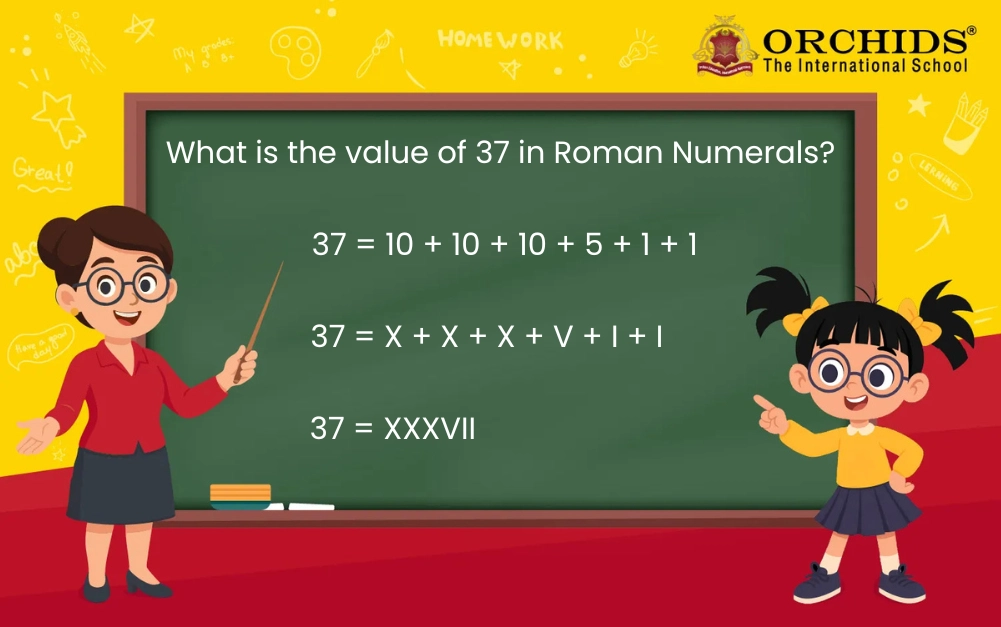
To convert 37 into Roman numerals, follow these simple steps:
Step 1: Recall basic symbols and values
Step 2: Break down the number
37 can be expressed as
37 = 30 + 7
Step 3: Convert each part
30 = 10 + 10 + 10 = XXX
7 = 5 + 1 + 1 = VII
Step 4: Combine the parts
XXX + VII = XXXVII
Hence, 37 in Roman numerals = XXXVII
Roman Numerals Overview:
Roman numerals follow certain guidelines that determine how numbers are written:
Additive Rule: When a smaller symbol follows a larger one, the values are added.
Example: XV = 10 + 5 = 15
Subtractive Rule: When a smaller symbol seems earlier than a larger one, it is subtracted.
Example: IX = 10 - 1 = 9
Repetition Rule: A symbol may be repeated up to 3 times for addition.
Example: XXX = 30
No Zero Concept: Romans did not have a symbol for zero.
In XXXVII, only the additive rule is used.

Roman Numerals from 35 to 40
Here’s a list of Roman numerals close to 37 to understand the pattern:
|
Number |
Symbol |
Explanation |
|
35 |
XXXV |
30 + 5 |
|
36 |
XXXVI |
30 + 6 |
|
37 |
XXXVII |
30 + 7 |
|
38 |
XXXVIII |
30 + 8 |
|
39 |
XXXIX |
30 + (10 - 1) |
|
40 |
XL |
50 - 10 |
Know more about related topics:
Solved Examples on 37 in Roman Numerals
Example 1: Convert 37 into Roman numerals.
37 = 30 + 7 = XXX + VII = XXXVII
Example 2: Add XXII (22) and XV (15).
22 + 15 = 37 = XXII + XV = XXXVII
Example 3: Subtract XIII (13) from L (50).
50 - 13 = 37 = L - XIII = XXXVII
Example 4: Multiply VII (7) by V (5).
7 × 5 = 35 = XXXV (Close to 37 but slightly less)
Example 5: A clock suggests the number 37 in a Roman form.
It is represented as XXXVII
Fun Facts about 37 in Roman Numerals
-
Roman Form: XXXVII
-
Type: Additive combination (no subtraction)
-
Interesting Property: 37 is a prime number, divisible only by 1 and 37.
-
No Zero Used: Romans didn’t represent zero in their system.
-
Usage Today: Seen in book chapters, clocks, film titles, and constructing inscriptions.
-
Easy Trick: Think of 30 + 7 = XXX + VII = XXXVI
Practice question on 37 in Roman Numerals
-
Write 37 in Roman numerals.
-
What number comes before XXXVII?
-
Convert XXXVIII into a standard number.
-
Add XXII (22) and XV (15). Express the result in Roman numerals.
-
Subtract XIII (13) from L (50). Write the answer in Roman numerals.
-
Multiply VII (7) by V (5) and convert the result into Roman numerals.
Conclusion
The Roman numeral for 37 is XXXVII, formed by combining XXX (30) and VII (7) using the additive rule. Learning Roman numerals complements mathematical understanding and connects us to the numeric traditions of historical Rome. Understanding a way to convert between number systems helps in history, design, and general math ideas.
Explore more topics like 37 in Roman numerals with simple explanations and examples at Orchids The International School.
Numbers make sense when they're taught right. To see how Orchids The International School turns Maths from intimidating to intuitive, reach out to our admissions team.
Frequently Asked Questions on 37 in Roman Numerals
1. Which number comes earlier than XXXVII?
XXXVI (36) comes earlier than 37.
2. How do you write 37 in Roman numerals?
37 is written as XXXVII (XXX = 30 and VII = 7).
3. What rule is used in 37 (XXXVII)?
The additive rule is used, meaning the values are delivered together.
4. Why doesn’t 37 use subtraction like 39 (XXXIX)?
Because 37 doesn’t go under a subtractive value like 9 or 40. It makes use of the most effective addition.
5. Is 37 an even number?
No, 37 is an odd prime number.
Related Links


Admissions Open for 2026-27
What type of concept pages would you prefer?
CBSE Schools In Popular Cities
- CBSE Schools in Bangalore
- CBSE Schools in Mumbai
- CBSE Schools in Pune
- CBSE Schools in Hyderabad
- CBSE Schools in Chennai
- CBSE Schools in Gurgaon
- CBSE Schools in Kolkata
- CBSE Schools in Indore
- CBSE Schools in Sonipat
- CBSE Schools in Delhi
- CBSE Schools in Rohtak
- CBSE Schools in Bhopal
- CBSE Schools in Aurangabad
- CBSE Schools in Jabalpur
- CBSE Schools in Jaipur
- CBSE Schools in Jodhpur
- CBSE Schools in Nagpur
- CBSE Schools in Ahmednagar
- CBSE School In Tumkur











Orchids The International School is one of India's leading chains of CBSE and ICSE schools, with 110+ schools across the country.