

800 in Roman Numerals
800 in Roman numerals is written as DCCC, a classic number system used by the Romans. To convert 800, we express it in expanded form: 800 = 500 + 100 + 100 + 100. Replacing these values with Roman symbols gives D + C + C + C = DCCC. Understanding how to read and write numbers like 800 in Roman numerals helps learners connect mathematical patterns in addition-based numeral formation. It also improves logical thinking by showing how repeated values are combined to represent larger numbers. The study of DCCC is not only a mathematical skill but also a link to ancient number systems, making learning numbers more interesting and meaningful in everyday life.
Table of Contents
- How to Write 800 in Roman Numerals?
- Roman Numerals for Numbers Related to 800
- Solved Examples on 800 in Roman Numerals
- Fun Facts on 800 in Roman Numerals
- Practice Questions on 800 in Roman Numerals
- Conclusion
- Frequently Asked Questions on 800 in Roman Numerals
How to Write 800 in Roman Numerals?
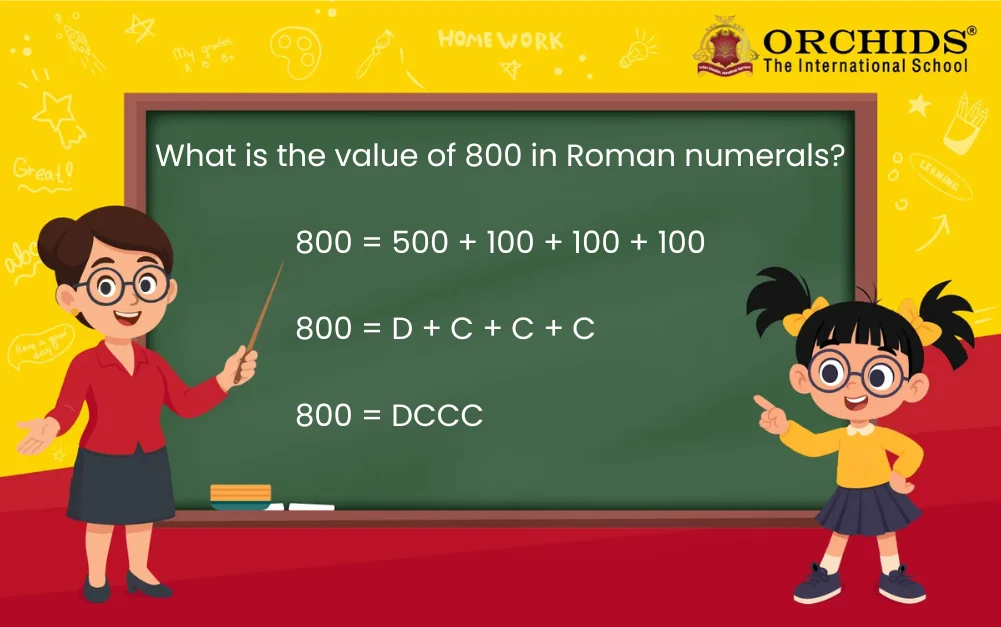
To write 800 in Roman numerals, break the number into parts and convert each part:
Step 1: Expand the number
-
800 = 500 + 100 + 100 + 100
Step 2: Write the Roman symbols
-
500 = D
-
100 = C
- So, 800 = D + C + C + C
Step 3: Combine all symbols DCCC
-
Therefore, 800 in Roman numerals is DCCC.

Roman Numerals for Numbers Related to 800
|
Number |
Roman Numeral |
|
700 |
DCC |
|
750 |
DCCL |
|
800 |
DCCC |
|
850 |
DCCCL |
|
900 |
CM |
|
1000 |
M |
Know more about related topics:
Solved Examples on 800 in Roman Numerals
Example 1: Add D (500) and CCC (300). Express results in Roman numerals.
-
D = 500, CCC = 300
-
500 + 300 = 800
-
800 = DCCC in Roman numerals
Example 2: Subtract CC (200) from M (1000). Express in Roman numerals.
-
M = 1000, CC = 200
-
1000 - 200 = 800
-
800 = DCCC in Roman numerals
Example 3: Multiply C (100) by VIII (8). Express results in Roman numerals.
-
C = 100, VIII = 8
-
100 × 8 = 800
-
800 = DCCC in Roman numerals
Example 4: Add CD (400) and CD (400). Express the sum in Roman numerals.
-
CD = 400
-
400 + 400 = 800
-
800 = DCCC in Roman numerals
Example 5: A library has D (500) old books and CCC (300) new books. How many books are there in total? Express in Roman numerals.
-
D = 500, CCC = 300
-
500 + 300 = 800
-
Total = DCCC
Fun Facts on 800 in Roman Numerals
-
800 = DCCC, where D = 500 and C = 100.
-
Roman numerals do not use zero (0).
-
There are no subtraction rules for 800; it is a simple addition of D and three Cs.
-
Roman numerals such as DCCC are often seen in building dates, clocks, and book chapters.
-
The year DCCC (800) marks the crowning of Charlemagne as the Emperor of the Romans.
Practice Questions on 800 in Roman Numerals
1. Write 800 in Roman numerals.
2. Add D (500) and CCC (300). Write your answer in Roman numerals.
3. Subtract CC (200) from M (1000). Express results in Roman numerals.
4. Write the next three numbers after 800 in Roman numerals.
5. Convert the year 850 to Roman numerals.
Conclusion
The Roman numeral for 800 is DCCC, formed by combining D (500) and C (100) three times. By breaking the number into simple parts and applying Roman numeral rules, students can easily understand how larger numbers are written using addition. Learning numbers like 800 in Roman numerals strengthens number sense, improves logical thinking, and helps students connect modern mathematics with ancient number systems. With regular practice, identifying and writing Roman numerals becomes quick, easy, and fun.
Learn 800 in Roman numerals in a structured and easy-to-remember way at Orchids International School.
Numbers make sense when they're taught right. To see how Orchids The International School turns Maths from intimidating to intuitive, reach out to our admissions team.
Frequently Asked Questions on 800 in Roman Numerals
1. What is 800 in Roman numerals?
800 in Roman numerals is written as DCCC.
2. Why is 800 written as DCCC in Roman numerals?
Because D = 500 and each C = 100, add 500 + 100 + 100 + 100 = 800.
3. What are the Roman numerals for 900?
900 is written as CM in Roman numerals, which follows the subtraction rule (1000 - 100).
4. What comes before and after 800 in Roman numerals?
Before 800 is DCC (700), and after 800 is DCCCL (850).
5. How do we read DCCC in normal numbers?
DCCC represents 800 in the standard number system.
Related Links


Admissions Open for 2026-27
What type of concept pages would you prefer?
CBSE Schools In Popular Cities
- CBSE Schools in Bangalore
- CBSE Schools in Mumbai
- CBSE Schools in Pune
- CBSE Schools in Hyderabad
- CBSE Schools in Chennai
- CBSE Schools in Gurgaon
- CBSE Schools in Kolkata
- CBSE Schools in Indore
- CBSE Schools in Sonipat
- CBSE Schools in Delhi
- CBSE Schools in Rohtak
- CBSE Schools in Bhopal
- CBSE Schools in Aurangabad
- CBSE Schools in Jabalpur
- CBSE Schools in Jaipur
- CBSE Schools in Jodhpur
- CBSE Schools in Nagpur
- CBSE Schools in Ahmednagar
- CBSE School In Tumkur











Orchids The International School is one of India's leading chains of CBSE and ICSE schools, with 110+ schools across the country.